
After completing six years on the Columban General Council and spending two years on sabbatical at the Catholic Theological Union in Chicago, Fr Frank Hoare returned to Fiji in 2009.
He spent the next two years serving at the Holy Family Parish, Labasa, where he refreshed his knowledge of both the Fijian and Hindi languages. In 2011, he was appointed Columban Vocation Director and Vicar for Evangelization for the Archdiocese of Suva, a role that required frequent travel throughout Fiji and other Pacific islands.
During this period, he also worked with the Evangelization Commission to promote small Christian communities across the country.
From 2018 until 2024 he served as the Columban Rector, later Coordinator of Formation, living with seminarians in Suva and overseeing their academic, pastoral, and personal formation.
He was also responsible for conducting psychological assessments of diocesan students at the Pacific Regional Seminary.
And now, as we move toward the close of 2025, we move toward the final chapter of his long mission in Fiji. We begin in 2010.
A multi-racial women’s forum
During a meeting with the Canada Fund in Labasa Fr Hoare recalled being present when the project team was challenged to justify their request for funding.
“Give me a good reason why the Canada Fund should finance your facilitation project here in Labasa,” the officer asked. “And don’t say it is to help poor women. Everybody says that.”
According to Fr Hoare, the PCP facilitator, Adi Vasu, responded by explaining the cultural gap the project aimed to solve.
“Here in Fiji, indigenous Fijian women can approach government through their provinces because of our hierarchical structure,” she said.
“But if their chiefly leader is not committed, no one can bypass her. Indo-Fijian women, on the other hand, have freedom to discuss and act, but they have no formal route to government. A multi-racial group brings the strengths of both.”
The explanation convinced the Canada Fund to approve the project, which became the Vunicuicui Multi-racial Women’s Forum. Participants completed short business courses, secured small grants, and planned a cooperative store and seed bank.
Fr Hoare facilitated a two-day intercultural workshop for the group.
“I tried to help the indigenous Fijian and Indo-Fijian women see how their different cultural values and communication styles affected their teamwork,” he said.
He later blessed the shop site at the soil-cutting ceremony.
A hospital mix-up
In recounting a local family’s experience, Fr Hoare highlighted a 1994 case in which two babies were accidentally switched at birth at the Labasa Hospital.
The mistake only became apparent when Sofia, an indigenous Fijian mother from Koromakawa, noticed her child had distinctly Indian features.
Fourteen months later, she learned of a boy in an Indo-Fijian family in Seaqaqa who looked Fijian.
“You have my baby and I have yours,” Sofia told Farida, the other mother. Farida, according to the story, reacted with shock and tears.
Although both families discussed exchanging the children, they found it too difficult. “We both wanted our own sons, but neither of us could part with the child we had raised,” Sofia later said.
The families maintained a relationship over the years, visiting each other and sharing celebrations, including Christmas on Taveuni. The boys also developed a friendship.
“I used to feel lonely being called an Indian,” Vilimone said later, “but the other children do like me. We play rugby and plant cassava together.”
For Fr Hoare, the story illustrated Fiji’s ethnic history. “British colonialists were the midwife who brought 60,000 people from India to the Pacific. There have been bad times and good times. The journey toward living together continues.”
Evangelisation breaks barriers
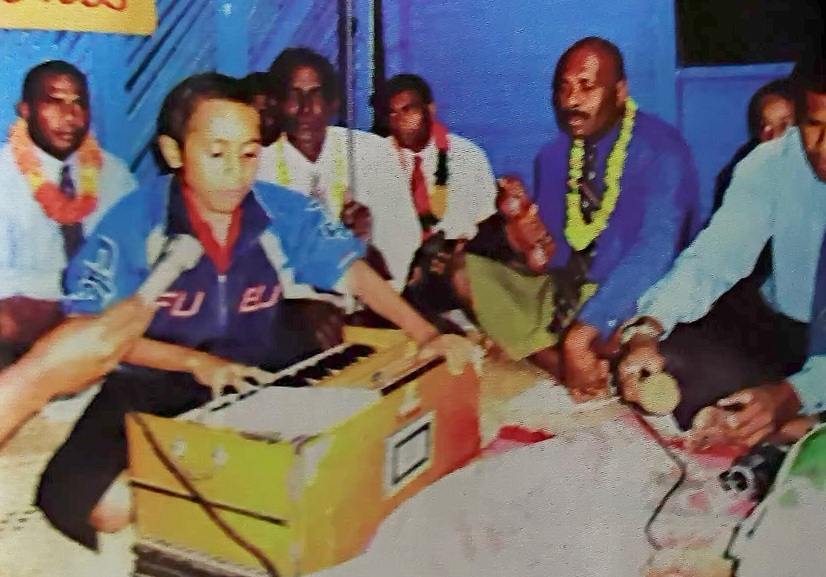
During an evangelisation event in Naleba in July 2010, Indo-Fijian Catholics responded strongly to a performance by a Fijian Methodist group known for singing Hindi hymns and preaching in Hindi.
“We didn’t realise they were this good,” one community member said afterward. “We’ll have to invite them again so more people can attend.”
The visiting group included an eight-year-old boy who played the harmonium “like an expert,” according to Fr Hoare.
The group’s leader, Apekuki, preached in Hindi and used examples that resonated with Indo-Fijian listeners.
With support from the Indo-Fijian community, Fr Hoare invited the group for a joint evangelisation evening. The shed filled with Christians, Hindus, and Muslims.
After several hymns, an Indo-Fijian woman read Ephesians 2:14–16. Apekuki preached on abandoning divisive instincts and “putting on Christ”. Fr Hoare followed with a homily on the Good Samaritan.
“The Methodist group’s example of crossing barriers of language and culture was clear,” he said. “The Indo-Fijian Catholics themselves admitted their failings.”
The program concluded with refreshments, yaqona, and continued singing.
Returning home for a final goodbye
In April 2011, while preparing to conduct a training program for formators in Myanmar, Fr Hoare learned that his father, who had celebrated his 100th birthday two years earlier, had been hospitalised.
“I was in total shock,” he said. Unsure whether to continue with the program or return home immediately, he sought advice.
“Do you want to see your dad alive again?” a fellow Columban priest asked him. “Then travel on to Ireland.”
He returned the same day and reached Ireland while his father was still alive. After a week in hospital, his father was discharged to his sister’s home, where the family cared for him.
“I said the rosary with him and slept beside his bed in case he needed something.”
His father grew weaker, and on the morning of April 10, he passed away.
Lessons to begin the end
“Purpose, I’ve come to realise, isn’t some burst of inspiration or a moment of lightning clarity,” he said.
“It grows quietly, almost stubbornly, in the people who keep showing up even when no one notices.”
Columban priest, Fr Hoare travelling across Fiji, sitting with uncertain young men, speaking hope into their confusion, he wasn’t chasing praise or legacy.
He was just faithful to the work placed in front of him. And maybe that’s the reminder we need today.
In a world where everyone wants quick success and instant meaning, we forget that purpose often hides in the slow, unglamorous commitments we make every day.
So if you’re feeling lost, or unsure of where your life is heading, don’t wait for some grand sign. Look at what’s already in your hands.
Sometimes the path God calls us to doesn’t begin with clarity, it begins with the courage to keep showing up, just like he did.

