
Early records trace Suva’s library service back to the Victoria Memorial Hall, once known as the Ming Palace and now home to the Vineyard Palace restaurant.
In 1907, Andrew Carnegie, renowned for his contributions to global library development, offered the Suva Town Board a grant of 1,500 pounds sterling to establish a public building in Suva.
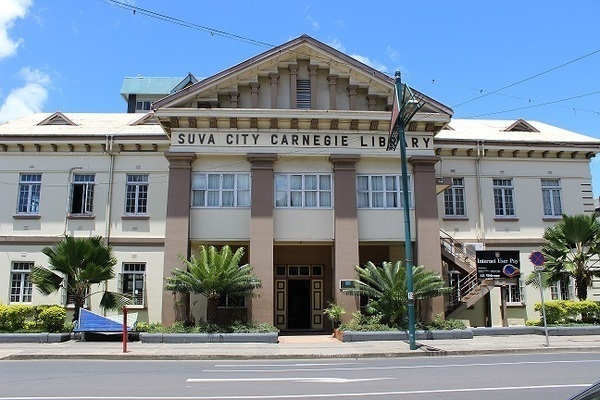
By 1909, the Carnegie Library was constructed, with a plaque commemorating Mr Carnegie’s generosity still present today. The library’s adult section is divided into fiction, non-fiction, Hindi, reference, and the Fijian Collection.
The Suva City Council has upheld this invaluable service, ensuring access to knowledge for people across Fiji, regardless of cultural, ethnic, or religious background.
A modest library service first existed in the Victoria Memorial Hall in 1904. In July of that year, the Suva Town Board assumed management and maintained both the library and a public reading room.
Prominent Suva citizen Henry Marks donated 400 books under the condition that the library remain open free of charge to the public each weekday evening from 7.30pm to 9pm.
Despite its limited size, the board recognised the library’s significance and appointed C.A. Huon as acting librarian. Mr Huon officially became librarian on February 6, 1905.
His expertise in library practices led to his promotion, along with a 40-pound allocation for books, magazines, and newspapers.
Subscription fees were set at five shillings per person for three months or 10 pounds annually, but progress was slow due to the high cost and limited availability of books.
In 1907, A.H. Ogilvie, Suva Town Board member and co-founder of Stuart, Ogilvie & Co., travelled to England and secured the 1,500 pounds grant from Mr Carnegie for a free library.
The grant’s conditions required the Town Board to provide a free site and guarantee 150 pounds annually for upkeep.
The Fiji government allocated a site along Victoria Parade, between the Victoria Memorial Hall and the former Suva Boys’ Grammar School.
A special board meeting determined the library’s design, initially proposing a two-storey wooden structure with a balcony. However, the colonial government mandated concrete construction.
On September 1, 1908, Fiji’s governor Sir Everard Im Thurn laid the library’s foundation stone.
The building cost 1298 pounds, with additional expenses for a septic tank, sandstone, and blue metal, totalling more than 71 pounds. Materials were acquired from the Commissioner of Works on October 18, 1908.
Architect R. Aurep not only designed but also supervised the construction for a fee of one percent of the total building cost. The library officially opened on November 20, 1909, by Sir Everard im Thurn.
Initially, only the central portion of the building was completed, with the ground floor housing books and serials and the upper floor serving as a reading room.
The library initially operated as a reference library, with no lending services. A public reading room provided access to books and periodicals. By the opening, the collection consisted of 4,200 volumes, supplemented by donations from Suva citizens, the governor, and Alport Barker, publisher of The Fiji Times and Herald Ltd.
A year after the foundation stone was laid, the completed Carnegie Library stood as a testament to community effort and philanthropy, continuing to serve as a beacon of knowledge for Fiji.

