
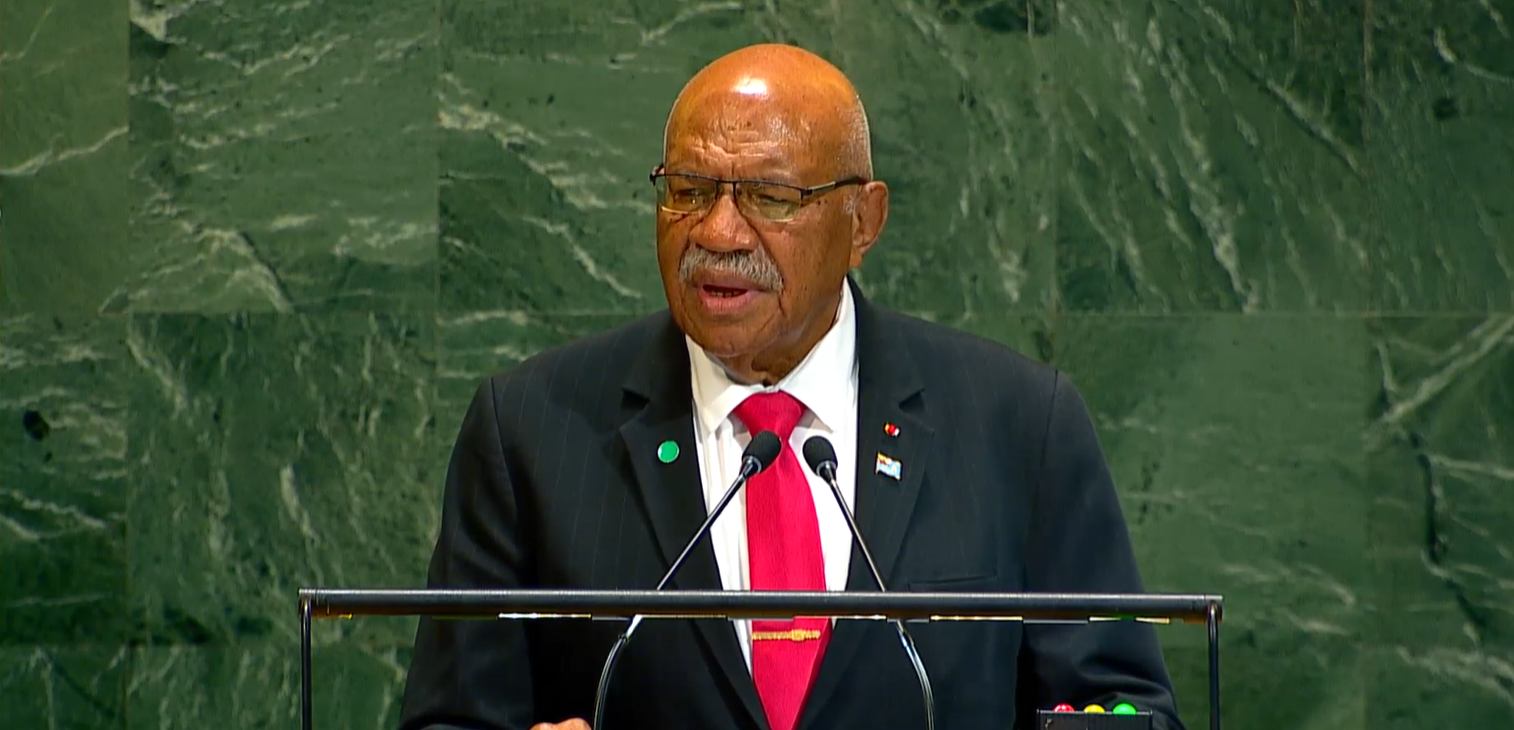
Prime Minister Sitiveni Rabuka used Fiji’s national statement at the 80th Session of the United Nations General Assembly (UNGA80) to highlight the growing threat of transnational organised crime, particularly drug trafficking, in the Pacific region.
Addressing world leaders at the UN Headquarters, Prime Minister Rabuka warned that Fiji is facing an “upsurge in transnational organized crime,” which is exploiting the country’s vast maritime borders.
“Drug trafficking has exploited our vast maritime domain, spanning over 1.3 million square kilometres of ocean,” Mr Rabuka said.
“This crisis threatens our national security and social fabric while exploiting our limited capacities.”
He stressed that the issue cannot be solved by enforcement alone.
“Our approach must be holistic,” he said, “combining law enforcement with mental health support, community-based recovery programs, and trauma-informed care for those affected.”
Mr Rabuka said Fiji looks forward to working with international partners to tackle the issue at every level—from supply chains to rehabilitation.
“We must address trafficking sources of supply, routes, enforcement, and demand reduction, while also focusing on healing and rehabilitation for affected individuals and communities.”
The Prime Minister also highlighted Fiji’s domestic response to growing security threats through the launch of its National Security Strategy (NSS) in June. This follows the release of the country’s first Foreign Policy White Paper and National Vision document.
“In response to the multitude of issues confronting Fiji after 16 years of autocratic rule, and the responsibilities we hold as the regional hub, a structured approach to national security was urgently needed,” he said.
Mr Rabuka described the National Security Strategy as a forward-looking framework designed to protect Fiji’s interests in an increasingly complex global environment.
“It is anchored in regionalism, aligning with the 2050 Strategy for the Blue Pacific Continent,” he added. “This promotes prosperity, human rights, and deeper cooperation with international partners.”
The Prime Minister’s address underlined Fiji’s continued push for global solidarity in tackling not only climate change and development, but also the growing challenges posed by organised crime and regional security threats.

