THE Catholic faith has left its mark almost everywhere in Fiji. Walk out your door and there is a good chance the next few people you meet will include someone whose life is shaped by the Catholic Church.
For many Fijians, Catholicism is more than a denomination. It is part of family, community and daily life.
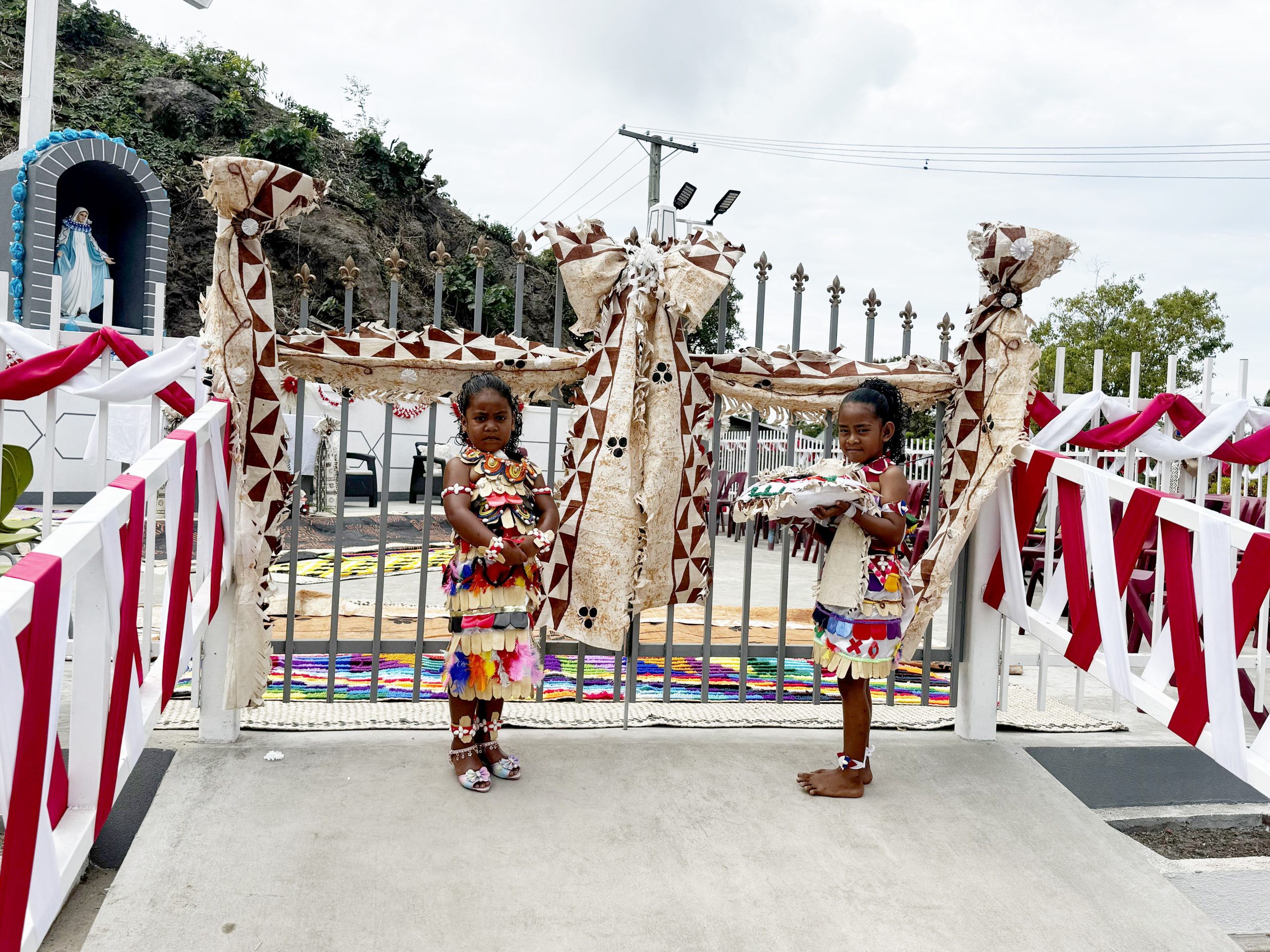
That legacy was remembered in Tubou, Lakeba in Lau in the second week of August this year when the Lauan Catholic community and Catholics from around Fiji gathered to mark 182 years since the arrival of the first Catholic missionaries in Fiji.
After 182 years, the story of the men who brought Catholicism to Fiji has been etched into the landscape of Lakeba where Head of the Catholic Church, Archbishop Peter Loy Chong, led celebrations for the opening of a landmark built by Lauan Catholics in their honour.
The celebrations honoured a mission that began with a small group of men arriving on Lakeba in the 1800s – a beginning that would eventually grow into one of Fiji’s established Christian traditions.
But behind the anniversary were the men themselves.
Long before their names became part of Fiji’s religious history, they had already lived lives shaped by faith, travel and missionary work across the world.
The Pacific Mission
During the days of old, religions across the world sought to expand their influence with the Catholic crusade starting that journey.
The idea to expand that crusade to the Pacific began with Bishop Pierre Maria Bataillon – a French Marist who left France in December 1836 as part of one of the first Marist missionary groups sent to Oceania.
Born on January 6, 1810, in the rural village of Saint-Cyr-les-Vignes, located in the Loire department of France, the late Bishop grew up in a modest farming household during the early 19th century, a period marked by the resurgence of Catholic devotion in post-Revolutionary France.
According to earliest records in the Catholic Church, his parents were cultivators who, despite their limited means, maintained a deep and unwavering faith that permeated family life.
In letters Bishop Bataillon sent to the church detailing his childhood, he described himself as exhibiting early signs of religious inclination, fostered by his parents’ piety and involvement in local parish activities, which laid the foundation for his future commitment to the Society of Mary.
Bishop Bataillon joined the Marists and was ordained a priest on December 19, 1835, before departing for the Pacific missions in 1836.
Arriving at Wallis Island in 1837, he overcame severe hardships, including hostility from locals, to convert the entire Polynesian population of approximately 2700 by 1842.
His work in Wallis eventually led to a much larger responsibility.
In 1842, the Holy See established the Vicariate Apostolic of Central Oceania and appointed Bishop Bataillon as its first Vicar Apostolic.
He was consecrated Bishop at Wallis in December 1843.
His vast mission territory included Fiji, Tonga, Samoa, Wallis and Futuna and other nearby islands.
As the senior Marist leader in the region, Bishop Bataillon oversaw the mission’s expansion.
For Bishop Bataillon, the journey to Fiji was part of a much wider effort to extend the Catholic mission across the Pacific.
For the men he journeyed with, it would become the beginning of their Fiji story.
Father Jean-Baptiste Breheret
Father Jean-Baptiste Breheret was also a French Marist priest.
Catholic records show he was 28 years old when he left Toulon, France and sailed towards Oceania on April 23 in 1843.
After a journey of more than seven months, he reached Wallis on November 30 that year where he joined the Marist mission under Bishop Bataillon.
His time in the Pacific before Fiji was short – within months of arriving in Wallis, Father Breheret was selected to join the new mission to Fiji.
Father Breheret was still relatively new to the Pacific when Fiji became his next destination.
Father Roulleaux
For Father Joseph-Francois Roulleaux however, the Pacific was already familiar ground by the time Fiji became his next destination.
Father Roulleaux travelled to New Zealand in 1840 as part of a group of Marist missionaries where he was ordained a priest in 1841.
His missionary work later took him to Futuna where he was sent following the death of Father Peter Chanel.
He spent about two years working on Futuna before being selected for the new mission to Fiji.
By the time he set out for Fiji, Father Roulleaux had already spent several years away from Europe gaining experience in the Pacific and adapting to the demands of missionary life.
His journey to Fiji was therefore another step in a missionary life already shaped by the Pacific.
Brother Perol
Travelling alongside the priests was Brother Annet Perol, a French Marist religious brother.
Born in 1814, Perol joined the Society of Mary in 1843, at a time when the Marists were expanding their missionary work across the Pacific.
That same year, he left France as part of a larger Marist expedition bound for Oceania.
He travelled with other missionaries towards the newly developing missions in the Pacific before being assigned to the work in Fiji.
By 1844, Perol had joined Bishop Batallion, Fathers Breheret and Roulleaux for the mission to Lakeba.
As a religious brother rather than a priest, his role was different from theirs, but he was part of the small Marist team making its way into a new mission field.
Ties to the Pacific
Travelling alongside the French Marist priests were two Wallisian catechists, Pako Feilolo and Apolonio Atufufu.
Both were converts to Catholicism from Wallis and had already been baptised before joining the mission to Fiji.
As catechists, they were part of the work of teaching and sharing the Catholic faith, bringing with them an understanding of the religion that came not simply from the European missionaries, but from their own experience as Pacific converts.
They were travelling alongside the European missionaries, helping carry a faith that was already moving between the islands of Oceania.
Before the French Marist priests arrived, there was already a Catholic connection on Lakeba. His name was Mosese Monatavai.
His journey to Catholicism was itself a journey across the Pacific. Born in Tonga and brought to Fiji while still young, he later travelled to Wallis, where his canoe was blown onto the island’s reefs. It was there that he encountered the Catholic mission, was baptised and became a catechist.
In 1842, he was brought back to Lakeba, where he had previously lived. He was placed there as a catechist with the intention of preparing the way for Catholic missionaries who would follow.
The late Monatavai began sharing his new faith with the people of Lakeba, but his efforts were met with strong opposition.
Nevertheless, his presence meant that Catholicism had reached Lakeba two years before the French Marist priests made their own attempt to establish a mission there.
Bound for Lakeba
Their stories were different, but by 1844 their journeys were converging on the same destination.
From France came the Marist priests and brother. From Wallis came Pako and Apolonio, Pacific catechists who had embraced the Catholic faith. And before them, Mosese Monatavai who had already made an attempt at establishing a Catholic connection on Lakeba.
In late July of 1844, aboard the mission vessel Adolphe, under the command of French captain Guillaume Morvan, the small party sailed towards Fiji.
With Bataillon, Breheret, Roulleaux, Perol on board, the voyage brought together Europeans and Pacific Catholics on a mission that would change the course of Fiji’s religious history.
On August 9, 1844, after voyaging across the Pacific, the Adolphe reached Lakeba.
Their long journey had reached its destination.
This is where the story of Catholics in Fiji began.