
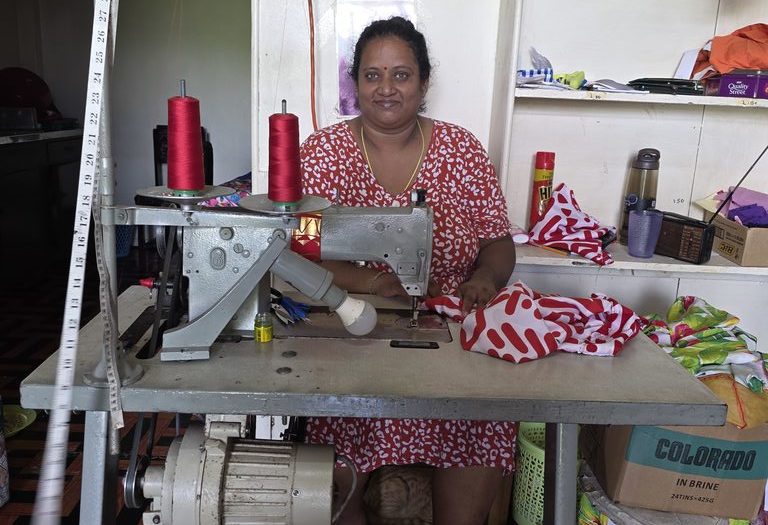
A tailor’s quiet success in Talele, Baulevu Landing is not the kind of place where you’d expect a tailoring enterprise to thrive.
Time moves slowly here, carried by the gentle flow of the great Rewa River and the hush of surrounding farmlands.
Yet, tucked into this laid-back and ultra-peaceful setting is a small tailoring business that hums with quiet determination.
Two years ago, Sonam Datt and her husband, Rahul, relocated to Talele, a quaint farming community in Baulevu, Naitasiri, once known for its sugarcane plantations during British colonial rule.
Their home now sits on land that once hosted a bustling colonial town along the river’s edge.
Where trade once flourished, Sonam now works in calm focus.
From this unlikely base, Sonam has stitches together a loyal clientele of men, women, and children from the nearby villages of Naganivatu, Nakini, Natoaika, and Deladamanu.
Word of her craftsmanship travels far in a place where trust and respect mean everything.
“Actually, I wanted to be a nurse when I was growing up,” Sonam said.
“But I didn’t pass Form 6 so I had to drop out of school.”
Life, however, had other plans. Sonam spent 14 years working in the garment industry. This quietly prepared her for independence.
When the time came, it was her family that nudged her to believe in herself.
“My husband and mum coaxed me into going out on my own and since taking that first leap of faith, I have never looked back.”
Running a business from an isolated riverside settlement has not been a barrier. If anything, life at Talele has strengthened her resolve.
“I work in a very isolated place but I never run out of customers.”
Sonam believes clothing is deeply personal. Each garment carries not just measurements, but confidence and pride.
“I get personal satisfaction when I make someone look confident and smart. That is really my job,” she said.
Her pricing reflects accessibility rather than ambition. Baby clothes sell for $3 per item, children’s wear for $5, while men’s and women’s outfits are priced at $17. Business ebbs and flows, shaped by village life and seasonal celebrations.
“When there is a gathering in the villages, I am kept busy with orders for bula shirts and sulu jaba.”
During quieter periods, Sonam turns to the land and river that sustain her community.
“When there are no orders, I do other chores like tending to my backyard garden where I plant vegetables, root crops, chillies and bananas.
“Sometimes I join iTaukei women in my community and collect freshwater mussels from the river.”
For Sonam, the simplicity of Talele is its greatest luxury.
“We stress when we live in a busy and noisy place. We don’t have that in Talele. Everything here is laid back but calm and just peaceful.”
The Datts do not have children yet, but they hope to adopt in the coming year. Until then, their household is shared with five cats and filled with quiet companionship.
“We have everything we need here. But we may just need children’s laughter to break the monotonous silence at home,” she said with a smile.
Beyond her own success, Sonam carries a message for women everywhere—especially housewives who may doubt their ability to contribute financially.
“You don’t have to run a big business, just something small is fine. All you need is to work hard and to constantly save for the unpredicted rainy days.”

