
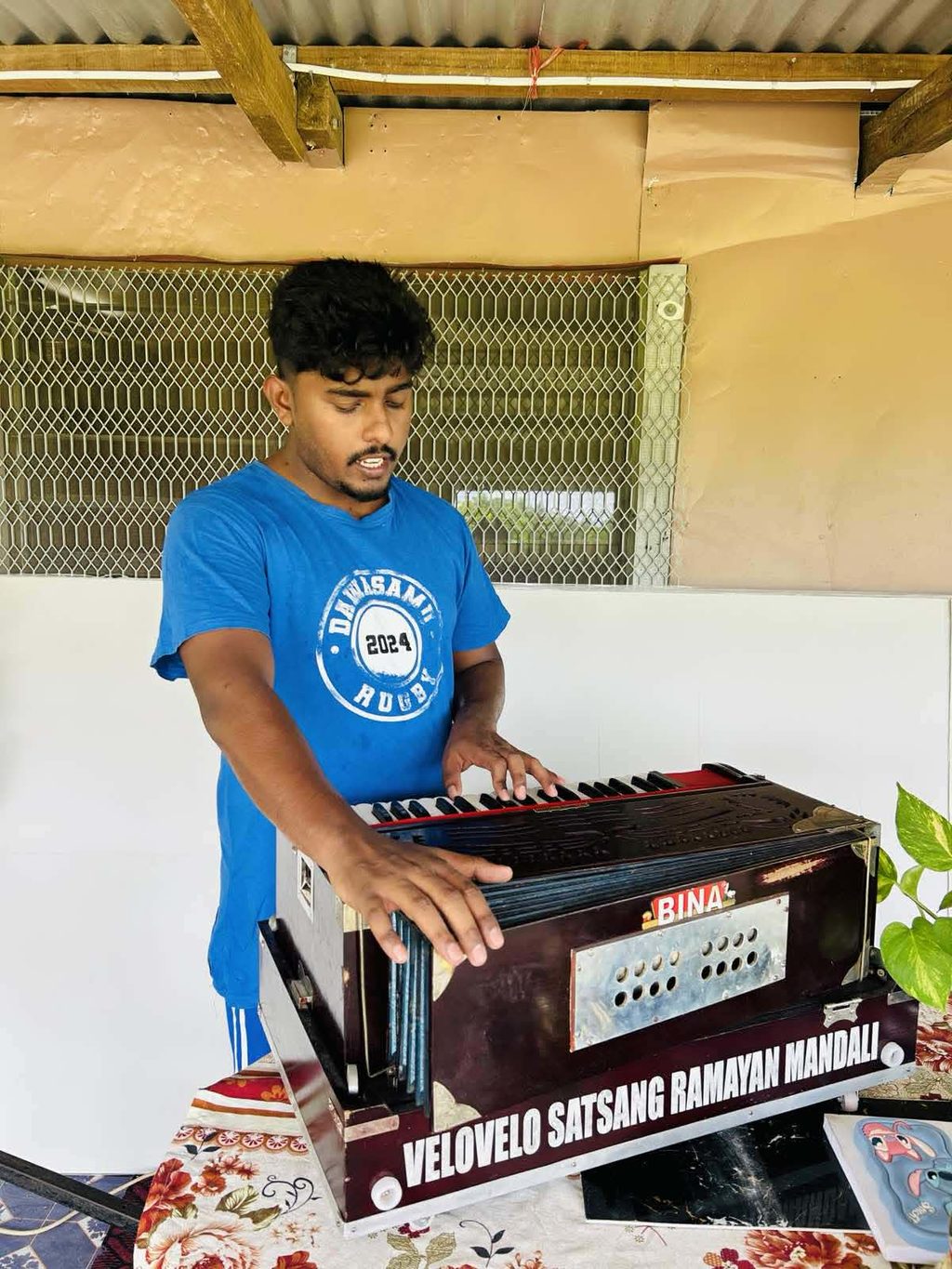
In the quiet settlement of Velovelo, Lautoka, a young teacher once stood at a crossroads that reshaped his life.
At 24, Avish Kumar was part of a new generation of Fijian educators, but his journey into the classroom did not begin with lesson plans or chalkboards.
It began with uncertainty, disruption, and a global pandemic that forced many young people to rethink their futures.
Mr Kumar’s original path had led him into civil engineering. Like many students, he had enrolled with clear goals.
“When COVID-19 struck, financial pressures mounted, and continuing my studies became impossible,” he said.
Faced with the choice of giving up entirely or starting again, he turned to something that had always quietly followed him—music.
“I am from a non-musical family, with no formal training or professional influence at home.”
“My interest in singing developed informally, shaped by hours spent observing kirtan singers at community gatherings and listening closely to film and Hollywood music.”
Mr Kumar said that one of his all-time favorite Bollywood songs is Laboon Ko and a kirtan that he enjoys singing all the time is sawali surat.
By watching, listening, and practising on his own, he slowly trained his ear and voice, learning through imitation long before entering a classroom or lecture hall.
That self-taught foundation eventually led him to pursue studies in Music and Physical Education (PEMAC), transforming a personal passion into a profession.
It was a turning point that would place him in front of a classroom, teaching students who were only a few years younger than himself.
His youth quickly became an advantage. He connected easily with students, using modern references, technology, and teaching styles that felt familiar rather than distant.
Lessons blended PowerPoint presentations, online videos, live demonstrations, and rhythmic clapping techniques to help students grasp complex musical concepts. In a generation shaped by speed and screens, his approach kept learning active and relatable.
One early highlight in his teaching journey was guiding a Fijian student through the basics of playing the harmonium, a traditional Indian instrument.
“At first the student couldn’t pull the fan and play the cords at the same time, but I helped him by telling him to concentrate on the playing the cords and slowly he improved.”
Outside school, Mr Kumar remained deeply connected to music. A vocalist and multi-instrumentalist, he gravitated towards the guitar and harmonium, often performing classical Bollywood styles influenced by the artists and compositions he had grown up listening to. Music became both his creative outlet and a form of release after long school days.
Having completed his postgraduate studies in education, Mr Kumar now looked ahead with measured confidence.
Plans are already in motion to establish a school choir and music club, creating opportunities for students to find confidence, discipline, and expression through music.
Mr Kumar does music tutoring for young children who are interested in the world of music. His journey serves as a reminder that when original plans fall apart, new paths can emerge—sometimes built not on formal beginnings, but on passion, patience, and lessons learned simply by watching, listening, and believing in oneself.

Mr Kumar makes a point in the classroom. Picture: SUPPLIED

