
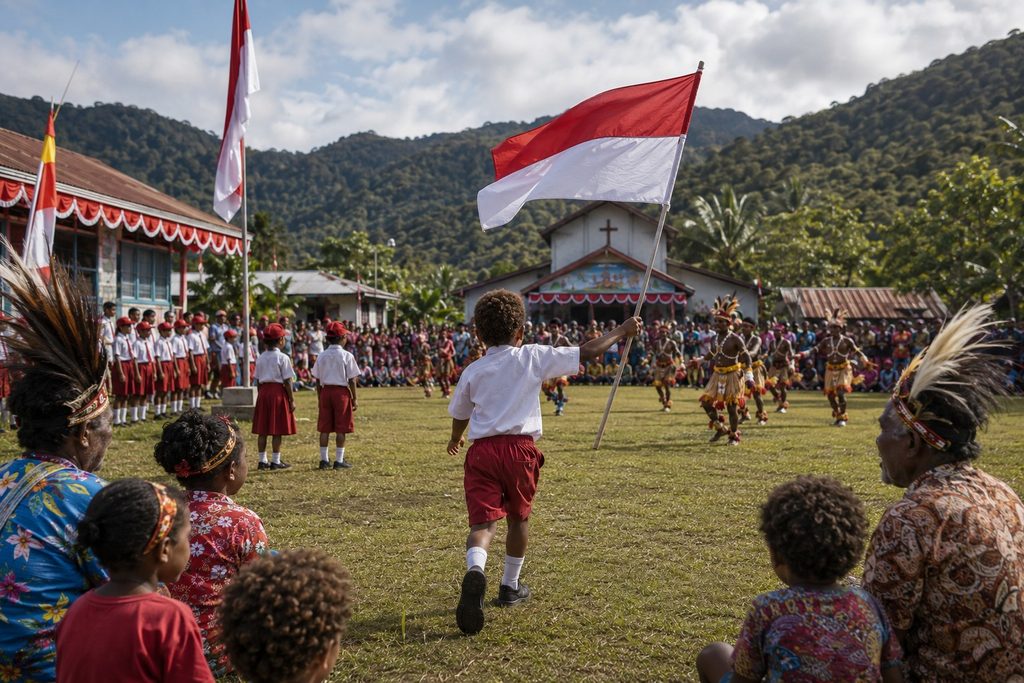
BEFORE sunrise on an August morning, a schoolyard in Papua begins to stir. A teacher checks the line of students rehearsing for the flag ceremony. Nearby, young people fasten red-and-white decorations to bamboo poles. Mothers arrange food for a community gathering, while children practise games they have waited all year to play. Somewhere in the background, a church choir rehearses a hymn of thanksgiving.
By midday, the field will be filled with laughter, music and families. Traditional dress will appear alongside the national colours. Local languages will flow easily through the crowd. Elders will watch as children dance, race and sing. The scene will be unmistakably Papuan and unmistakably part of Indonesia’s Independence Day.
Yet this is rarely the Papua the world sees.
For many people outside the region, Papua is encountered mainly through reports of political dispute, armed violence, security operations and competing claims about its future. Those issues are real and should not be dismissed. But when they become the only lens through which Papua is viewed, millions of ordinary lives disappear behind the headline.
A different picture every August
Every August, another picture comes into focus.
From Jayapura on the Pacific coast to Merauke in the far south, from Wamena in the highlands to Timika, Biak and Sorong, preparations for August 17 take shape in schools, churches, neighbourhoods and villages. Students rehearse ceremonies. Youth groups decorate streets. Congregations gather in prayer. Community organisations prepare cultural performances, local food and competitions that bring neighbours together.
These celebrations are not spectacles designed for foreign audiences. Most will never be filmed by an international broadcaster or quoted in a political statement. They continue because communities themselves organise them, year after year, as part of the rhythm of local life.
A child carrying a flag almost as tall as he is does not imagine that he is making a geopolitical argument. A mother straightening her daughter’s ceremonial uniform is not performing for a camera. A customary elder watching grandchildren dance is not reading from a government script. They are taking part in moments that are familiar, local and deeply human.
The lives behind the narrative
That matters because Papua is too often discussed as an abstraction. It becomes a territory on a map, a diplomatic issue or a contest between rival narratives. The people who live there are then reduced to symbols selected by one side or another.
But Papua is not an abstraction to the teacher preparing tomorrow’s lesson, the fisherman leaving before dawn, the farmer tending a garden, the trader opening a market stall, the pastor visiting a family or the parent hoping a child will have better opportunities. Their daily concerns are not so different from those of families elsewhere in the Pacific.
The Ocean of Peace perspective
For Fiji, this is worth reflecting upon through the vision of the Pacific as an Ocean of Peace. Prime Minister Sitiveni Rabuka’s idea asks the region to build peace through trust, dialogue and mutual respect. It also asks something more difficult: the willingness to see neighbouring societies in their full complexity, rather than through the most dramatic images available to us.
Peace begins with accuracy. It is difficult to understand a society fairly when conflict is treated as its permanent condition and ordinary life as an exception. In reality, it is ordinary life that carries a community from one day to the next.
Identity and coexistence
Papua’s Independence Day celebrations do not erase indigenous identity. One only has to look at the celebrations themselves. Papuan languages are spoken. Traditional music is played. Indigenous dances take centre stage. Local food is shared. Customary leaders remain respected. The red-and-white flag does not require these communities to leave their culture at the gate. Their culture enters the celebration with them.
This coexistence may appear inconvenient to those who prefer simple political categories. Yet human identity is rarely simple. A person can be deeply rooted in a clan, a church, a language, a town and a nation at the same time. These loyalties do not always cancel one another.
Often, they shape one another.
Recognising complexity
An honest view of Papua must also acknowledge that the region contains different political opinions, experiences and grievances. No serious observer should pretend otherwise. Development gaps, inequality, violence and distrust deserve sober attention, and civilian safety must remain central to every discussion.
But honesty cannot stop there. Diversity of opinion also means that no single activist, political group, armed organisation or government official can speak for every Papuan. The most visible voice is not necessarily the most representative, and the loudest moment is not necessarily the most typical.
A lesson familiar to Fiji
Fijians understand this instinctively. No one would claim to know Fiji by looking only at its political crises while ignoring daily life in Suva, Lautoka, Labasa, Levuka or the outer islands. Such a portrait might contain facts, but it would still be false in its incompleteness. It would miss the schools, markets, churches, villages, friendships and family obligations through which the country is actually lived.
Papua deserves the same fairness.
This does not mean turning away from difficult questions. It means refusing to let difficult questions erase everything else. Journalism should report conflict, but audiences should remember that conflict is an event, not an entire people. Political debate may shape perceptions of Papua, but it does not wake children for school, put food on tables or sustain communities through grief and celebration.
Seeing the other Papua
On 17 August, many of those communities will gather again. Some will begin with prayer. Some will stand for a flag ceremony. Some will celebrate through football, sack races, music or traditional dance. Small businesses will sell food and handicrafts. Families will take photographs. Children will return home tired, carrying small prizes and stories they will repeat until next year’s celebration.
Long after the speeches have ended, the most enduring image may be the simplest: a child running across a field with a red-and-white flag in one hand, while a parent calls from the edge of the crowd and an elder smiles nearby.
There is nothing dramatic enough in that scene to become breaking news.
But it tells us something essential.
Papua is not only the place where political arguments occur. It is also a place where people teach, worship, trade, farm, fish, raise families, preserve their traditions and celebrate together. Its future will be shaped not only by those who issue statements or carry weapons, but by the millions who quietly build community every day.
Every August, the world sees one Papua.
Perhaps it is time the Pacific also saw the other.
This commentary draws on publicly available information from Indonesia’s Badan Pusat Statistik (BPS), UNESCO, the United Nations Development Programme (UNDP), the World Bank, the Australian National University’s Department of Pacific Affairs, the International Crisis Group, the University of Papua (UNIPA), and Indonesia’s Ministry of Education, Culture, Research and Technology. These sources provide data and research on Papua’s demographic diversity, indigenous cultures, human development, education, governance and regional affairs, recognising both the region’s challenges and the everyday lives of its communities.

