
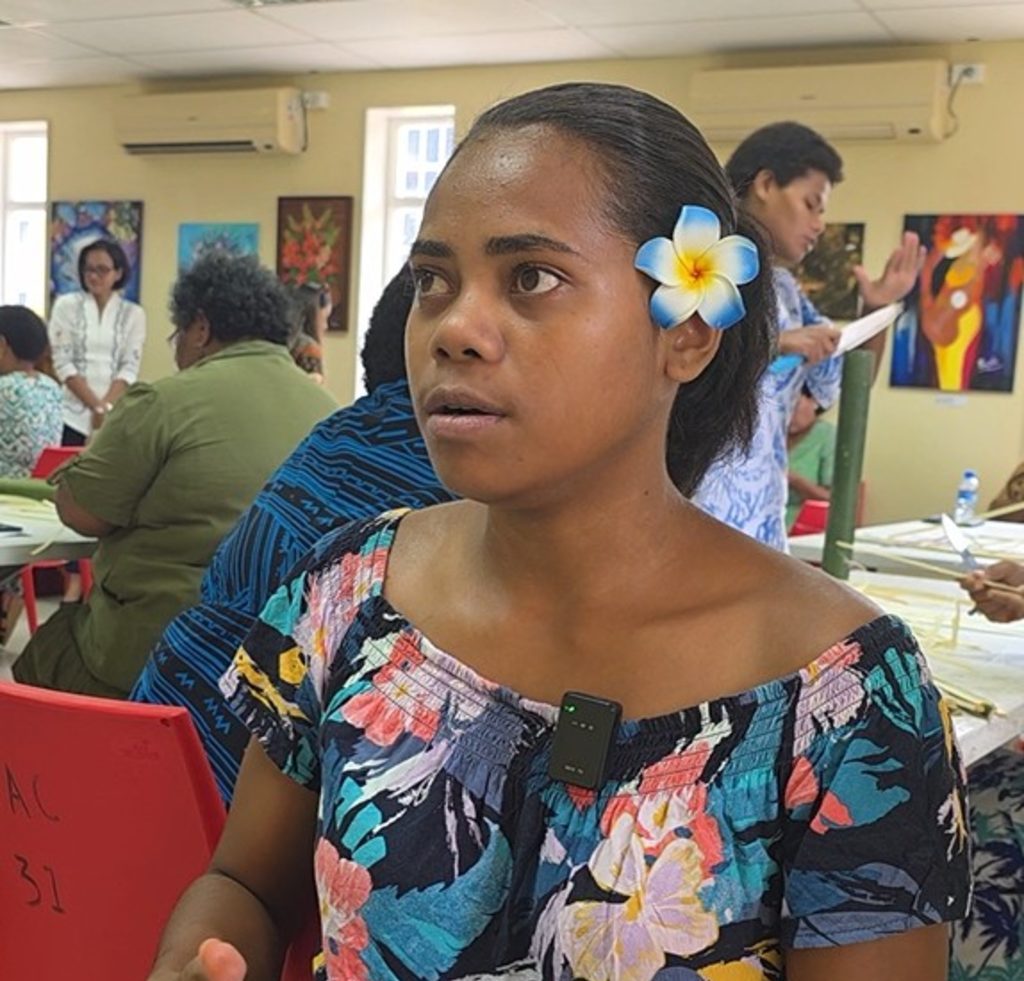
Melaia Korosigasigari’s path to forestry did not begin in a lecture theatre but in the forests she explored as a child with her father.
The 23-year-old Fiji National University (FNU) Koronivia campus student, who hails from Ogea Island in Lau with maternal links to Namosi, is pursuing a Bachelor of Science in Forestry with a clear vision to promote bamboo as a sustainable alternative to traditional timber.
“My dad and I used to spend a lot of time in the forest when I was growing up,” she said.
“That’s when I fell in love with it, and it inspired me to choose forestry as my field of study.”
Beyond her academic work, Ms Korosigasigari is also involved in a small but growing bamboo craft enterprise, Sunnyville Bamboo, operated by bamboo specialist Sukulu Soko, widely known as “Mr Bamboo”.
The business focuses on a range of activities, including weaving, carving, charcoal production, furniture creation, and interior and exterior design work, often combining bamboo with traditional materials such as magimagi.
The team also conducts awareness workshops to promote bamboo’s potential.
Through her involvement, she has come to appreciate bamboo not only as a versatile material but as an under-valued resource.
“Many people don’t realise how valuable bamboo is,” she said.
“Almost every part of the plant can be used, the roots, the leaves, the stems, even the water inside. You can get so much out of it compared with many other materials.”
Her long-term goal is to specialise in silviculture, focusing on the management and cultivation of forest resources, and to explore innovative ways of combining bamboo and wood to create new products suited to modern needs.
“I want to work on blending wood and bamboo together so we can produce new materials and designs,” she said.
“There is a lot of potential there.”
Ms Korosigasigari believes the forestry sector, particularly bamboo development, offers promising opportunities for young people, even though it is not always seen as a popular career path.
“Forestry is not a field many youths think about, but it is rewarding,” she said.
“Wood resources may become limited over time, but bamboo keeps regenerating quickly. It could become an important replacement material, especially for housing and construction.”
She also hopes that increasing awareness efforts, including the work being done by bamboo advocates and community-based enterprises, will help change long-held perceptions of bamboo as merely a simple plant rather than a valuable economic resource.
“I think attitudes are already starting to change,” she said.
“People are beginning to see bamboo as something that can be used instead of wood and even concrete in some cases. With more awareness, I believe it will be taken more seriously in the coming years.”
The young woman from Lau believes her mission is both professional and personal, as it follows on from the work she grew up around and is now helping to shape a more sustainable future for Fiji’s building and craft industries,
“I just want to keep learning more about weaving and working with bamboo,” she said.
“It’s something I truly enjoy, and I believe it has a strong future.”

