
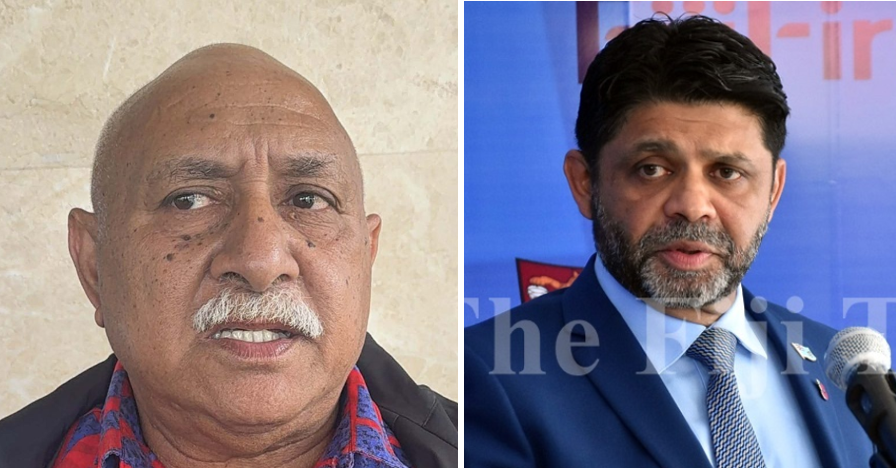
THE People’s Alliance party (PAP) has blamed former attorney-general Aiyaz Sayed-Khaiyum and the former FijiFirst Government for the current pressure to increase electricity prices, saying the situation was created by decisions made under his leadership.
In a statement responding to Mr Sayed-Khaiyum’s recent comments on electricity tariffs, PAP general secretary Sila Balawa said the former A-G’s explanation was “long and technical” but failed to acknowledge his own role in shaping the problem now faced by consumers.
He said the pressure to increase electricity prices “is financial, and it comes directly from decisions made by Mr Sayed-Khaiyum and the FijiFirst Government”.
He pointed to the 2021 sale of 44 per cent of Energy Fiji Ltd (EFL) to Japanese company Chugoku, a deal valued at about $1.25billion, which he said fundamentally changed the nature of the electricity provider.
“From that moment, EFL stopped being purely a public service and became a business required to make profits and pay returns to shareholders.
“No serious investor puts $1.25billion into a company without expecting strong returns. The demand for higher revenue was built into the system Mr Sayed-Khaiyum created.”
He said EFL’s own submission to the Fijian Competition and Consumer Commission (FCCC) confirmed this reality, noting that the company was seeking a 32 per cent electricity tariff increase over the next four years.
According to EFL, current tariffs are insufficient to support its investment needs, with electricity demand growing at about 4 per cent annually.
Mr Balawa said EFL estimates that around $4.3billion in new investment will be required by 2031, including about $1.4billion for transmission and distribution upgrades across Fiji’s main islands.
He added that while there had been no tariff increase since 2019, EFL’s operating costs and asset base had continued to grow.
“These pressures are not accidental. They are the predictable result of turning a public utility into a profit-driven enterprise.”
He criticised Mr Sayed-Khaiyum for now speaking about regulation, consultation and transparency, claiming the public was not properly consulted when nearly half of EFL was sold to a foreign investor.
“Mr Sayed-Khaiyum did not properly consult the public on how selling nearly half of EFL would affect electricity prices for ordinary Fijians in the years ahead.”
Mr Balawa said the PAP supported the requirement for the FCCC to follow the law and consult the public, which was why the party backed the pause on the proposed tariff increase and the commencement of public consultations.
However, he said it was misleading to suggest the issue rested solely with the FCCC or the current Coalition Government.
“It is dishonest to pretend this problem started today or sits only with the FCCC or the Coalition Government.
“The structure forcing EFL to prioritise shareholder returns alongside public affordability was designed and implemented by Mr Sayed-Khaiyum himself.”
He said the Coalition Government was now dealing with the consequences of past decisions and, unlike the previous administration, was allowing public consultation to take place.
“The People’s Alliance party will continue to speak up for ordinary Fijians and will not allow those responsible for creating today’s problems to rewrite history.”

