
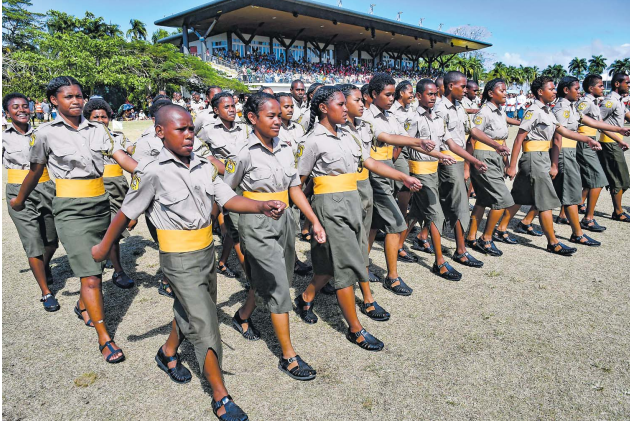
To understand the debate over cadet training in Fiji, is to witness a profound clash of worldviews, often masquerading as a simple policy disagreement. As an iTaukei, a product of the cadet system, the military, the United Nations and a traditional high chief, I see this clash not in the abstract, but in the stark relief of lived experience and cultural duty. The opposition’s narrative, often framed in the language of liberal modernity — anti-militarism, individual autonomy, fear of authoritarianism — fundamentally misapprehends what the cadet system represents within an iTaukei framework. It is not an imported military indoctrination, but a structured, modern expression of the very vakavanua, that binds our society. To oppose it, using an iTaukei voice no less, is not to protect iTaukei culture, but to unwittingly advocate for its dilution.
THE critic sees a uniform and thinks “soldier.” The iTaukei who understands tradition, sees a uniform and recognises a marker of role, duty, and collective identity. The disciplined ranks of a cadet unit are not a mindless parade ground; they are the living geometry of our vanua — a physical manifestation of order, hierarchy, and mutual dependence. The core principles our Permanent Representative to the United Nations, Ambassador Filipo Tarakinikini outlined recently — discipline, obedience to legitimate authority, service, teamwork, subsumption of self to community — are not foreign concepts. They are the bedrock of our traditional upbringing: vakarokoroko (respect), veiqaravi (service), vakabauta (loyalty), and kerekere (reciprocal obligation). The cadet system institutionalises these values in a secular, national context, providing a common ground where the son of a chief and the son of a farmer stand equal before the same standard — a concept deeply resonant with the communal accountability of the vanua.
This is where the weaponisation of identity becomes so pernicious. To position an iTaukei against cadet training is to create a cultural paradox. It forces a traditional voice to argue against a system that bureaucratises tradition. The opponent’s cry of “militarism” cleverly obscures the real issue: the cadet system is a form of structured, state-sponsored discipline, that operates outside the purely individualistic, rights-centric model of modern liberal education. It is a rival to the idea that correction, order, and collective duty are private matters. For a society feeling the erosion of traditional disciplinary structures, the cadet system offers a legitimate, inclusive pathway to instil what families and villages once did cohesively. To have an iTaukei argue against this is to have them champion the very vacuum that is causing societal anxiety.
The attempted linkage between the cadet system and Fiji’s coups is a prime example of this flawed logic. It is a post hoc fallacy of the highest order. The political misadventures of our nation’s armed forces in its tumultuous post-colonial era are a complex saga of politics, ethnicity, and power. They are not the progeny of schoolchildren learning to march, polish boots, and work as a team. This linkage is a cynical attempt to poison the well, to taint a character-building institution with the sins of a few adults in a specific historical context. By this same logic, we would disband physics classes because the atomic bomb was built, or abolish religious studies because of holy wars. The cadet system does not create coup-plotters; it aims to create citizens with the integrity to resist corruption, the discipline to pursue lawful change, and the loyalty to nation over faction.
As a chief, I see the cadet system not as a threat to tradition, but as its necessary ally in the 21st century. The vanua is not a museum piece; it is a living system that must find expression in new institutions to remain relevant. The cadet system can be one such vessel. It takes the iTaukei child from the village and the Indo-Fijian child from the cane belt and gives them a shared experience of Fijian citizenship, built on a foundation of character that transcends ethnicity. It teaches that authority, when legitimate and exercised with fairness, is to be respected — a lesson any chief worth his/her title, knows is fundamental to social harmony.
Yes, as Ambassador Tarakinikini wisely concedes, the implementation must be beyond reproach. Incompetent instructors, lack of resources, and a hollow syllabus betray the purpose. This is the call to action: not abolition, but reformation. We must invest in the system with the same seriousness we invest in mathematics or language, for it teaches the grammar of citizenship and the calculus of collective survival.
The choice before Fiji is stark. We can heed the siren call of a fragmented modernity that mistakes all structure for oppression, all discipline for tyranny, and in doing so, abandon our youth to a world of atomised selves without compass. Or, we can consciously choose to build citizens of character. We can recognize in the cadet system a modern vakasama — a way of thinking — that aligns with the ancient wisdom of the vanua: that we are forged not in isolation, but in community; that true freedom is found in mastered self, not surrendered impulse; and that the individual’s highest calling is service to something greater.
The cadet system is not about creating soldiers. It is about creating Fijians. To oppose it from a position that misunderstands its cultural resonance is to fight not for progress, but for a rootless future.
As one who has worn the cadet uniform, the military uniform, and bears the invisible mantle of chiefly service, I see these not as contradictions, but as different expressions of the same foundational truth: a nation, like a vanua, endures only through the disciplined hearts and collective spirit of its people.
RO NAULU MATAITINI is a member of the Bose Levu Vakaturaga. The views expressed herein are his.

