
Some weeks back, we brought our discussion to the Deed of Cession and tried to enact the actual sequence of events that took place on October 10, 1874 at Nasova in Levuka. We also walked through the visuals and the actual venue where the signing took place.
We then scrutinised the 13 signatories to that historical document that changed the course that Fiji took to its development from there onwards. I stopped by promising to focus on an intriguing question that is often given scant regard in the more prevalent historical accounts of the time; that is the question that parts of Fiji refused to submit to cession. We will delve into this later.
Before we proceed, I would like to apologise for the fact that I have been missing for almost a month.
That is because we have been in the exam and semester-end phase at USP.
This usually escalates our workload as academics and it becomes very difficult to fit in the research that is required to churn out these types of papers that we present as opinion columns for the benefit of a community that has never really been taken through a researched and structured set of public writings that attempt to not only clarify but simplify an understanding of our history that has yet to find its way into our school curriculum.
Now coming to this article, I wish to acknowledge and thank two readers for pointing out that more is needed on the war club that Cakobau surrendered and offered to the Queen’s representative, His Excellency Sir Hercules Robinson, as a present embodying a commitment to accepting and supporting Britain’s subsequent plans for Fiji.
I wish to thank these contributors (by way of feedback) for pointing out that Cakobau’s war club – Nai Tutuvi Kuta ni Radini Bau – does indeed have a history of its own.
We will now focus on the origins and history of that war club.
Cakobau’s war club
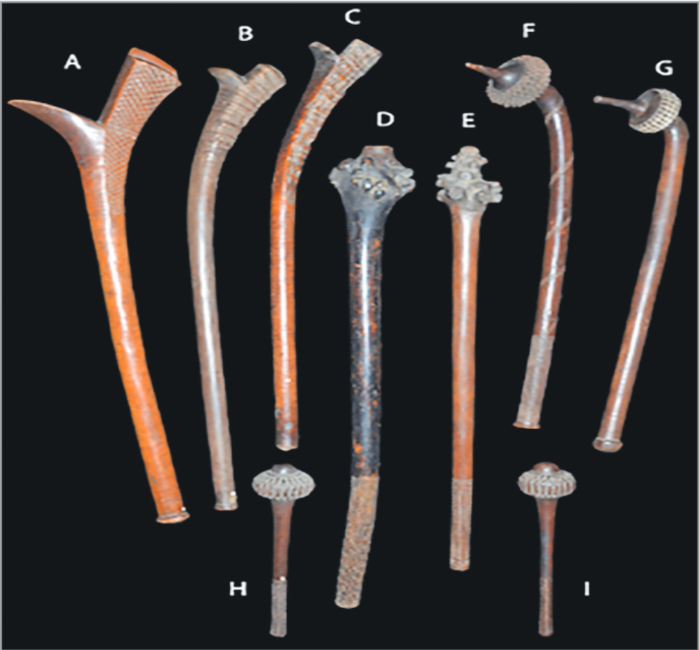
THE revered Mace that is seen in Fiji’s Parliament is no other than the Tutuvi Kuta ni Radini Bau that was said to be Cakobau’s inseparable companion during his heyday. Oral tradition has it that it was his favourite war club holding special significance for him because so many of his foes had been ritually slaughtered with it. Ro Kania (Roko Tui Dreketi) was one whose skull was slit even as he sat in his canoe and pleaded in vain for his life as he expected Cakobau, a close relative, to spare him after the Battle of Kaba 1855 when Bau routed Rewa (FT 9/08/2025). Accounts emphasise that so bloody was the history of the old war club that it was known more bluntly as the Blood Bather (Brewster, King of the Cannibal Isles, 1937).
The club itself was made from a particularly hard wood called gadi. Its name Nai Tutuvi Kuta ni Radini Bau means a blanket-like coverlet of the Queen of Bau. The blanket is made for royalty from finely plaited rushes/reeds called kuta, which is carefully bleached in the sun. Cakobau gave this name to his favourite club as a show of concern, duty (and probably affection) to protect his Queen from harm. According to oral history, the war club originally belonged to Rokomoutu, one of the four sons of Lutunasobasoba.
This is a brief take behind it. Followers of Fijian history know the dominant narrative that Lutunasobasoba crash landed at Vuda aboard the vessel, Kaunitoni. This “First” Chief’s four sons, a daughter and an extended family then ventured over the Nakauvadra mountain range to other parts of Fiji. This group initially made its adventurous journey to Ucunivanua, Verata where they set up base. Rokomoutu’s sister, Buisavulu was overly protected by her four brothers and only came out at night when the moon was out. In search of a less suffocating existence she requested to be allowed to reside in Ovalau where she subsequently moved to and lived at Bureta.
While in Ovalau she gave birth to a son, Vula. This naming might have had to do with the fact that at Ucunivanua she only experienced freedom under the moonlight. The people of Bureta resented Vula, so Buisavulu sent him to the neighbouring island of Moturiki. A call to arms from Degei brought Vula back to mainland Viti Levu. He subsequently eloped with Rokomoutu’s daughter, Adi Buna Naitokalau, who was his cousin. They had a son whom they named, Vueti (Vuetiverata). This child would go on to become the first Roko Tui Bau. Vueti was raised by his grandfather, Rokomoutu, in Verata.
When Degei waged war on Rau na Ciri who had stolen his prized rooster, Turukawa, he requested assistance from Verata among others. Rokomoutu thus sent his grandson,Vueti, to Nakauvadra with his own war club known as the Sigalavalava. Vueti took on the Ciri and when he cut open the legendary vines of waka ni vugayali, the war was won. The victorious Vueti was then gifted the Sigalavalava (war club) by his grandfather, Rokomoutu.
Taking oral accounts further, Rokomoutu was searching for an heir and could not consider his eldest son, Buatavatava because he was a Vasu i Bua and also because he had disobeyed his father. Rokomoutu did not want his people to fall under the rule of Bua. So, he organised a race among his 17 grandsons. The race was won by Tuivanuakula who was not accepted by his older brothers. He then journeyed around until he came to Wainibuka where he married Daviko and fathered two sons, Ratu Drua and Mekemeke. Ratu Drua married and had a son, Roko Seru I. A flu outbreak prompted Ratu Drua to send his only son, Roko Seru I, to search for medicine in Viria.
Roko Seru I took two wives from Nausori and moved to Bureitu where the people of Kaba requested that they move to Kaba. It was here that he married Adi Savusavu, a direct descendant of Vueti. Adi Savusavu was mother to Ratu Banuve and grandmother to Ratu Tanoa. Ratu Tanoa had two sons (among a host of others), Tubuanakoro and Roko Seru II. Roko Seru II became Ratu Seru Cabobau after he conquered Bau in 1837. In the process he wrested the famous war club, Sigalavalava, and made it his own. He renamed it the Tutuvi Kuta ni Radini Bau. Thus, the Mace originally belonged to Rokomouta according to oral accounts. It needs to be noted that there is some confusion if there were two Adi Savusavus in the Cakobau lineage. The Fiji Times journalist, Sikeli Qounadovu, traced and wrote about this in an enlightening series in November 2016. Readers can get more details from there. Let’s move to the Mace now.
The Mace
The war club was first used as a Mace by Cakobau in 1871 in his parliament in Levuka. Readers will recall that Cakobau had mixed success at setting up a constitutional monarchy at Levuka in 1871 (FT 25/10/2025). When the first legislative assembly was called in November of that year, Cakobau declared that his principal war club would serve as its Mace because it had been the symbol of the law of the land during his reign as the dominant chief of Fiji. The club was decorated with silver palm/olive leaves and doves at this point in time. These were meant to serve as symbols of peace and tranquillity as Ratu Cakobau converted to Christianity in 1854 before the missionary James Calvert (Mennell, 1892). It was the missionaries who helped Cakobau add these symbols of Christianity on his war club.
After it was handed to Sir Hercules Robinson on October 10 1874, the war club went to England. A deeper dive into history revealed that the war club (Mace) was taken to London after the signing of the Deed of Cession. In 1875, it was lent to the Royal Colonial Institute for display at an exhibition in the South Kensington Museum in London. Nothing was heard of it over the next fifty years. Then it curiously surfaced in July 1930 through a ruckus in the House of Commons. Apparently, the mace had been sitting in that august house virtually unnoticed. The ruckus mentioned here involved John Beckett, the Labour MP for Peckham at the time. Reports have it that after a division in the Commons, Beckett walked off with the Mace and almost carried it out of the House before he was intercepted by the Sergeant at Arms.
Interest suddenly piqued after reports of this incident were published in the London newspaper, Times. One of those who pursued this story was a former colonial civil servant who had served in Fiji, A.B Brewster. His Letter to the Editor published on July 31, 1930, requested for help in tracing the whereabouts of the former Fiji Mace. The Private Secretary to King George V saw this and responded. Brewster was told that the Mace was kept at Windsor Castle and he was welcome to inspect it. The story of Mr and Mrs Brewster’s visit to the castle to see the Mace reached Fiji, and Governor Sir Murchison Fletcher immediately contacted the Royal Household to ask if the Mace could be returned to Fiji.
He said the Mace would be used in Fiji’s Legislative Council and the King consented. Thus, Cakobau’s war club returned to Fiji in 1932 after King George V released it (Time, 17/10/1932). When the Legislative Council sat in Suva on October 3, 1932, the Mace was formally brought into the chamber by Ratu Tevita Raivalita, a chief of Bau and a relative of Cakobau. It is of particular interest that this Bauan chief carried the name of Ro Raivalita (Rewa) who had been treacherously trapped and ritually slaughtered by Ratu Seru Cakobau himself because he saw him as a political rival in 1854 during pre-cession Fiji.
Anyway, during the 2000 coup, Speight’s rebels tried to trash the Mace with the Parliament building. An alert policeman very astutely fled with it, and it found its way back to Parliament in 2015. That is the story of Cakobau’s war club. We will move this further next week.
DR SUBHASH APPANNA is a senior USP academic who has been writing regularly on issues of historical and national significance. The views expressed here are his alone and not necessarily shared by this newspaper or his employers subhash.appana@ usp.ac.fj

