
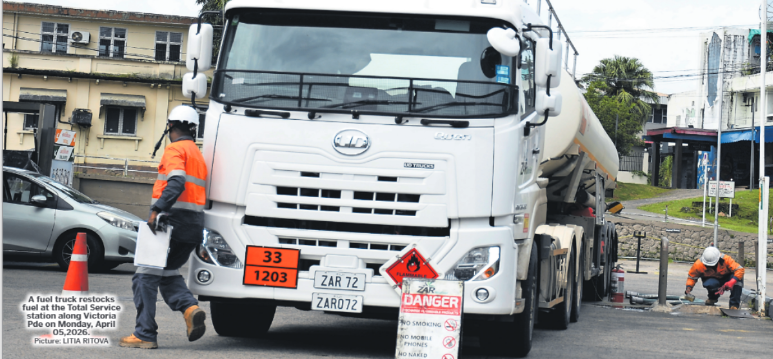
Every time fuel prices rise, every Fijian pays — at the pump, at the supermarket checkout, and on their electricity bill.
What begins as a global oil shock quickly becomes a local cost-of-living crisis.
A typical household may not import fuel directly, but it pays for it indirectly every day through transport, electricity, and food. Across these channels, the combined burden runs into thousands of dollars per year.
Fiji’s exposure to global fuel prices is real. It is externally driven, and there is no dispute about that.
But the depth of our dependence on imported fuel — and the vulnerability that comes with it — is entirely of our own making. This is not an external inevitability. It is a domestic policy outcome. Each year, Fiji spends in the order of $1.6 billion on fuel imports — often representing between 15 and 24 per cent of total imports. That is the structural issue. The real problem is not volatility. It is dependence.
Where the fuel goes — The 90% problem
TO understand this dependence, we must first look at where the fuel is actually used.
Transport accounts for roughly 50 to 60 per cent of petroleum consumption in Fiji. Electricity generation — including diesel and heavy fuel oil used for backup, peak demand, and outer island supply — makes up a further significant share, often around 35 to 45 per cent in practice.
Together, these two sectors consume close to 90 per cent of the country’s fuel imports.
This concentration matters.
It means that Fiji’s fuel dependence is not spread across the economy — it is heavily concentrated in just two systems: How we move, and how we power our homes and businesses.
Any credible pathway to energy independence must therefore target transport and electricity first.
Without addressing these two sectors directly, the conversation remains superficial — and the dependence remains intact.
Electricity generation — the hidden anchor of dependence
Electricity plays a deeper role in Fiji’s fuel dependence than is often acknowledged.
The national generation mix is frequently described as renewable-heavy, with hydropower contributing around 50 to 60 per cent. But this headline obscures a critical reality: Diesel and heavy fuel oil still account for roughly 35 to 45 per cent — and often more in practice — particularly during dry periods or when firm capacity is required to maintain reliability.
Solar, despite Fiji’s exceptional natural conditions, still contributes less than five per cent of total generation.
This matters because electricity tariffs remain indirectly anchored to imported fuel. When fuel prices rise, the impact does not stay within the energy sector. It flows through generation costs into tariffs — and from there into households, businesses, and the wider economy.
Electricity is not just another sector.
It is the conduit through which fuel price volatility is transmitted across the entire system.
Resource reality v policy reality
Fiji is not constrained by resources. The country receives between five and six peak sun hours per day, with solar irradiation of around 4.5 to 5.5 kWh/m²/day — among the highest in the Pacific. In technical terms, Fiji is exceptionally well suited to solar energy generation. This means the constraint is not physical. It is policy. The resource is abundant, predictable, and free. The barriers are man-made.
The solar shift has already begun — just not where it matters most
What makes this even more compelling is that the solar transition is already underway — just not at the household level.
Across Fiji, larger businesses are moving decisively toward solar for one simple reason: it makes economic sense. Supermarkets, factories, resorts, and other commercial operators are installing rooftop systems to reduce operating costs, manage exposure to fuel volatility, and secure long-term energy predictability.
Companies such as Rups have deployed multiple on-grid systems across locations in Rakiraki, Nadi, and Lautoka. At a larger scale, Airports Fiji Ltd has progressed multi-megawatt solar development. These are not symbolic gestures. They are disciplined financial decisions. And they send a clear signal:
-The economics of solar already work in Fiji;
-the question is no longer whether solar is viable; and
-It is why households are not being enabled to participate at scale.
The overlooked superpower — rooftop solar
Among all available options, rooftop solar is uniquely suited to Fiji’s context and ideally positioned to reduce exposure to externally driven fuel shocks. It does not require landowner negotiations. It avoids multi-year project delays. It does not depend on large, centralised capital coordination. It can be deployed in days, not years. And it generates power exactly where it is consumed.
In Fiji’s conditions, a properly sized 15–20 kW rooftop system can generate approximately 40–60 kWh per day and typically pays for itself within about 6 to 10 years. After that, electricity — and even transport, when paired with an electric vehicle — becomes significantly cheaper.
Solar panels have lifespans of 25 to 30 years, while modern battery systems typically last 10 to 12 years. Yet despite these advantages, rooftop solar adoption remains marginal.
This is not a technical constraint. It is a strategic blind spot.
The missing half — transport electrification
Transport is the single largest consumer of fuel in Fiji, but the pathway to reduce that dependence already exists. When rooftop solar is paired with electric vehicles, it does more than lower electricity costs — it displaces petrol itself.
This is where the system begins to change fundamentally. A solar-powered home with an electric vehicle is no longer exposed to fuel price shocks in the same way. Mobility shifts from imported fuel to locally generated energy. At that point, the household has effectively exited the fuel economy.
The dependency loop — how the system reinforces itself
When fuel becomes a foundational input across the economy, it creates a predictable chain through which costs — and taxes — flow across every sector.
Fuel dependency ↑ → Vulnerability to global shocks ↑ → Fuel prices ↑ → Transport costs ↑ → Electricity costs ↑ → Food prices ↑ → Cost of living ↑ → VAT ↑ → Government revenue ↑
Two links in this chain deserve particular attention: The rise in the cost of living, and the corresponding rise in government revenue.
As prices increase across transport, electricity, and food, VAT collections rise alongside them. Households absorb the pressure, while public revenues are partially sustained by the same conditions. This is not an allegation of intent. It is a structural outcome.
Whether by design or by delay, the result is the same:Dependence is preserved.
The Strategic Question
Why does rooftop solar remain marginal despite clear technical and economic advantages?
Why are households and businesses not systematically enabled to generate their own power?
These are not technical questions. They are design questions and they lead to a deeper issue:
Is fuel dependence accidental — or structurally sustained by the way the system is set up?
The flow of costs, and the way revenue responds to those costs, is already visible.
What that implies is a matter for public consideration.
Global shift — the world is moving
Across the world, the direction of travel is clear.
Distributed solar is now reaching 20 to 30 per cent or more of electricity generation in many countries. Households are no longer just consumers — they are becoming active producers. At the same time, electrification of transport and cooking is steadily reducing reliance on imported fuels. Fiji has equal — and in many cases superior — solar resources to these countries.
What it lacks is not sunlight. It is speed.
The current approach — necessary but too slow
The national energy transition continues to rely heavily on utility-scale projects, centralised planning, and long procurement timelines. These are necessary for system stability and long-term capacity, but they are slow by design. Utility-scale projects take years to plan, approve, and deliver. Rooftop solar systems can be installed in days. The difference is not marginal. It is strategic.
The System Design Problem
At the same time, the current framework constrains the very pathway that can move fastest.
Rooftop capacity caps, restrictive grid participation, and limited incentives for decentralisation all combine to slow adoption. The system remains structured around a central provider model, rather than an open platform that enables households and businesses to participate. This is not incidental friction. It is system design. Fiji does not have a fuel problem. It has an energy system design problem.
The missing lever — household energy independence
Every rooftop solar system installed:
• reduces fuel imports
• lowers electricity bills
• shields households from price shocks
• builds resilience from the bottom up
At scale, this is not incremental. It is transformational.
Even a moderate increase in solar penetration — to around 20 per cent of electricity generation — could retain hundreds of millions of dollars within Fiji each year. That is money that currently leaves the country to pay for imported fuel, but could instead circulate locally within the economy.This is not just energy policy. It is economic strategy.
The strategic choice
Fiji now faces a clear decision. Continue on the current path, and every global conflict or oil market shock will continue to translate into domestic hardship — higher costs, increased pressure on households, and ongoing economic vulnerability. Or redesign the system so that households and businesses become active participants in the solution, reducing dependence and building resilience from within.
The fastest path forward
The fastest structural move Fiji can make is clear:
Scale rooftop and distributed solar from its current low single-digit share to 20 to 30 per cent of electricity generation within the next few years.
This is the only pathway that can deliver speed, scale, and resilience simultaneously.
Large-scale projects should continue — but they must complement, not crowd out, this transition.
Policy shifts required
This transition does not require new technology. It requires policy clarity and alignment.
-raise or remove restrictive rooftop capacity caps (towards 15–20 kW and beyond, where appropriate);
-implement fair, predictable, and bankable net metering or net billing frameworks;
-open grid access to households and businesses as legitimate energy producers;
-provide accessible financing pathways, including FNPF-linked options, concessional loans, and targeted support;
-treat households not just as consumers, but as participants in generation; and
-reposition Energy Fiji Ltd as a modern grid enabler and integrator, rather than solely a centralised supplier.
These are practical, achievable steps and they determine whether the transition accelerates or stalls.
The end state — real independence
A properly solar-powered home can meet its electricity needs, support induction cooking, and charge an electric vehicle.
At that point, the household has effectively exited fuel dependence.
When this transition occurs at scale, the national impact follows:
-fuel imports decline;
-cost-of-living pressures ease;
-household and economic resilience strengthen; and
-national vulnerability is reduced.
This is what real energy independence looks like — not as a slogan, but as a system.
Final insight — where the real transition lives
Large-scale projects will remain important. They provide backbone capacity, system stability, and long-term supply, but they are not where the fastest or most inclusive transition will be decided.
That transition will not be determined offshore, in prolonged negotiations, or in projects scheduled years into the future. It will be determined much closer to home.
It is already sitting on every rooftop in Fiji — untapped, immediate, and ready to scale. The technology exists. The economics already work. The resource is abundant and free. What remains is not feasibility. It is implementation. And ultimately, it is choice.
Conclusion — the choice before us
Fiji’s vulnerability to global fuel shocks is real, but the dependence that turns those shocks into domestic crises is not. It is designed. Nearly 90 per cent of our fuel use is concentrated in just two systems — transport and electricity. Both now have clear, viable alternatives. Electricity is no longer constrained by resources. Fiji has some of the best solar conditions in the Pacific.
And the economics are no longer theoretical — they are already being proven by businesses across the country. The missing piece is not technology. It is not financing. It is not even capability. It is system design.
Today, the fastest and most scalable solution — rooftop solar, paired with electrification — remains constrained, while slower, centralised pathways dominate the transition. That is not a technical outcome. It is a policy outcome and the consequences are visible:
A system where fuel dependence feeds into transport, electricity, and food costs — where the cost of living rises — and where that same rise sustains the government revenue flows.
This is not an allegation of intent. It is a structural reality. Which brings us to the central question: If the solution exists, if the economics work, and if the resource is abundant — then what exactly is holding the transition back? Fiji now faces a clear choice. Continue on the current path, and every global disruption will continue to translate into domestic hardship. Or redesign the system so that households and businesses become active participants in energy production — reducing imports, lowering costs, and building resilience from within.
Because the transition we are waiting for is not offshore. It is not locked in negotiations. It is not years away. It is already here. It is sitting on every rooftop in Fiji. The technology exists. The economics work. The resource is abundant and free. What remains is not feasibility. It is choice.
-SUNIL CHAND is an engineer and reform strategist with three decades of senior-level experience across manufacturing, regulation, and higher education. He served as Director of Projects at the Fijian Competition and Consumer Commission (2007–2009). The views expressed herein are his and not of this newspaper.

