
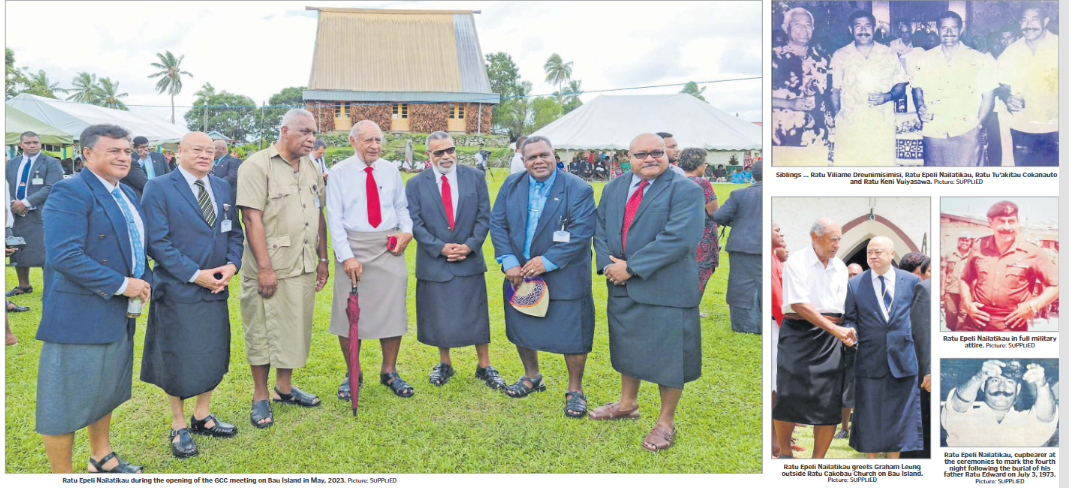
THE death has occurred in Suva of Ratu Epeli Q. Nailatikau, the former President of Fiji, at the age of 84. News of passing has been met with sadness across the country.
Ratu Nailatikau was born was as blue blooded as they come, the scion of royalty spanning two countries.
Tui Nai as he was also known, was the second son of the late Ratu Sir Edward Tugi Cakobau, the son of King George Tupou II of the Kingdom of Tonga and Adi Litia Cakobau, granddaughter of the Vunivalu of Bau, Ratu Seru Epenisa Cakobau. By virtue of his paternal links, he was a nephew of the much-loved Queen Salote of Tonga. His lineage connected him to the chiefly houses of Burebasaga and Tovata.
His mother was Adi Vasemaca Tuiburelevu, of the mataqali Navusaradave, the daughter of Ratu Ilaitia Toroca and Adi Seini Vakaoca. After the Vunivalu of Bau, he was the most senior member of the Yavusa Tui Kaba. He was a gentleman of the old school, a man of two pedigrees.
Following his education, first at the Bau District School, the Draiba Fijian School, and later at the Levuka Public School (LPS), he proceeded to ‘Vulinitu’ or Queen Victoria School. The latter was where the sons of chiefs were sent for education.
It was at LPS during his formative years, that he was to form lifelong friendships and a natural affinity for the other races and students of different backgrounds. My father ran the local butchery at the time and it was in that period that my parents made the acquaintance of Ratu Epeli’s father.
Levuka in the late 1950s and early 1960s was a microcosm of Fiji where race mattered little and everyone got along. The old capital left an indelible impression on his character and his outlook on life in general. I suspect it touched the lives of many others who went on to serve the country with distinction.
There was an inevitability that Ratu Epeli was destined to have a military career. His illustrious father had undertaken military service in the Solomon Islands and subsequently in Malaya (now Malaysia) during the emergency in the 1950s to fend off the communist insurgency which had threatened to overcome the country.
In 1970 he was Equerry to the then Prince of Wales (now King Charles) when he visited Fiji to deliver the country’s instruments of independence to Prime Minister, Ratu Sir Kamisese Mara.
In 1981, Ratu Epeli married Adi Koila Vasemaca Mara, the second daughter of Ratu Kamisese and the Roko Tui Dreketi, Adi Lady Lala Mara. That he and Adi Koila were closely related helped cement the union of two chiefly dynasties.
Ratu Epeli’s military training started in New Zealand and continued through the Fiji Infantry Regiment. By 1987, his natural ability and early showing of leadership saw his progressive promotion, rising through the ranks, to Brigadier General, and later Commander of the Royal Fiji Military Forces.
Upon his retirement from the army, he was appointed Fiji’s High Commissioner to the Court of St James, and accredited as Fiji’s Ambassador to the Holy See, Denmark, Germany and Egypt.
In October 2004, he chaired the first conference of Pacific Parliamentarians in the fight against HIV/AIDS. This was a role that he took seriously and carried out with aplomb.
That a senior chief was prepared to assume a leadership position in such a sensitive space, demystified fears about HIV, and in many ways helped to destigmatise in Fiji, the scourge surrounding AIDS.
It was a role that he relished and took seriously, much to the bemusement of those who felt that it was not appropriate for someone in high office to be the spokesman for the “dreaded disease.”
It was not unknown for him to reach into his breast pocket and pull out a condom at a cocktail reception, shocking those around him.
Some observers may have felt that he was being frivolous, but behind the cheeky humour, he was conveying a serious message about the importance of safe sex.
In June 2005, he was appointed UNAIDS special representative for the Pacific, selected for his high profile and the respect with which he was held in the region.
He was sworn in as Fiji’s Minister for Affairs following the military coup on December 5 2006. It will be for historians to divine his motives, but for whatever reason, he became ensnared in the Bainimarama-Sayed Khaiyum regime.
The regime unashamedly had little compunction about rolling out a raft of laws, many of which remain on the statute books, during his two terms as President. His critics argue that on his watch, indigenous rights were watered down and that he was complicit in dismantling institutions that mattered to the i Taukei.
His character reflected a rare blend of traditional chiefly values and modern leadership principles, making him widely admired across Fiji’s diverse communities.
On April 10 2007, representatives of two of the three traditional Fijian confederacies in the Great Council of Chiefs rejected then President Josefa Iloilovatu’s nomination of Ratu Epeli as the next vice president.
He was nominated because of his record of public service as a former Speaker of Parliament, diplomat and military commander.
It was expected that the GCC would simply rubber stamp the president’s nomination. However, when the chiefs, some of whom were members of the deposed Qarase government met, only the Tovata confederacy supported Ratu Epeli’s nomination.
On the retirement of Ratu Iloilovatu, Ratu Epeli was sworn into office as President on November 5 2009. I doubt whether he realised at the time that he was being thrown into the lion’s den.
Perhaps much later when it was too late, the realisation may have come about that he had been asked to drink from a poisoned chalice. His military background, however, would have insisted that he soldier on and make the best of a dreadful situation.
His term as President was not without controversy.
On November 25 2011, he signed into law the now infamous “Decree 51” which made changes to the Fiji National Provident Fund Act. The practical result of the law was to prevent the courts from entertaining any challenge by unhappy pensioners seeking to take the FNPF to court over changes to the law. Legal actions against the fund were to be treated as if they had been terminated.
A pensioner, David Burness’ attempt to challenge FNPF at the time came to naught because the new rules meant that the decree could not be challenged in the courts.
On March 9 2012, he signed into law changes to the Taukei Trust Fund Act, the effect of which weakened the role of the Great Council of Chiefs in the affairs of the Taukei Trust Fund.
On September 6 2013, Ratu Epeli endorsed Decree No 24 which brought into existence the heavily criticised 2013 Constitution, exercising his powers as President.
His detractors claim he was the handmaiden of the Bainimarama government, content to enjoy the spoils of office while being blithely indifferent to the countless laws he was endorsing as head of state, many of which had far reaching consequences for the human rights of people.
For all his accomplishments, and there were many, he had feet of clay. Like the rest of us, he was not perfect. But his redeeming quality was his humanity.
Even his most ardent critics would concede that one of his endearing traits was his humility and lack of pomposity. Despite holding the highest office in the land, he carried himself with simplicity and grace, always approachable, and respectful to people from all walks of life.
He was as comfortable talking to the shoe shine boys that ply their trade on the streets of Suva as he was conversing with foreign diplomats about superpower rivalries.
Ratu Epeli demonstrated a rare sense of security about who he was that he had no need to preen. Unaffected by the trappings of power or status, he was comfortable being himself.
His humility was grounded in his upbringing within the chiefly system, where leadership is seen as service rather than authority. He never made you feel lesser than him. He was in that regard, an uncommon man with a common touch. He had that extraordinary quality of making you feel special when you met him.
In times of political uncertainty, he remained measured, helping to maintain public confidence in national institutions.
Ratu Epeli also embodied wisdom and calm leadership. He was known for his thoughtful decision-making and ability to listen before acting. Rather than reacting impulsively, he approached issues with patience and a long-term perspective — qualities that align with the iTaukei concept of vakatulewa vakasakiti (wise and considered decision-making). His calm demeanour was reassuring during challenging periods in Fiji’s tumultuous recent past.
When I met him in Bau in May 2023 at the opening of the newly revived Great Council of Chiefs, he was his usual welcoming self. If he had harboured any ill feelings about the GCC’s past ambivalent feelings towards him, he did not show them, and mingled freely with the assembled chiefs.
Equally important was his respect for tradition and unity. As a high chief, he deeply valued the customs and cultural heritage of the iTaukei people, while also promoting inclusivity and national unity across Fiji’s diverse communities. He understood the importance of bridging traditional leadership with modern governance. I remember on one occasion when he had graced my home for dinner. He had had a few drinks and was feeling jovial. He got up and asked the other guests to sing along with him to the favourite tune of “Sisili mai Wainadoi”. He had a mischievous sense of humour, was the life of every party and loved to share jokes.
The legacy of Ratu Epeli Nailatikau is defined by a life of purpose and service.
He ended his life the way he lived it, attending public and family functions and gatherings making it easy for people from all walks of life to warm to him.
Ratu Epeli lived life to the fullest. His assignment on earth has been completed. He would not want us to mourn his passing. He was too practical in life to be sentimental. He would probably wish us to remember him for his humanity and his ability to make you smile.
He is survived by his wife Adi Koila, a son Ratu Kamisese and daughter Adi Litia Cakobau.
Honours: Companion of the Order of Fiji (CF), Order of the Crown, Grand Cross (Tonga), Hon Lt Royal Victorian Order (LVO), Hon Officer of the Order of the British Empire (OBE)
GRAHAM LEUNG, the former attorney-general, has been a regular visitor to the island of Bau over a long period, and is an amateur historian.

