
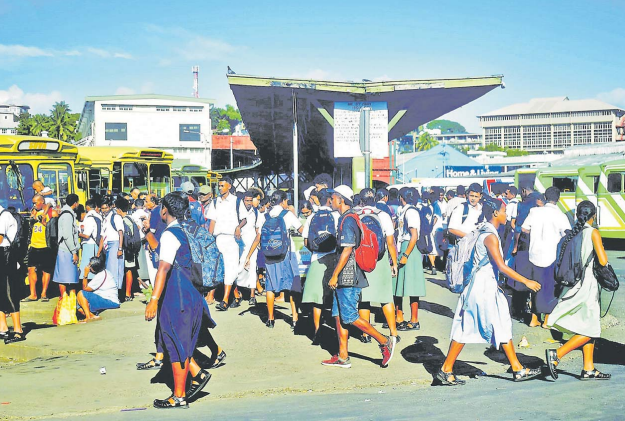
Last month, I was shocked to read that the compulsory education provision in the Education Bill states that parents may be imprisoned for up to 12 months or pay a fine of $2000 if they do not send their children to school. Which genius came up with this suggestion and what inspired that brainwave?
The Fiji Education Commission
MUCH to my relief, the Education Commission feels that compulsory education in the Education Bill is an inappropriate and disproportionate penalty against parents.
The Commission, chaired by Professor Vijay Naidu, has the unenviable task of conducting a “comprehensive, consultative review of Fiji’s education system to reform curriculum, teacher quality, school leadership, and institutional frameworks. Its mission is to create a more inclusive, equitable, and relevant education system.”
Dr Ganesh Chand, Pacific Polytech chairperson concurs with Prof Naidu. Fining or jailing parents whose children miss school is not the answer, he told the Parliament’s Standing Committee on Justice, Law and Human Rights.
Key objectives of the Commission
The Commission has some ambitious goals — evaluating curriculum, school leadership, teacher training, and policy, aligning education with future labour market demands, ensuring that education is accessible to all, promoting unity, national identity, diversity, and ethical citizenship, and gathering input from students, educators, and the community to improve learning outcomes.
Consultative approach
Based on the performance of the previous government, I am concerned that there is a gross lack of consultative approach. From personal experience, suggestions provided to the ministry failed to get any response. While the last Minister for Education, Premila Kumar, was very progressive and innovative, her term was too short for her to make a difference since FijiFirst lost the general election. I am hopeful that the present government will put its money where its mouth is.
What is being done?
The idea of penalising parents of errant students has drawn concern from several education stakeholders. While making submissions on the Education Bill, Dr Vijay Naidu says they have discussed this matter and are suggesting that an investigation be carried out into why there is prolonged absenteeism, and that steps be taken before parents are penalised.
What are the challenges?
My wife and I are former high school teachers. We migrated to the US in 1976 and lived there for 35 years. When we returned to Fiji in 2010, we noticed that the system has deteriorated noticeably. The declining quality of education has led many affluent families to withdraw from public schools, leaving middle- and working-class communities with fewer resources, less influence, and limited momentum for reform.
Responsibility, however, is not one-sided. Social changes within lower- and middle-income households have also played a role. The rise in single-parent families has been particularly challenging. When the sole caregiver is working up to 60 hours a week to make ends meet, there is understandably little time to support homework, attend school meetings, or engage with educators. Even in dual-income households, time and energy are often stretched thin.
The frustration among teachers
Teachers, for their part, have good reason to despair. Despite the monumental importance of their work, many are underpaid. They face administrators who value standardised test scores above all else.
Meanwhile, declining standards for decorum and discipline have made some schools unsafe for both teachers and students. Violence and insubordination create an environment unfit for serious learning. Some parents treat schools as daycare centres or demand good grades for minimal effort. Worse, parents of disruptive students often refuse to ensure their children do not rob others of the opportunity to learn.
Are teachers dedicated enough?
Another harsh truth is that many teachers are unprepared for the job. The education system has failed for so long that many teachers have never mastered the material they are supposed to teach.
Outdated curricula make the issues worse. Most schools still use models from the late 20th century, failing to address how computing, the internet, and artificial intelligence have transformed how we read, write, and learn.
How about our universities?
Our tertiary institutes are also sub-standard. Enrolling underprepared students has lowered academic standards. General education curricula often assume a need for revision, leaving motivated students without the challenge they deserve.
Financial aid has inflated tuition costs while diminishing the value of college degrees. Proposals to cancel student debt signal to universities that they can continue raising prices without consequence, encouraging predatory admission policies that saddle parents with a lot of debt.
Can we make it better?
Nothing short of an academic rocket will suffice. Just as the rocket spurred the urgency to make travel faster, we need a bold initiative to revolutionise education. We need to make K-12 curricula prioritise history, civics, and an understanding of our government. We need to expand vocational training and enhance opportunities for gifted students. We need to raise teacher credentialing standards to ensure advanced subject knowledge. We need to enforce decorum and discipline in schools. We need to revise college accreditation standards to reflect post-graduation success and employment metrics.
Vocational pathways need to be expanded and respected, while gifted students should be offered greater opportunities to stretch their potential. Teacher credentialing standards must be raised to ensure deep subject mastery, and schools must re-establish a culture of decorum and discipline.
Higher education also warrants scrutiny. College accreditation standards should be aligned more closely with meaningful outcomes — particularly post-graduation success and employability.
But most important of all…
But above all, the system hinges on the quality and commitment of its teachers. We need educators who are genuinely passionate about teaching — individuals who can bring energy, purpose, and relevance into the classroom, making students want to be there. Too often today, the process feels transactional, with assignments replacing engagement.
At its core, sustained interest is not imposed by curriculum alone. Curiosity is deeply personal — it cannot be manufactured uniformly. Education becomes truly effective only when it connects with individuals, respond to their questions, and is grounded in a shared framework of values and standards.
Regrettably, such a transformation appears distant. And that, to borrow from Shakespeare, “is the most unkindest cut of all”.
– ARVIND MANI is a former teacher who is passionate about quality education. The views expressed are the author’s and do not necessarily reflect the views of this newspaper. He can be reached at theinspiredteacher9@gmail.com

