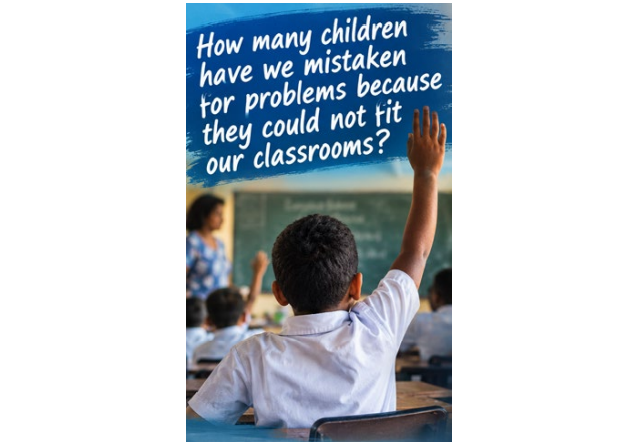
A question followed me out of a professional development day in Nagoya: How many children have we mistaken for problems because they could not fit our classrooms? We were exploring Universal Design for Learning, or UDL, which asks educators to anticipate differences rather than punish them. But I was no longer thinking about the children I teach. I was thinking about a boy in Lautoka, forever raising his hand, forever being told to lower it. That boy was me. I never quite fitted in. He asks too many questions. He has too many opinions. He is too hyper. He thinks he is too smart. Some criticisms were probably deserved; I could be impatient and argumentative, but there is a loneliness in discovering that the parts of you most alive are the parts adults most want silenced.
AT Arya Samaj Primary School, and later Tilak High School, I learned from teachers whose dedication I still respect. I also learned how easily classrooms confuse compliance with character. A neat exercise book sometimes spoke louder than a complicated thought; a quiet child seemed more promising than a restless one. I wanted another explanation, another example, another chance to question the board. What I needed was not permission to misbehave, but permission to think differently.
Perhaps that explains my letters to the editor of The Fiji Times. I needed somewhere to put the anger, frustration and questions too large for a school desk. On paper, nobody could interrupt halfway through a sentence or tell me to accept things. I could argue, disagree and discover my own voice. Writing became a place to release what I had spent so much time trying to suppress.
That is what unsettled me in Nagoya: The possibility that the child was not always the problem. Perhaps the environment had too few doors. I wish someone had looked beyond the talking, the impatience and the questions and said, “maybe he learns and processes differently”. It would not have excused every poor choice. But it might have changed the story I was learning to tell about myself. To be understood, rather than managed, is a gift some children wait years to receive.
UDL begins with a simple premise: Children do not arrive at school as identical minds waiting to be filled. Some benefit from hearing an explanation; others need to see it, handle something or talk it through. Some understand beautifully aloud, but freeze before a blank page. Others need more time, movement or predictable routines before their thinking becomes visible. Good teaching keeps ambitious goals while making more than one path towards them possible.
UDL is not an excuse for abandoning standards, or a claim that everyone has a fixed “learning style”. It encourages varied ways to engage with ideas, encounter information and demonstrate understanding. A child struggling to explain multiplication in writing might first demonstrate it with bottle tops while continuing to develop written explanations. The academic destination remains important. We simply stop pretending that every child must arrive by the same road.
Picture a classroom in Fiji. One child fidgets after a difficult morning at home. Another speaks confidently in Fiji Hindi or iTaukei, but struggles to do so in formal English. One understands fractions when dividing roti yet stumbles over the same idea on a worksheet. At the back sits a quiet child, praised for good behaviour, though nothing has made sense all morning. Which children do we notice, and which do we lose?
We have a habit, hardly unique to Fiji, of naming children before understanding them. Troublemaker. Lazy. Slow. Attention seeker. Labels travel from staffrooms into playgrounds, from reports into dinner conversations, until children begin inhabiting identities adults have prepared. Some eventually stop asking for help because they have been told, repeatedly, who they are. A label is sometimes easier to write than an explanation is to find.
Our islands know more about diversity than many education manuals could explain. We learn through stories on verandas, through song, prayer, farming, markets, sport, kinship and elders. Our children grow among languages and traditions, moving between different expectations each day.
Yet traces of British imperial schooling linger whenever we prize silence above questioning and treat examinations as the final verdict on intelligence. We inherited institutions; we need not inherit every assumption behind them.
This does not mean Fiji has made no progress. We already have a policy on special and inclusive education and laws recognising the rights of persons with disabilities. Teachers and families have fought for dignity long before I attended a workshop in Japan. But policy cannot sit beside a child crying over a task they cannot access. Inclusion must be something a child feels when the classroom door opens, not something printed in a ministry document.
We must also examine what inclusion means. It is not simply placing a child with a disability inside a mainstream classroom and congratulating ourselves. It asks whether that child can participate, communicate, belong and learn without humiliation. Nor is UDL confined to diagnosed disabilities; barriers arise from language, poverty, anxiety, inaccessible materials or unfamiliar methods. A classroom can appear equal while quietly being unfair.
I know the objection. Teachers in Fiji are stretched, facing resource constraints and responsibilities far beyond instruction. Demanding that they redesign everything without time, training or support would be another injustice disguised as reform. UDL cannot become a workshop certificate or an order sent from an office in Suva. School leaders, teacher educators and government must invest in sustained training, accessible materials and practical support.
Still, change need not begin with imported technology. Write instructions as well as saying them. Let children discuss an idea before answering alone. Use shells, bottle tops or leaves to make abstract concepts visible. Give a reluctant writer a sentence starter without abandoning the expectation that their writing will improve. Small changes can interrupt the long, damaging message: “You are not good enough.”
Assessment requires equal courage. If intelligence is recognised only through speed, tidy handwriting and examination marks, we confuse the measurement with the child. Tests matter, as do literacy, numeracy, discipline and effort. But a result should begin a conversation about what to teach next, not end one about what a child might become. Assessment should illuminate learning, not pronounce a sentence on someone’s future.
Here is the uncomfortable truth: Teachers, including me, carry our childhood classrooms inside us. I teach young children in Tokyo now, and know the exhaustion of trying to give 22 minds what they need. Under pressure, I hear the old demand for quiet and recognise the temptation to reward whoever asks least of me. I must examine when my need for order threatens to outweigh a child’s need to understand. Remembering my younger self does not automatically make me a better teacher. It merely removes the excuse of not knowing what exclusion feels like. Before calling a student difficult, what if we asked what the difficulty was telling us? Perhaps the boy interrupting needs challenge, support or a firmer boundary delivered without shame.
Perhaps the girl who never volunteers has ideas worth hearing in another language or another way. We cannot reach every child perfectly. But we can refuse to make one narrow definition of a good student the price of belonging.
I keep thinking of that boy in Lautoka, compressing his questions into letters for a newspaper. He did not need adults to applaud every interruption or excuse his mistakes.
He needed somebody to see that curiosity was not an enemy to defeat.
Somewhere in Fiji today, another child is deciding whether to raise a hand, swallow a question or give up altogether. What we do before that hand falls may shape far more than a school report.
n ASHNEEL JAYNESH PRASAD is a Fiji-born New Zealand citizen currently working as a teacher in Shinagawa-ku, Tokyo, Japan