In 2025, I went to India searching for peace. The truth was less graceful. I went because something inside me had grown tired. I had carried too much for too long: My own mistakes, my restlessness, my private shame, and the inherited ache of people who once left India and never came back. I wondered whether peace was something one had to travel toward, earn, beg for, or suffer into existence.
FOR a Fiji-Indian, India is never just another country. It is memory and mythology, wound and womb, longing and argument. It is the place our ancestors left, often without knowing what waited. Between 1879 and 1916, more than 60,000 Indians were taken to Fiji under the indenture system, a system they called girmit, from the English word agreement. But what kind of agreement can truly exist between hunger and empire?
From that rupture, a new people began to form. Not fully Indian in the old sense, never fully accepted in the colonial sense, and yet stubbornly, beautifully, defiantly Fiji-Indian. We were made from cane fields, coolie lines, broken bhojpuri, remembered gods, borrowed soil, and women who carried entire civilisations in the edge of their sari. We were made from people who could not return, so they built return into ritual. Faith was not decoration. It was oxygen.
So when I went to India, I did not go alone. I carried my aaji and nani. I carried women who lit diya in Fiji while rain battered tin roofs. I carried men who cut cane under a sun who did not care for their names. I carried the child I had been in Lautoka, the boy who wondered whether the gods could hear prayers spoken in Fiji Hindi, English, and silence.
Ayodhya was the moment I thought would heal everything. And then, one day, I saw him. I felt him. Not only with my eyes, but somewhere deeper, somewhere I had no language for. Ram Lalla, the child-god I had grown up hearing about, the name spoken in Fiji homes during weddings, deaths, exams, departures, and quiet despair, was suddenly before me.
But I must confess something that still weighs on my heart. I was selfish. I could not wait any longer. I let my New Zealand passport grant me a privilege I perhaps did not deserve. I took the VVIP line, bypassing thousands who had waited their entire lives. My wait lasted seconds; theirs lasted hours. That moment forced me to confront an uncomfortable truth: Pilgrimage can reveal devotion, but it can also expose privilege. Faith should humble us, but too often we carry worldly hierarchies into sacred spaces and call it convenience.
And yet, when I stepped inside and my eyes met Ram Lalla, time stopped. The world faded. It was just me and my Ram. Tears came before I understood why. I was not crying because I was happy. I was crying because, for a few seconds, I felt impossibly, unbearably home.
I thought of my ancestors then, the girmitya who left India on ships and never returned. Those who whispered Ram Ram while tilling foreign land. Those who may have wept for Ayodhya without ever seeing it again. They never got to stand before Ram Lalla. But I did. In that moment, I carried their longing, their devotion, and every sacrifice that had made my arrival possible.
The Sarayu deepened that feeling. Standing by its waters, I felt I was not merely looking at a river, but at a witness to time itself. As people chanted Jai Shree Ram around me, I realised that faith is not simply about celebration. It is also about memory, and what survives after kingdoms fall.
That was where my journey became critical, not only devotional. India overwhelmed me with its holiness, but it also unsettled me with its contradictions. I saw devotion so pure it could break the heart, and systems so unequal they could harden it again. I saw the divine everywhere, but I also saw how easily human beings build gates around God. If the girmitya taught us anything, it is that faith belongs most fiercely to those who have been denied everything else. No line, passport, title, or donation receipt should decide who reaches God first.
Kashi was different. Varanasi, Banaras, Kashi: three names, one ancient ache. I was not looking for answers exactly. I was looking for surrender. At sunrise, watching the Ganga move like liquid memory, I felt the weight of countless seekers before me. The river did not ask what passport I held, what mistakes I had made, or what grief I carried. It simply flowed.
In Kashi, I prayed for my ancestors. I prayed for those whose names were misspelled on immigration passes by colonial hands that could not hear them properly. I prayed not that we become rich or powerful, but that we become whole. That we stop apologising for being born from displacement. That we stop treating our Fiji Hindi, our food, our songs, our stories, and our hybrid selves as less pure than what was left behind.
At Sankat Mochan Temple, I thought of Tulsidas and Hanumanji. At the Tulsidas temple, surrounded by Ramayan inscribed into walls, I felt how scripture travels. The Ramayan that lived in India also crossed the kala pani. It entered Fiji not as a museum piece, but as a living companion. It sat in mandali. It shaped weddings. It taught our people that exile was not the end of the story. Ram returned from the forest. Hanuman crossed oceans. Perhaps that is why these stories clung to us. We too were ocean-crossed people, trying to turn exile into meaning.
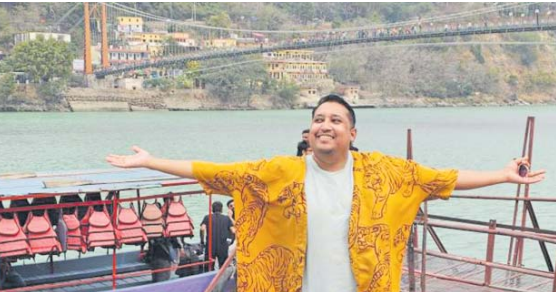
Rishikesh gave me questions rather than answers. Sitting by the Ganga, I called her Maa, though I wondered whether I deserved to. I poured Ganga-jal over a Shivling and felt the absurdity of the act. Who was I to offer water to the one from whose jata the Ganga descends? It was like trying to illuminate the sun with a candle. But then I understood: The act was not for Him. It was for me. I had not come to erase my flaws. I had come to stop pretending they did not exist.
At Har Ki Pauri in Haridwar, the aarti felt like a storm made of fire. Bells rang. Brass lamps rose. Diya floated away like small, brave souls. The crowd swallowed my name, my ego, my questions. I had returned there during Maha Shivratri, during the sacred season of the 2025 Maha Kumbh, when millions moved in search of cleansing, merit, memory, and moksha. But even there, I wondered: What are we willing to let go of, and what do we only pretend to surrender?
Vrindavan softened me. In the dust of Braj, I felt less like a pilgrim and more like someone remembering a song from another life. At Baanke Bihari Mandir, darshan was brief, almost unbearably brief, but in that instant I saw Krishna not as an idol but as mischief, tenderness, beauty, and longing itself. In Mathura, where tradition holds Krishna was born, I thought of the boy who once sat at the Hare Krishna temple in Kumeu, waiting and praying. I wanted to tell him: one day you will reach here.
Govardhan reminded me that faith is not passive. It is a radical story of protection, community, and defiance. It is about standing against the storm, even when the storm is sent by power itself. For Fiji-Indians, that matters. Our ancestors survived because someone was always lifting a mountain: A grandmother preserving language, a father working beyond exhaustion, a mother turning scarcity into food, a community building schools and temples from almost nothing.
And yet, after Ayodhya, Kashi, Rishikesh, Haridwar, Vrindavan, Mathura, and Govardhan, I realised something that humbled me. I had gone to India to find peace, to make penance for myself and perhaps for my ancestors too. But the deeper I travelled into India, the more clearly Fiji called back to me. Not loudly. Not dramatically. Just with the quiet certainty of a grandmother calling from the kitchen.
My peace was not only in Ayodhya. It was not only in Kashi. It was not only in the Ganga, the Sarayu, or the dust of Vrindavan. My peace lay near a small house that used to be near the Saru church, under the ber tree. It was where memory had become soil. It was where my people had laughed, cooked, prayed, argued, aged, and loved. It was where aaji and nani existed not as ancestors in an abstract sense, but as voices, hands, recipes, stories, and warmth.
This is the truth I brought back: For descendants of girmit, India may be the ancestral homeland, but Fiji is the land that made us. Our ancestors left India, but they did not simply remain Indian elsewhere. They became something new. They turned trauma into culture. They turned bhojpuri into Fiji Hindi. To honour them is not only to return to India. It is to honour the Fiji they built with bloodied hands and stubborn hope.
That is why any spiritual journey must eventually become ethical. It cannot end with private peace alone. If pilgrimage does not make us kinder, it is tourism with incense. If prayer does not make us more honest, it is performance. If remembering girmit does not make us critical of exploitation today, then we have reduced our ancestors to garlands and speeches. They deserve justice in how we live.
I went to India hoping to be cleansed. Instead, I was returned to myself. I learned that peace is not escape. It is reconciliation. I learned that ancestors are not only behind us; they are beneath us, holding the ground steady. I learned that home is not always the place we romanticise from afar. Sometimes it is the place we outgrew, misunderstood, or left too quickly. Sometimes it is a vanished house near Saru church. Sometimes it is the shade of a ber tree.
One day, when I take my final travel to the other side, I do not know what theology will prove correct. But I know what I hope for. I hope I find myself beneath that ber tree. I hope the air smells of rain on Fiji soil. I hope my aaji and nani are waiting there, not as ghosts, but as home itself. And I hope they smile and ask, “Aa gaya tu?”
Yes, I will say. I went everywhere. I searched in Ayodhya, Kashi, Haridwar, Rishikesh, Mathura, Vrindavan, and Govardhan. I carried your names. I cried for you. I prayed for you. I tried to make sense of the journey that began when our people crossed the black waters.
And then, finally, I came home.