
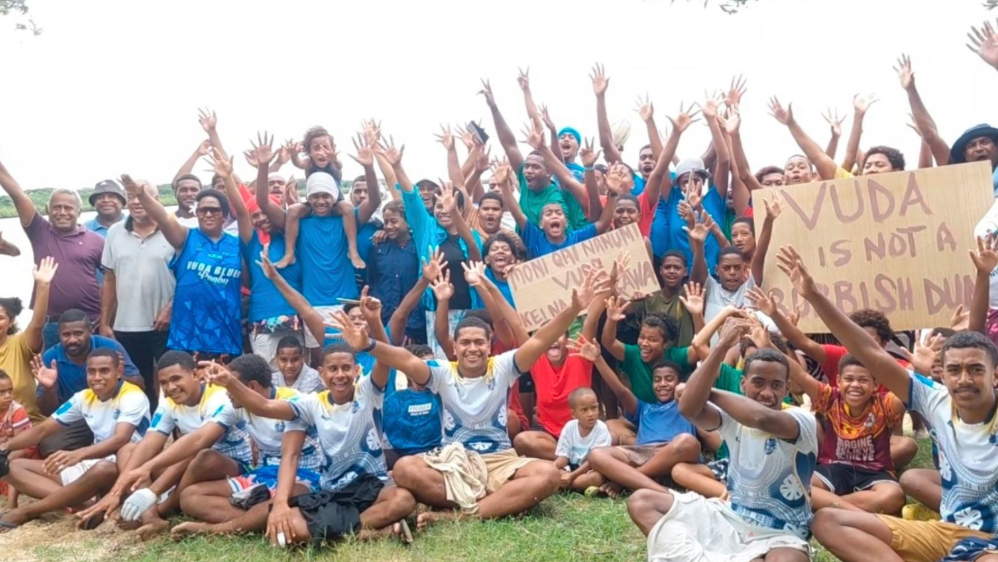
A paid communications consultant, a sacred first-nations shore, a $F4.5billion renewable program already at tender, and a 700,000-tonne arithmetic gap — the questions TNG’s May 11 right of reply will not answer.
The argument that avoids the question
On May 11 2026, The Fiji Times published an article by Cheerieann Wilson, a paid communications consultant for TNG Holdings Fiji, under the heading: “Can Fiji turn its waste problem into the answer to its energy crisis?” That framing is advocacy, not rebuttal. It positions every critic of the Vuda incinerator as an opponent of Fiji’s energy future — a construction designed to win before reasoning begins. Wilson never engages the threshold question: not whether Fiji can develop energy-from-waste capacity somewhere, but whether Vuda can host it. Since publication, TNG’s representatives have argued that Australian legal standards do not apply in Fiji. They are correct. But the implication that Fiji’s framework is therefore more accommodating demands scrutiny. The same investors, the same commercial logic, and the same project were rejected by seven Australian regulatory bodies over seven years. A developing nation’s framework is not a loophole.
Disclosure, conflict, and a legal threat
Wilson’s article disclosed in a footnote that she is a paid TNG consultant. That partial disclosure was necessary but insufficient. She is also a former Deputy Director of Communications for the People’s Alliance Party and a former Media Advisor in the Office of the Prime Minister. Further, she is reportedly married to the PS of the Ministry of Lands and Mineral Resources, which is not an issue, except that there would be a direct perception of a conflict-of-interest being so close to the Cabinet members, who are backing the project in principle. These affiliations are matters of public record. On May 5 2026, hours after “Poison, Process and Broken Promises” appeared, Wilson wrote to editor Fred Wesley listing eight allegations of factual error and threatening legal action. Not one has been sustained by independent documentary evidence. The submission period was 21 working days — the legislated minimum, not the 63 days TNG claimed. TNG did not obtain the retraction it demanded. It obtained full editorial space for advocacy, written by its paid consultant, published in the paper where she once served as Deputy Chief of Staff.
The sacred shore of Lutunasobasoba
The shoreline at Vuda Point is where Lutunasobasoba, the founding ancestor of the iTaukei people, first set foot on these islands. It is the point of origin of iTaukei Fijian civilisation, recorded in oral tradition as the most sacred coastal site in the Fijian archipelago. Vuda Marina, whose chief executive Adam Wade sits on the Fiji Hotel and Tourism Association’s 2025–26 board, operates directly at Vuda Point. First Landing Beach Resort, another FHTA member, stands four minutes on foot from the marina. The proposed 84-hectare industrial complex lies within direct sight of the Sheraton-Denarau corridor, the passenger gateway to the Yasawa and Mamanuca island chains, and Nadi International Airport. Tourism generated $F2,813.8million in 2023, approximately 40 per cent of GDP. Minister Gavoka and the full tourism sector have recorded their opposition on location grounds alone. Nearly 9000 Fijians signed the petition. TNG’s own GHD-prepared EIA concedes that stronger cyclones and rising sea levels could pose serious risks to the site if global emissions remain high — an admission that alone warrants refusal.
The cyclone hazard the EIA ignored
As a WMO-accredited Class 1 Professional Meteorologist with tropical cyclone qualifications from the University of Miami, Florida USA and the NOAA National Hurricane Centre, Coral Gables, I state the following on the public record. Vuda Point is an open, low-elevation coastline facing west and northwest into the principal landfall corridor of South Pacific tropical cyclones. Immediately inland, Mount Evans — Koroyanitu, meaning “Village of the Devil” — rises suddenly from near sea level to 1195 metres, forming a vertical wall behind the coastal plain. This sudden mountain barrier accelerates onshore winds at its base by 50 to 60 per cent above sustained measured speeds, producing phenomenal destructive force at precisely the elevation of the proposed facility. During a Category 4 or 5 landfall at or west of Vuda, storm surge combined with extreme low barometric pressure and sustained wave action can raise effective coastal sea levels by 20 to 30 metres above the shoreline. Category 5 Tropical Cyclone Winston in February 2016 — at 295 kilometres per hour the most intense Southern Hemisphere cyclone on record — demonstrated the full destructive capacity of such a system. The 1982–83 season produced 19 named cyclones against a climatological average of nine; I was on the operational bench at the WMO Regional Tropical Warning Centre, Nadi, throughout. In September 2009, present in Samoa following the magnitude 8.1 Tonga Trench earthquake, I witnessed tsunami runup heights of 22 to 30 metres kill 192 people and drive coral and volcanic boulders of five tonnes or more hundreds of metres inland. The Vuda coastal plain — sandwiched between open sea and a vertical mountain wall at almost sea level — faces identical exposure. No tropical cyclone hazard assessment appears anywhere in the 1,528 pages of TNG’s GHD EIA. I am prepared to provide expert evidence to the Technical Review Committee on this critical and unresolved omission.
The 700,000-tonne arithmetic
TNG’s EIA proposes processing 900,000 tonnes of waste annually to generate 80 megawatts. Fiji generates approximately 190,000 to 200,000 tonnes of municipal solid waste per year. The 700,000-tonne annual deficit cannot be bridged by legacy stockpiles, which are finite and cannot sustain continuous industrial combustion across a 25-year operating life. TNG’s EIA states the facility “is capable of operating on domestic and legacy waste streams without reliance on waste imports” — a sentence engineered to avoid disclosing where 700,000 tonnes per year will originate.
Fiji is a signatory to the Waigani Convention, prohibiting importation of hazardous waste from developed to developing Pacific nations. TNG has provided no binding written identification of overseas jurisdictions committed to supplying that deficit. Every electricity output figure and energy security claim in TNG’s submission is predicated on 900,000 tonnes of annual fuel. Without source identification for 700,000 of those tonnes, the entire proposal rests on an undisclosed and unresolved premise.
The manufactured base-load gap
Wilson argues that solar and wind are intermittent, and only TNG can provide the continuous base-load power Fiji’s grid requires. That is false. The same $F4.5billion renewable energy program she cites includes the Qaliwana Hydropower Project and the Vatutokotoko Lower Ba River Hydropower Project — two hydroelectric facilities producing precisely the continuous, weather-independent, 24-hour base-load generation she presents as TNG’s unique contribution. Both are at the international competitive tender shortlisting stage. The gap Wilson manufactures does not exist. Wilson cites Germany, Sweden, and Denmark as precedents. Those countries carry some of the highest household electricity prices in the developed world, a direct consequence of energy infrastructure capital costs embedded in consumer tariffs across decades. TNG’s three-revenue-stream model — tipping fees, grid electricity sales, and tariff entitlements — is a commercial arrangement, not a public utility. The long-term cost-bearing party, as in every comparable jurisdiction, is the Fijian electricity consumer.
Questions the committee must answer
The EIA Technical Review Committee’s mandate is scientific assessment and regulatory determination, not ratification of a pre-signalled Cabinet position. The Office of the Prime Minister has confirmed publicly that if the EIA process is satisfied, the project will proceed.
Every member of that body now knows the Prime Minister’s Office has signalled conditional endorsement. That is not an independent review. Before any finding is issued, five questions require binding, documented answers from TNG: the overseas jurisdictions formally committed to supplying 700,000 tonnes annually; legally binding disposal arrangements for the 150,000 to 360,000 tonnes of toxic ash generated annually at a reef-adjacent coastal site; independent demand modelling demonstrating a base-load gap that Qaliwana and Vatutokotoko do not already close; an independent bioaccumulation and atmospheric dispersion study assessing dioxin exposure pathways for Saweni, Vuda, Lovu, and Namaka; and a comprehensive independent tropical cyclone and tsunami hazard assessment for the proposed site. The sacred shore of Lutunasobasoba is still waiting for an honest answer.
Dr Sushil K Sharma BA MA MEng (RMIT) PhD (Melbourne) is a World Meteorological Organisation (WMO) Accredited Class 1 Professional Meteorologist. Former British Aerospace, The Royal Saudi Air Force and Bahrain Meteorological Service Aviation Meteorologist. Former Associate Professor of Meteorology, Fiji National University, and Operational Meteorologist and Manager, Climate Research and Services Division, Fiji Meteorological Services. The views expressed are those of the author alone and do not represent the views of this newspaper.

