
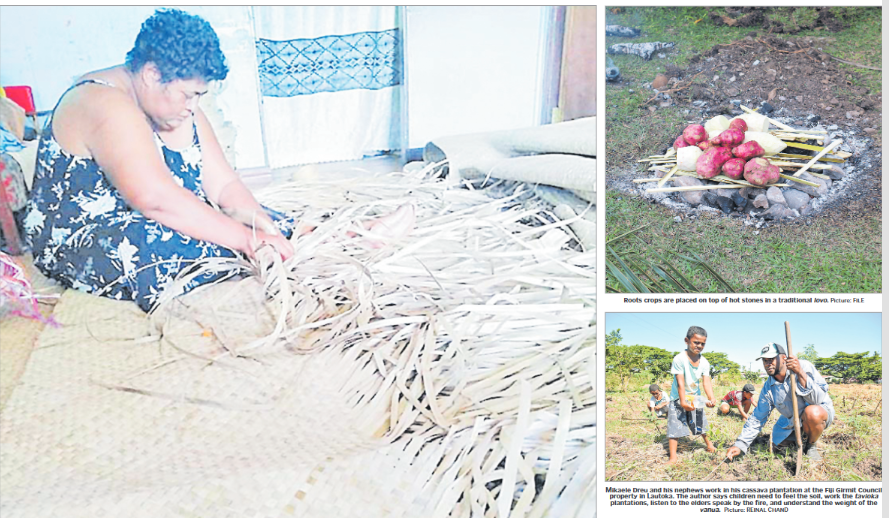
The rustle of construction paper and the innocent chatter of children filled my classroom the other week. Our school was celebrating International Day, and as part of the festivities, I decided to root my students in the soil of the Pacific. I wanted to give them something tangible, something undeniably ours, so I designed an art and language lesson centered on Pasifika mat making. We used simple paper cutouts to simulate the intricate weaving of the Samoan ‘ie or our own Fijian ibe. As I moved between the desks, watching small hands awkwardly interlace the strips of paper — mimicking the profound, rhythmic over-and-under motions our ancestors used with dried voivoi leaves — a sudden, paralysing realisation hit me.
My nephew doesn’t even know how to do this.
He doesn’t know the texture of the pandanus, the patience required to prepare it, or the silent, generational conversations that happen when women sit together to weave a mat meant for a birth, a wedding, or a funeral. As I stood there in my brightly lit classroom, a cold terror gripped my heart: this art form, this sacred geometry of our people, will probably end with me in my family lineage. I am the bottleneck. We are the bottleneck.
To break the heavy silence in my own head, I pivoted to teaching the class basic iTaukei words. I wrote them on the board, sounding them out loud: Bula. Vinaka. Yadra. The kids parroted them back with enthusiastic, clumsy accents. But as I listened to them, another heartbreaking truth surfaced. Ours is a fiercely phonetic language, an oral tradition where history, emotion, and survival are carried not in ink, but in the breath. Our ancestors passed down these skills, this profound vocabulary of existence, orally and through art. But how long can we realistically keep it alive when the chain of transmission is breaking in real-time?
From our food cooked in the lovo, to our masi cloth, to the intricate carvings of our tanoa, to the very cadence of our language — everything about us is so radically, beautifully different from the rest of the world. We are a people of the ocean, a people of the earth. But if you do not know our culture, if you do not live and breathe it, then the significance of it dies with us. A woven mat becomes just a rug. A carved bowl becomes just wood. Bula becomes a cheap greeting thrown at a tourist in a resort lobby, rather than a profound wishing of life and health upon another soul.
Today, we are fighting a war on two fronts, and we are losing.
On one front, there is the literal rising tide. Due to global warming, our history, our culture, and our sacred norms are quite literally going under the water. Our ancestral burial grounds are being washed away by king tides. The coastal villages where our legends were born are being relocated. When the land — the vanua —is swallowed by the sea, the culture tethered to it drowns as well. We are watching our heritage become climate casualties.
On the other front, we are haemorrhaging our identity to the snare of English and the illusion of greener pastures. Due to mass migration overseas, our diaspora is growing, and our language is dying on the tongues of our children. English is the language of commerce, the language of the internet, the language of “success.” In our desperation to survive and compete in a globalised world, we have willingly placed our mother tongue on the sacrificial altar. We speak to our children in English so they won’t fall behind in school, utterly blind to the fact that we are ensuring they fall behind in life, forever untethered from their roots.
Look at Fiji’s current commitment to our arts, heritage, and culture. We proudly parade it when it brings in the tourist dollar. We dress up in traditional attire for the cameras, perform a meke for the guests, and sell mass-produced handicrafts in Nadi and Suva. But when the tourists leave, what remains? Superficial preservation for the sake of capitalism is not preservation; it is exploitation. We have reduced our soul to a commodity. We treat our culture as a museum exhibit rather than a living, breathing entity that requires daily nourishment.
This is the time to act. We cannot afford the luxury of passive hope. We need a rigorous, uncompromising system to keep our culture alive for our future generations, and that system must begin in the very place we are currently losing them: our schools.
We need to purposefully and explicitly implement indigenous knowledge from a young age through our schooling systems. And I do not mean tossing in an hour of “culture class” on a Friday afternoon. We need to integrate it into our everyday learning. This is not a separate subject. This is us. It needs to be the foundation of our entire curriculum. Why are we teaching our children about European history before they even know the names of the indigenous chiefs who navigated the greatest ocean on earth? Why are we teaching them Western biology without teaching them the traditional names and medicinal uses of the flora growing in their own backyards?
The tragedy deepens when you look at how we validate knowledge. We treat foreign artists, Western academics, and expatriate consultants with a reverence that borders on sycophancy. We put them on an impossibly high pedestal, paying them exorbitant fees to come to our islands and tell us who we are. Meanwhile, we forget our true artists. We ignore our master weavers, our carvers, our traditional healers, and our storytellers. They are growing old. Their hands are shaking, their voices are weakening, and they are dying in our villages, taking libraries of unwritten knowledge with them to the grave.
We need to look inwards. We need to put our own people in the limelight. We cannot let them give up on our heritage simply because we don’t pay them enough or respect them enough to see their genius. We must institutionalise our respect. There desperately needs to be more Bachelors of Pasifika Art, indigenous epistemology, and corresponding heritage degrees introduced and heavily funded at the University of the South Pacific (USP), Fiji National University (FNU), and the University of Fiji.
But it cannot just be academic theory written by scholars in air-conditioned offices. We need to bring these local, grassroots artists and storytellers into the lecture halls. Give them professorships based on their lived expertise, not a piece of paper from a Western university. Empower them to impart their knowledge to the current and future generations. We must bridge the gap between the village and the university, proving to our youth that traditional knowledge is not just “folklore”—it is a highly advanced, sophisticated science of living.
Under the guise of modernisation, we have been brainwashed into believing that Western academia is the only valid form of intelligence. What an absolute, tragic lie. Our ancestors knew so much about astronomy, reading the stars to navigate thousands of miles of open, terrifying ocean without a single compass. They possessed an encyclopedic knowledge of medicine, curing ailments with barks, leaves, and roots centuries before the invention of the pharmacy. They understood the sustainable rhythms of fishing, reading the moon phases and the tides to ensure the reef was never depleted. They possessed a profound, holistic brilliance without a shred of Western academic validation. Frankly, they knew so much more about how to exist in harmony with the earth than we do now, with all our degrees and smart phones. In our blind, desperate rush to “modernise,” we are letting true, tested, survival-grade knowledge die out.
To stop this bleeding, we have to force a reconnection. There should be mandatory, deeply immersive visits from schools to local villages. I do not mean a superficial field trip where kids take photos and leave. I mean mandatory periods where our youth go to learn, live, and spend real time with our past. They need to sit on the ibe they helped weave. They need to feel the soil, work the tavioka plantations, listen to the elders speak by the fire, and understand the weight of the vanua.
Because if we don’t understand our past, we have absolutely no future identity. We will become a generation of ghosts — hollow echoes of Pacific Islanders, walking around with brown skin but entirely colonised minds, speaking a language that isn’t ours, living by rules that don’t fit our spirit, and drowning in an ocean our ancestors once commanded.
I refuse to accept that fate. I refuse to look at my nephew and accept that he will be the first in a thousand years to forget the rhythm of our people. The fire is dying down to embers, but it is not out yet. It is time we blow life back into it. It is time we reclaim our classrooms, our universities, and our pride. We are the custodians of the most beautiful, complex, and resilient culture on earth. We cannot, we must not, let it die with us.
ASHNEEL JAYNESH PRASAD is a Fiji-born writer and citizen of New Zealand who works as a teacher in Tokyo, Japan.

