
The Terms of Reference for the 2026 CRC are as stated in the Government Gazette Vol. 27 No. 21 (Friday, March 27, 2026) requiring the Commissioners to “inquire into and examine the democratic deficit of the 2013 Constitution of Republic of Fiji, as identified by the Supreme Court of the Republic of Fiji”.
While the above might seem unduly restrictive to the Supreme Court Opinion (of 29 August 2025), the CRC is also required to inquire into and report on the perspectives from Fiji’s diverse communities into a wide-ranging set of eight issues, much broader than what the Supreme Court was tasked with.
Following my submission to the CRC on July 6 2026, I covered issues (A) to (F) below (the contents of this article) and G in Part II coming next Saturday, so as to result effectively in a “new” constitution for Fiji.
(A) What constitution does Fiji have today?
(B) An Upper House or Senate
(C) Removal of cancerous Decrees denying the 2012 Pensioners their day in court
(D) Removal of immunities in the 2013 Constitutions not approved by Parliament
(E) Removing the over-riding role of the military: the 2013 Constitution Cap 131 (2).
(F) Remove strange discretionary power of Speaker in Parliament.
Coming in Part II next Saturday:
(G) An electoral system for the people from the people.
(H) Have the 2026 Constitution approved by the Parliament and the people of Fiji.
MY recommendations are not new. They have been all written about in more than 600 articles published between 1996 and now and published in four books downloadable for free from my website NarseyOnFiji:
1. The Challenges of Growing the Fiji Economy 2017.
2. A Fair Go For All Fiji. 2022.
3. Our struggles for Democracy in Fiji, Rule of Law and Media Freedom 2022.
4. Towards a Decent Fiji. 2023.
Fiji’s sad history of coups leading to the 2025 Supreme Court opinion
At the heart of Fiji’s constitutional changes since political independence from Britain in 1970 have been military coups, with ethnic tensions being central in 1987 and 2000, but not in the 2006 coup.
No one disputes the facts regarding the 1987 coup by Sitiveni Rabuka; the imposition of the 1990 Constitution, its replacement by a revised consensus 1997 Constitution approved by the Fiji Parliament (both Houses) with immunity granted to Rabuka and his associates, as well as others who had opposed the 1987 coup.
No one disputes that after the 1999 Elections when Rabuka lost power, the Fiji Labour Party of Mahendra Chaudhry then formed Government. But he held office for just one year when a 2000 coup by a unit of CRW soldiers, backed initially at the highest levels of the RFMF and key elements of the GCC but led in Parliament by civilians (prominent being George Speight and Jo Nata), removed the Chaudhry Government.
There was no popular uprising against this treason. The real leaders have never been identified despite the existence of a Truth and Reconciliation Commission.
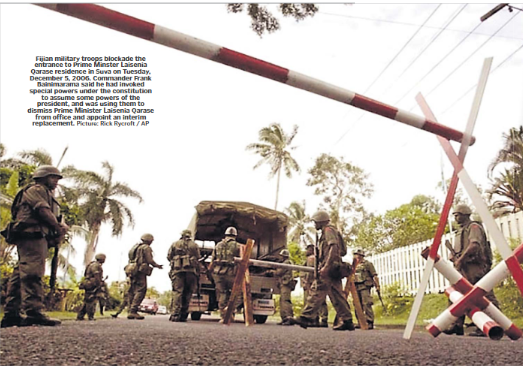
No one disputes that in 2006 the lawful multi-party Government of SDL (Qarase) and FLP (with Chaudhry personally staying out) was removed by Commodore Bainimarama. There was no popular uprising against this coup, with the GCC also remaining quiet.
Then when the Fiji Court of Appeal ruled in 2009 that the 1997 Constitution had not been abrogated the Bainimarama Military Government by military might then ruled Fiji for eight years.
Not publicly acknowledged is that major local business houses (with all the usual prominent names) donated millions to the coffers of Bainimarama’s FijiFirst Party and actively courted the support of senior RFMF officers.
The military Bainimarama Government then imposed the 2013 Constitution which was never ratified by any Parliament (despite the Bainimarama Government being in control from 2014 to 2022); and never ratified by a Referendum despite there being three national elections in 2014, 2018 and 2022 during which Referenda could have been easily held.
In total contradiction, to change any element of the 2013 Constitution there needed to be three quarters majority in the Parliament and three quarters majority of registered voters in a Referendum (a virtual impossibility).
The 2013 Constitution also granted a whole range of immunities for unspecified acts by the Bainimarama Government agents (but not their opponents) from 2000 to 2014.
Elections were held in 2014 and 2018 returning Bainimarama’s FijiFirst Party to Government. There were grave concerns about the fairness of the elections and the climate of fear prevailing. Finally, the 2022 Elections saw FFP defeated narrowly by a coalition of PAP, NFP and SODELPA.
In the March 2025 sitting of Parliament, the Fiji Government tabled the Constitution
(Amendment) Bill 2025 (Amendment Bill) which sought to amend the amendment process in section 160 (by deleting “three quarters” and substituting “two thirds” in s 160(2)(b) and deleting subsections (3) to (6) and repeal the amendment prohibition in section 159 (by deleting s 159(2)(c).
The Bill was defeated on its second reading hence the Supreme Court Opinion.
The 2025 Supreme Court opinion
The Coalition Government then through the Office of the Solicitor General (OSG) sought an “Opinion” from the Supreme Court on five issues, the first four being merely conditions for changing the 2013 Constitution and the fifth on the validity of the 1997 Constitution. The Supreme Court went further.
The Panel of Supreme Court judges argued that the conditions for change were too onerous making the Constitution unresponsive to people’s changing needs. The Opinion ruled that a two thirds majority in Parliament and a simple majority in a Referendum should be enough to keep the constitution “alive” and responsive to changing needs over time, but also not too easy to change.
I disagree with the same Supreme Court Opinion that while the 1997 Constitution has not been lawfully abrogated, “events have overtaken the 1997 Constitution”. Any rational person must ask: what “events” can “overtake” a constitution?
This is however a moot point now with the Supreme Court ruling otherwise. The Supreme Court has argued that by a number of criteria and arguments (which they discuss and seem quite plausible- “too much legal water has flowed under the bridge”) they have determined that the 2013 Constitution must now be regarded as the “common law” of Fiji.
The Supreme Court asserted that this was a “determination” and not just an “Opinion”.
While I personally disagree with the Supreme Court Opinion that the 2013 Constitution is still in place, I believe that Fiji can move forward now with fundamental changes (B to (G) listed above, which results effectively in a “new” constitution.
The changes would need to be passed by Parliament (with two thirds majority) and a Referendum (simple majority), as determined by the Supreme Court Opinion.
(B) Must re-establish Upper House or Senate
One of the undoubted benefits of the 1970 and 1997 Constitution was that Parliament had an Upper House (Senate) which was an excellent “checks and balance” mechanism for the Lower House of elected MPs. The authoritarian Bainimarama Government saw no need for an oversight body in their 2013 Constitution.
It is puzzling that neither the Government nor the “Opposition” have shown any urgency for the restoration of the Upper House. Do they enjoy the lack of oversight and accountability to the public?
I would strongly recommend that the 2026 CRC explore with the public the full restoration of an Upper House in the new 2026 Constitution, discuss what could be the components and what would be its key functions. They can take guidance from the 1970 and the 1997 Constitutions which both had parliamentary legitimacy.
I suggest that as before there could be nominations from the Prime Minister (8), Leader of the Opposition (7), the GCC (5) and Council of Rotuma (1).
I suggest that there also be 10 from the religious organizations: Christian churches (7), Hindu (2) and Muslim (1) roughly their support throughout Fiji as indicated by FBS data.
I believe that the representatives of religious groups in Fiji will provide far more moral and ethical guidance to Parliament than political parties or even the GCC (which has had a chequered past in previous coups (such as in 1987 and 2000).
The Great Council of Chiefs
While GCC has been restored by the Coalition Government, it has no role in the Constitution.
In a previous article (“GCC and Chiefs still failing Fijians”, FT 21 March 2015) I gave my own assessments of the effectiveness of the GCC in leading the iTaukei according to 10 criteria I personally thought important. My total score only came to 27 out of 100.
I suspect even today the GCC despite some good leaders like Ratu Viliame Seruvakula and Ratu Naulu Mataitini, the GCC would struggle to reach 40 out of 1000.
Given that the iTaukei representation in Senate will be further strengthened by the religious organisation nominees I suggest above, I believe that the GCC representation can be reduced to 5.
Recollect that when Bainimarama closed this institution down, there were no public protests from the iTaukei and the GCC went away quietly, while a prominent few continued doing national mischief under Bainimarama.
Overall there will be a significant majority of iTaukei representatives in Senate, even higher than their share of population.
(C) Removing cancerous decrees against 2012 pensioners
The Coalition Government has already removed some undesirable Decrees imposed by the Bainimarama Government, such as the Media Decree.
It is just as important to remove Decrees 51 and 52 which the Bainimarama Government imposed so as to break the lawful contracts that the 2012 Pensioners had with FNPF and to throw out the late David Burness case which was already being heard by the High Court. This has never been done before in the judicial history of Fiji
It is absolutely critical for the Coalition Government or any Fiji Government to remove from the Constitution any cancerous legislation that denies Fiji citizens their right to take their perceived grievance to court – to be at least heard, whatever the court may subsequently decide on their case.
(D) Removing the immunities not approved by Parliament?
The Supreme Court Opinion strangely ruled that no changes may be made to the 2013 Constitution’s provisions for immunity. Their arguments are extremely dubious and challengeable.
It cannot be disputed (also acknowledged by the Supreme Court Opinion) that “punishment” for those who break the rule of law, is crucial to the existence of the rule of law: as a deterrence of the offender and others, for retribution and reform of the criminal, all ultimately with the objective of protecting society. But the 2013 Constitution give wide-ranging immunity to Bainimarama and all coup collaborators stretching back not just to the 2006 coup but also to the 2000 coup and mutiny.
I call on the CRC to ask why there has there been no “punishment” for (a) The 5 deaths of CRW soldiers in military custody after the 2000 mutiny without trial, judge or jury and (b) those who clearly committed treason in 2006.
It is extremely unfortunate that the Panel of Supreme Court judges did not inquire into the possible fundamental causes of the 2000 coup.
While prominent civilian front men (such as George Speight and Jo Nata) have been prosecuted, found guilty and paid their dues, not so those quiet supporters of the 2000 coup at the highest levels of the RFMF.
The Commander, who had been prewarned about the impending coup strangely chose to go off to an unimportant meeting in Norway and even refused to appear before the Evans Board or Inquiry.
There was one senior officer identified by the Evans Board of Inquiry Report as being in contact with the CRW soldiers on the morning of the coup and he is currently occupying a high diplomatic position in the Coalition Government.
The facts are also abundantly clear that the 2006 coup had nothing to do with ethnic tensions but possibly tragic events, such as the 2000 killing of five CRW soldiers after the putting down of the 2000 mutiny.
It has been forgotten that in early 2006 the Commissioner of Police at the time (the late Andrew Hughes) was about to lay charges for these five deaths and sedition against the Qarase Government, but had to flee with his family to Australia, following threats made on their safety.
While there was no punishment meted out for treason committed by Rabuka in 1987 the sad difference is that Rabuka was guaranteed immunity in the 1997 Constitution which was approved by both Houses of a legitimately elected parliament in 1997.
In contrast, the 2013 Constitution was unilaterally imposed on Fiji by the unelected military Bainimarama Government, without any parliamentary approval or Referendum, and “signed into law” by one individual, arguably also an illegally appointed President.
I suggest that should the 2026 CRC continue the immunities granted in the 2013 Constitution not approved by any Parliament this would permanently reinforce and strengthen the perverse historical logic that anyone can commit any crime in Fiji, overthrow the government, hold power long enough, even hold elections under distorted electoral laws and rewrite the constitution to include immunity for themselves.
There can be no end to this cycle. It is surely time to draw a line under that cycle.
E Removing the “overriding” role of the military
In the 2013 Constitution, Section 131 (2) states “It shall be the overall responsibility of the Republic of Fiji Military Forces to ensure at all times the security, defence and well-being of Fiji and all Fijians”
The current RFMF Commander has indeed withstood many public calls (and private pressure) for him to remove an elected government following the 2022 Elections using Section 131 (2).
This occurred during the counting of votes after the 2022 elections and several times thereafter there were calls in the social media, from all sides of the political divide, for the RFMF to use this specific clause and interfere with the government formation process.
The RFMF leadership now has publicly acknowledged responsibility for RFMF involvement in all the past coups; they recognise the harm that all their coups have done Fiji and have declared that they will never again support a coup against a lawfully elected government.
The Commander has also opposed the immunity clauses in the constitution.
The 2026 CRC should throw Section 131 (2) out from the Constitution.
(F) Remove power of Speaker undermining democracy
I call on the 2026 CRC to investigate a virtually ignored anti-democratic exercise of power by the Coalition Government’s first Speaker of the House, Ratu Lalabalavu (now President).
Following the dissolution of the Fiji First Party and the departure of the FFP Leaders Bainimarama and Khaiyum from the Parliament, the Speaker strangely ruled that the remaining FFP MPs could join any of the other Parties in Parliament.
Some 9 MPs who had gone into Parliament under votes for the FijiFirst Party then chose to join the PAP and several were made Ministers or Assistant Ministers.
How utterly extraordinary and undermining of the ballot box choices of voters for the FFP. It also absolutely gutted the Opposition in Parliament. Was this Rabuka’s third coup in Fiji?
I strongly recommend that the 2026 CRC remove whatever powers in the Constitution, if any, were used by the Speaker to give this ruling so undermining of voters’ choices.

