
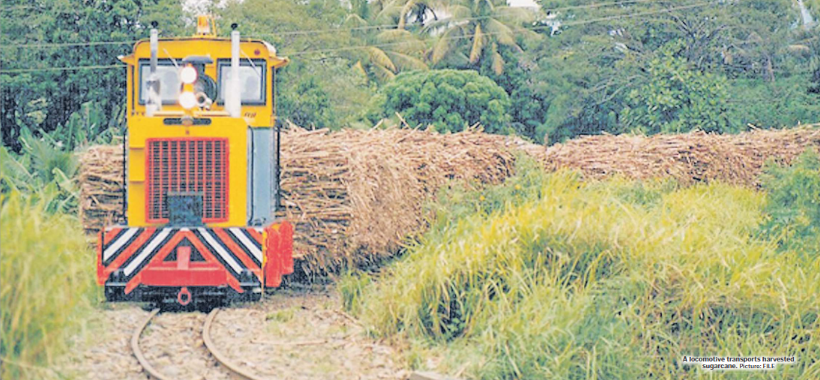
For more than a century, Fiji’s sugar industry survived on one fact: Cane moved from field to mill free of charge. Rail did that work under the Master Award, carrying over 70 per cent of the crop for free while lorries handled the rest, on tributary lines reaching within metres of river-valley farms. That was not sentiment; it was the load-bearing wall of the price structure. Once the FSC stopped using it, everything downstream – the guaranteed price, the grower’s margin, rural towns from Sigatoka to Rakiraki and Labasa – began to buckle, until it became impossible to ignore. Now rail has been reduced to 5 per cent. Profitability in the industry will return only if rail’s share climbs back toward 70-90 per cent – and the industry’s direction never again rests on whichever FSC executive holds the post.
Rail backbone destroyed
UNDER the Master Award, FSC was contractually bound to transport cane in every rail-served belt at zero cost to the grower – the architecture holding the guaranteed price together. Remove free transport, and $85 a tonne stops being a guarantee and becomes a fiction. Most cane farms sit within metres of a line, with tributary spurs reaching into the river valleys where much of the crop grows – the obligation was never a stretch. FSC did not retire this system; it starved it. Maintenance was withheld, empty carts vanished for days, and gangs of ten cutters in Drasa waited for a single cart carrying three or four tonnes. Growers were coerced into lorry conversion on a promise of guaranteed daily loads FSC never had to honour once the tracks to lorry conversion was achieved – which in fact was an engineered strategic transfer of the transport costs onto the grower.
Hulme confirms neglect
If rail’s collapse sounds abstract, Fijian readers were supplied with specifics in a letter by Terry Hulme (FT 30/06/26) who itemised how the infrastructure vanished: Resorts built over tramlines at Natadola, Grace Roads Group fencing off the lines at Yadua, villagers planting between the rails, and Sigatoka Town Council tearing up the line’s termination point for a car park. Rail did not decay, Hulme argued – infrastructure is hard to build and easy to lose – and FSC allowed the collapse without maintenance, protest, or stewardship. At no stage did the FSC file any reports with the police despite all the tram line areas throughout Fiji’s cane belt belonging to them as freehold land, and permissions are normally needed if roads need to be built across it. Rakesh Chand Sharma, a Nadi grower writing the same day, drew the obvious conclusion: An investigation is owed into why rail was discontinued, since the cost of trucking cane today explains why so many farmers no longer bother to harvest.
The contractor’s cut
On June 24, Fijian Competition and Consumer Commission (FCCC) approved a 30.3 per cent rise in mechanical harvesting rates and a 25.4 per cent rise in cartage rates, framed as help for operators absorbing a fuel spike. Growers, who got nothing from the same decision, must now sign a Memorandum of Growers Agreement with those operators before a stalk is cut. The National Farmers Union’s demand for $110 a tonne, passed in Ba on June 7, priced in these increases 17 days before FCCC approved them. No rate review captures the informal economy underneath: A grower without a harvester travels to an iTaukei village to engage a cutting gang, paying for food, accommodation, cane knives, boots, two weeks of groceries, and a goodwill advance of $200 to $1000 to secure a promise the gang will show – a promise gangs can and do break mid-harvest. Add kava and transport, and a day of harvesting can run past $200 before a stick of cane is even harvested or reaches the mill.
The arithmetic of bankruptcy
Put the regulatory decisions and field costs together and the problem is unmistakable. A grower producing 100 tonnes at the guaranteed $85 grosses $8500. Mechanical harvesting now costs $2463 and cartage $3762 – $6225 combined. Field operations – ploughing, fertiliser at $35 a bag – add $6890. The total, $13,115, works out to $131.15 a tonne: A $46.15 loss per tonne, or $23,075 a year on a standard 500-tonne farm. This is bankruptcy built into the price itself – why the ministry’s own budget release quietly advises growers to diversify into cassava, an admission that cane farming under its current price does not work. Rail removes the single largest cost driving this: cartage under lorry costs $37.62 a tonne, but under rail transport historically cost growers between zero to $5 – FSC’s own contractual obligation, never disputed. Eliminate that cost, and the loss becomes a genuine surplus before any other reform is made.
The subsidy that never arrives
The government’s headline $5 million diesel subsidy, announced June 23, sounds like relief until the arithmetic is checked. The figure is drawn from Fiji’s total national fuel consumption, not the cane sector – so the amount that could plausibly reach agriculture is a fraction of what was advertised, and even that fraction goes to the contractors and harvester operators who set their own rates, never to the grower. Fiji has run this experiment before when the government channelled a fuel subsidy to bus operators in 2025, the companies simply took the subsidy, then still cut trip frequencies, leaving rural commuters worse off. Cane subsidies follow the identical path – money announced for growers, are paid to contractors, who demand it.
Voices from the cane belts
Numbers like these can feel abstract, so it is worth returning to the people they describe. Fields of Despair report (FT 05/07/26) puts faces to the arithmetic: Sowani Veremalua Tovata of Garam Pani, watching 150 tonnes of standing cane he cannot afford to cut; Umesh Chandra of Tagitagi, who left cane to rot for want of lorry money; Gopal Krishna of Draumasi, who gave up his 25 acres for cattle; and Naseem Begum of Karavi, three months a widow, her cane deliberately torched, now forced a mechanical harvester she never can afford, nor asked to run. Narendra Reddy of Yaladro put it plainest, watching 37 of his 72 railway neighbours already gone:, said there was so much cane standing (FT 05/07/26) but it costs more to harvest than it is worth. That sentence is the $131.15-a-tonne arithmetic of my total cost per tonne, in human form. Not $75 as reportedly calculated by businessman, cane grower and cane transporter in Vaileka, Ra.
Tavua growers protest
That decision is now visible in the west, not only the accounts. As this is written, growers across Tavua are protesting the closure of the rail line by the FSC. FSC’s application to shut tramline operations at Rarawai and Lautoka mills, filed with the Sugar Industry Tribunal on May 22, is opposed by both the Sugar Cane Growers Council and the National Farmers Union. I also filed a comprehensive submission. The filing omits that in July 2025, then minister Charan Jeath Singh directed FSC to reactivate the Lausa Loop–Tawatawa Point line after more than 40 farmers from Drumasi, Yaladro and Tagitagi raised the alarm, funded by a $1.7million government grant completed by September 2025. Ten months later, FSC closed the very line it was ordered and was paid to fix, blaming Tavua’s falling production for a decline its own lorry costs helped accelerate.
Reddy’s ledger, not the grower’s
FSC’s own warnings show whose interests are protected. The corporation says a further three-week delay risks 250,000 tonnes of cane and $3.5million a week, on top of a $125,000 weekly wage bill for 400 idle seasonal workers and a supply obligation of 9200 tonnes to the United States by mid-September. Every figure describes FSC’s exposure – exports, wage bill, mill schedule – not the growers. Before a cent of any harvest reaches a grower’s account, the harvesting contractor, the lorry operator and FSC’s own advances for fertiliser and weedicide have already taken their share, without counting the unpaid family labour that plants and nurses the crop. Every other participant draws a wage, fortnightly or better. The grower draws none and waits months while being told his sugar has simply not sold yet. He gets his payments over 18 months in four instalments, the last one for 2025 was $0.84 per tonne, a mere $8.40 for a 100-tonne farm production. This is the raw truth of the injustice perpetrated on the sugar cane growers.
The great betrayal
The roots of that wait go back further. An earlier investigation, the great betrayal, (FT 13/06/26) traced the $85 guarantee to its origin: fixed by then-prime minister Voreqe Bainimarama on June 5, 2018, when rural diesel cost $1.54 a litre, unchanged since, even as diesel more than doubled. On a conservative calculation, the true price owed today is closer to $115 a tonne. The $30 gap is not a policy oversight; it is a broken promise, compounded annually. Even the promise that exists is not straightforward: Paid in three main instalments, with a fourth “washout” payment added only once FSC reconciles its books – last year, 84 cents a tonne, $8.40 on a 100-tonne harvest. That is not a payment. It is a rounding error, dressed up as the industry’s fourth instalment. Farmers who went to the bank to get their payment received $4.20 to $12.60 for average 50-150 tonnes of cane supplied. This is the heart-breaking story of our nation, and our leaders should hang their heads in shame for this to happen under their watch.
Governance capture
The sugar industry’s collapse stems from governance capture and the absence of any institution capable of scrutinising decisions made on growers’ behalf. The Sugar Cane Growers Council (SCGC) is an impotent organisation, with all 38 elected farmer representatives, with no elections held since 2004. FSC operates unilaterally, as the miller, price setter, first–payment arbiter, mode of cane transport decision–maker – and answerable to no one. One CEO centralised juice extraction into Lautoka, another pursued an uneconomic ethanol plant, and a predecessor dismantled the rail network entirely. FSC executives awarded themselves enormous salaries – one earning $840,000 a year plus $10,000 monthly accommodation paid at Denarau, while FSC debts exceeded $443million and taxpayers repeatedly wrote off hundreds of millions more.
One mill, one flood away
The latest reversal is already underway. FSC chief executive officer (CEO) Bhan Pratap Singh told Parliament’s Standing Committee on June 13 that FSC is considering a $150 million plan to close every mill on Viti Levu except Rarawai, contingent on upgrading its boiler to crush 300 tonnes an hour. The proposal omits a documented risk: Rarawai sits on the Ba River, with major floods recorded since 1892, including 2009 and 2012 when the mill floor was buried in silt and shut down. Concentrating the island’s entire crush capacity on one flood–prone site – while adding the cost of hauling cane from Sigatoka, Nadi, Lautoka, Rakiraki and Tavua – is not efficient. The mill itself operates only four to five months a year regardless of strategy, and the CEO’s are not rocket scientists either, but earned $840,000 is salary alone, plus $10,000 in monthly accommodation costs at Denarau.
Steel tracks to a green revolution
My modelling, Steel Tracks to Fiji’s Green Revolution (FT 13/06/26), shows that restoring rail and shifting 70 per cent of a 1.5–million–tonne crushing season back onto tramlines would remove 148,000 long–haul truck movements a season. Lorries burn roughly 12 million litres of diesel; locomotives use under 4 million – saving over 11 million litres and an estimated $53 million in foreign reserves. Transport now consumes 40–75 per cent of a grower’s gross earnings; a coordinated harvester–and–rail–bin system brings that to 5–10 per cent. Queensland’s model works, and Fiji has already trialled and used it. FSC faces a binary choice: restore rail to 90 per cent of deliveries or watch an industry supporting over 250,000 Fijians collapse. Parliament – not FSC executives – must approve any mill closure or transport shift in future and bring the FSC under its oversight. After all we as taxpayers are either paying or writing off debts and also continue to provide ongoing loan guarantees to FSC. An independent enquiry into the FSC, SCGC and SCGF is long overdue and hopefully the new incoming government in 2027 will set up an enquiry.

