ON April 2, 2026, Brent crude reached $US128 a barrel. Within days, Fiji’s April pump-price determination added seventy-five Fijian cents a litre across products — a thirty-five per cent jump on diesel, forty-two per cent on kerosene.
Tuvalu declared a State of Public Emergency on April 13. The Marshall Islands was already operating under a ninety-day economic emergency. And on April 17, the Pacific Islands Forum (PIF) Troika activated the Biketawa Declaration for the first time in its history on a matter of energy security.
These are not stories unfolding on another continent. They are the shape of a crisis that began at the Strait of Hormuz and reached Fijian households, utilities and boats within weeks.
Most Pacific fuel is routed through Singapore, whose crude runs through Hormuz.
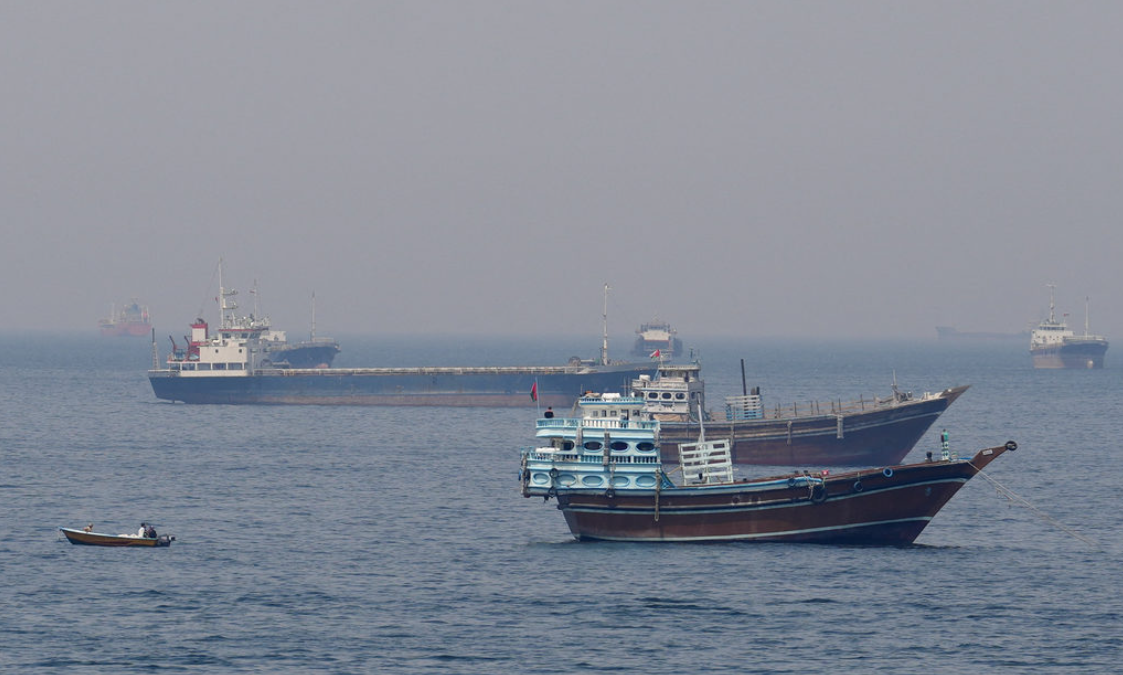
A conflict ten thousand kilometres away is now setting the price of kerosene in Labasa.
The deeper problem is that the institutions built to prevent such spillovers are failing. The United Nations (UN) Charter is openly flouted. The UN Security Council is impotent when its permanent members are themselves party to the conflicts on its agenda. The World Trade Organization’s (WTO) dispute settlement system has been paralysed for years. What has replaced the rules-based order is something older and harder: the might of states doing what they can get away with.
Small states are not the authors of that shift. We are its price-takers.
This is the environment Fiji’s foreign policy must be calibrated for — more fragmented, more transactional, more impatient than any Fiji has faced since independence.
The question is not whether Fiji has interests worth defending. We have always had those. The question is whether we have sharpened our doctrine to the point where those interests can actually be secured.
Presence is not influence. Presence without outcomes is theatre; influence is the ability to secure outcomes.
The 2024 Fiji’s Foreign Policy White Paper gave us the foundation: sovereignty, security, and prosperity as the pillars of national engagement; non-alignment as principle rather than drift; the Pacific family at the heart of our external relationships; and Ocean of Peace as our contribution to regional order. That doctrine is sound. What follows is an attempt to extend it — to propose a framework for how a small state, consciously and strategically, converts position into outcome.
Active non-alignment: Engage all, align with none, deliver outcomes
Non-alignment, correctly understood, is not neutrality. It is not equidistance between partners. And it is certainly not the absence of close friends — Fiji has traditional partners with whom we have worked closely since independence, and the depth of those relationships is an asset, not a compromise.
What non-alignment means, in an environment as contested as this one, is something more specific. It is the conscious discipline of making independent decisions on our own terms, reaffirmed daily, never drifting into the preferences of any single power. That discipline has three operational expressions.
Engaging all means maintaining active and credible relationships across the full spectrum of partners that matter to Fiji’s interests — not selectively, not reactively, and not only when a crisis forces our hand. The test of a bilateral relationship is whether it moves when it needs to move, on both sides.
Aligning with none means that the closeness of a relationship never translates into the surrender of a decision. This is active and disciplined statecraft — a conscious strategy to maximise relationships while maintaining control over our own choices. It preserves the independence that the White Paper rightly identifies as essential to small-state agency.
Delivering outcomes means tying every engagement to measurable national benefit — market access, investment, climate finance, labour mobility, strategic influence. Presence alone is not sufficient. The realist insight that Morgenthau articulated — that states act on interests rather than goodwill — is not a threat to small states. It is liberating. If we define our interests clearly and pursue them with discipline, we can shape outcomes that passive engagement cannot deliver.
This is what active non-alignment looks like in practice. Three words, each a discipline. Together, they turn a posture into a working doctrine.
The scalene triangle, managed as equilateral
Three relationships define the strategic system Fiji operates in: the United States, China, and Australia with New Zealand. They are not interchangeable. They do not weigh the same, they do not act through the same instruments, and they do not want the same things in the Pacific (see Figure 1).
The United States brings security weight and strategic presence. Its engagement is episodic — it arrives when strategic competition demands attention, then recedes — but when it arrives, it is overwhelming. Trade access, security cooperation, diplomatic weight: all flow through a single relationship that can open or close quickly. United States is Fiji’s largest export destination, and its consumer market valuable, despite uncertainty.
China brings infrastructure, long patience, and a different theory of regional order. Its engagement is continuous and incremental, working through economic presence, connectivity, and relationship density. China is already Fiji’s largest non-fuel import source and an active infrastructure partner. The question is not whether to engage. It is how to structure that engagement so it serves Fijian priorities.
Australia and New Zealand bring proximity and institutional density. They are our closest development partners, our largest labour mobility markets, and the powers most embedded in our regional architecture — through the Vuvale Partnership with Australia, the Duavata Partnership with New Zealand, and the Pacific Agreement on Closer Economic Relations Plus (PACER Plus) pathway, the region’s substantive trade and development framework. Proximity also creates its own responsibilities — on both sides — to keep the relationship current rather than habitual.
These three vertices form a scalene triangle. They are unequal in weight, unequal in reach, unequal in the development, economic and strategic instruments they bring. That is a fact about the world. The task is not to pretend the triangle is equilateral. The task is to manage it as equilateral — to ensure that no single vertex acquires a claim on Fiji’s decision-space that the others do not have, and that no vertex is permitted to define the range of options available to us.
This is balance-of-power reasoning applied from a small-state vantage. Great powers manage balance between themselves from positions of strength. Small states must manage balance between great powers from positions of exposure. Exposure is not weakness. It is the condition that forces discipline.
The instruments are different. The discipline is the same. The greatest risk for small states is not pressure. It is drift — the slow, unexamined accumulation of convenient decisions that, taken individually, appear pragmatic but, over time, narrow strategic space and erode the ability to act independently.
The test of that discipline is straightforward: can Fiji say yes to one power without that decision being read as alignment by the other two, and can it say no without consequences cascading across the system?
The outer ring: Where optionality is built
The scalene triangle is necessary but not sufficient. A triangle managed alone, without reinforcement, tends to tilt. The vertex that invests most consistently acquires the greatest claim, and the small state at the centre finds its options narrowing even as its relationships deepen. The answer is structural: a buffer ring of partners whose combined presence expands Fiji’s field of play and prevents any single vertex from becoming determinative. The purpose of the ring is not diversification for its own sake. It is to prevent dependency from hardening into constraint. The ring is not decoration and it is not a secondary tier. It is the mechanism that makes active non-alignment possible. The ring is ordered by weight, not by function, and two arcs carry most of it.
On the European and Middle Eastern arc, the European Union sits at the top — the heaviest non-triangle partner by market size, regulatory reach, and climate finance architecture. France and the United Kingdom follow: France as a Pacific resident power with territory, defence posture, and Indo-Pacific strategy of its own, and the UK through post-Brexit market access, Commonwealth density, and a long defence and training relationship with Fiji.
The United Arab Emirates anchors the Gulf end of that arc — a fast-growing relationship with real investment potential, and the concrete opening of a Comprehensive Economic Partnership Agreement (CEPA) pathway that the UAE has extended with comparable economies from India to Indonesia, and that Fiji is a natural candidate to pursue both bilaterally and as a template for wider Pacific engagement. On the Indo-Pacific arc, Japan sits at the top — over five decades the most consistently trusted external actor in the Pacific, bringing infrastructure, development cooperation through JICA, and a patient long-game preence that has never asked Fiji to choose sides.
Korea, India, Indonesia, and Malaysia descend the arc: Korea with real technical and industrial reach, India with diaspora linkages and continental-scale market access, Indonesia and Malaysia anchoring ASEAN and the maritime Southeast Asian corridor Fiji has not yet worked seriously enough.
At the base of the ring, Canada and Singapore play hub and anchor roles — Singapore as the Pacific’s closest small-state model of disciplined statecraft, and Canada as a like-minded middle power with genuine Pacific interest. There could be other countries that join and others that may leave, the group of countries listed describes the current engagements that could be further enhanced.
Without the ring, Fiji is three relationships deep. With the ring, Fiji operates inside a web dense enough that no single vertex can collapse our optionality. The ring is where a small state builds the leverage it cannot generate on its own.
Ocean of Peace, and the Grotian tradition
Fiji’s Ocean of Peace doctrine sits naturally inside this framework. It is our expression of what international relations scholars call the Grotian tradition — the idea, after the seventeenth-century jurist Hugo Grotius, that states operate under shared rules and norms that serve collective interests. For a maritime region spread across vast distances and small populations, a rules-based Pacific is how we hold the field together.
Rules-based orders, however, do not defend themselves. They are defended — or bypassed. Ocean of Peace, to deliver on its promise, must be carried into every bilateral conversation as a principle Fiji expects its partners to respect, and operationalised through the regional institutions, especially the Pacific Islands Forum, that give it institutional form. Passive peace erodes. Active peace compounds.
Three priorities for the next 12 to 18 months
The framework translates into three operational priorities.
First, anchor Fiji’s strategic independence. Manage the scalene triangle with continuous engagement — no diplomatic gaps, no alignment pressure accepted, no vertex allowed to become determinative. Activate the buffer ring through consistent senior engagement with Japan, the EU, Korea, Singapore, UAE, India, and the UK. Lead in the Pacific Islands Forum rather than attend. Hold firm on the sovereign positions embedded in our National Security Strategy 2025-2029 (NSS)— partnerships yes, foreign bases no, on terms Fiji sets.
Second, secure and expand Fiji’s economic position. The America Reciprocal Tariff (ART) negotiation is the immediate file: Section 122 expires in July 2026, the Zero List for Fiji Water, kava, turmeric, ginger, and mahogany must be secured, and the relationship must be held at working tempo through conclusion. Failure to secure outcomes here weakens Fiji’s credibility across its wider trade agenda. The ART is one component of a broader strategy, not the strategy itself.
The UAE CEPA pathway should be pursued in parallel — bilaterally for Fiji, and as a template for wider Pacific engagement with Gulf capital.
The EU interim Economic Partnership Agreement (iEPA) remains underexploited, especially the global sourcing rules of origin on processed fish of the iEPA that was operationalised in 2025 through active engagement. Brussels needs a restored mission to capitalise on it. And the China track — where Fiji’s negotiating team secured the shift from a Free Trade Agreement (FTA) to a CEPA, a hard-fought and meaningful upgrade, since a CEPA carries investment, services, and cooperation architecture a conventional FTA does not — now needs to be carried through to conclusion with the same discipline it took to shape.
Third, convert climate advocacy into actual finance. Fiji has earned real moral authority on climate. Soft power, in the sense Joseph Nye described, is genuine — but soft power without hard outcomes risks becoming self-congratulation. The single-year swing in the Pacific fuel-import bill triggered by the Hormuz disruption is on the order of two to six billion United States dollars above 2025 levels, on the EIA’s April 2026 Brent price path applied to the region’s roughly US$6 billion fuel-import baseline — of the same order as the region’s annual climate adaptation finance inflows. That arithmetic makes the priority unambiguous. The Loss and Damage Fund commitments from COP30 must translate into Fiji-specific disbursement pathways. The Reserve Bank’s green taxonomy should be used to attract green bond issuance and debt-for-climate swaps. And the window between COP30 and COP31 in Brisbane must be used to position the Pacific voice as purposeful, not reactive. These three priorities are a system, not a menu. Strategic independence creates the space within which economic diversification becomes possible. Economic position generates the resources that make climate advocacy credible. Climate finance reinforces the strategic independence that lets us speak on our own terms. Each priority strengthens the others.
The enabling condition: Delivery discipline
Underneath the three priorities sits a fourth imperative — delivery discipline. Presence is not influence. Position is not power. Without delivery discipline, both decay. Delivery discipline is not a priority alongside the others; it is the enabling condition without which the others cannot be delivered.
Every small state learns this lesson the hard way. Positions earned over months can evaporate in weeks if momentum is not held. Partners read silence as a decision. The ART negotiations — difficult, technical, and hard-won — are a reminder of how rapidly a position can shift when response cycles slow, and of how much institutional focus it takes to keep a file at working tempo from start to finish. That lesson, once absorbed, becomes a doctrine in itself. Four institutional settings make delivery discipline operational. A permanent inter-agency negotiating capability — Foreign Affairs, Finance, Commerce, Agriculture, and the Solicitor-General’s Office — briefed, resourced, and accountable. Response cycles that are fast enough that partners never read silence as a signal. Trade and diplomacy operating as a single instrument: every mission a trade post, every negotiation carrying a diplomatic dimension. And mission accountability reported quarterly to Cabinet against agreed indicators. Lee Kuan Yew’s rule for small states still holds: survival depends on being relevant, disciplined, and strategic. Relevance earns the seat. Discipline holds it. Strategy converts it into outcomes. These are not aspirational standards. Small states that fail to meet them do not get overrun—they become irrelevant.
The task ahead
Diplomacy is where power, interests, and rules intersect. States that understand all three shape outcomes. Small states that understand all three shape their own outcomes — within constraints, against friction, but materially.
Fiji is a small island developing state (SIDS). We are, as the White Paper correctly observed, a strategic price taker. But a price taker is not without agency and credibility. This is built through discipline — through active choices, reaffirmed daily, in a region where the status quo cannot be assumed to hold. The framework is straightforward. Engage all partners. Align with none. Deliver outcomes for each. Manage the scalene triangle with conscious discipline. Activate the buffer ring to expand our field of play. Carry Ocean of Peace into every conversation as a principle Fiji expects its partners to respect. And hold delivery discipline as the enabling condition that makes all of it real.
Presence is not influence. Influence is earned through discipline, clarity, and delivery. Fiji does not lack strategy.
The task now is to execute it — consistently, deliberately, and on our own terms.
n DISCLAIMER: Shaheen Ali is a former Permanent Secretary for Trade, Cooperatives, MSMEs and Communications with 27 years of experience as a career civil servant. He holds a Master’s in Foreign Affairs and Trade from Monash University. The views expressed are those of the author alone and do not represent the views of this newspaper.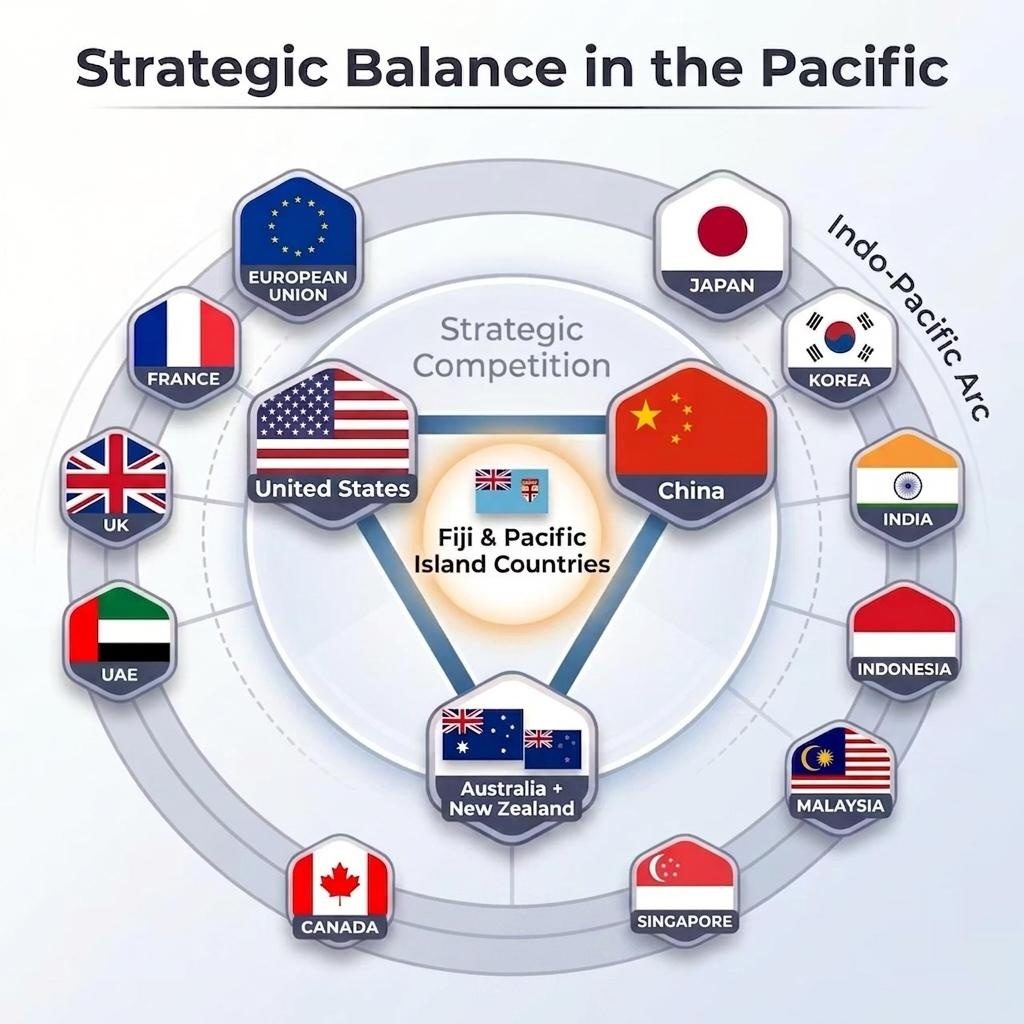
FIGURE 1: Fiji and the Pacific Island Countries at the centre of a scalene strategic triangle, with a layered buffer ring of regional and global partners. Source: SUPPLIED
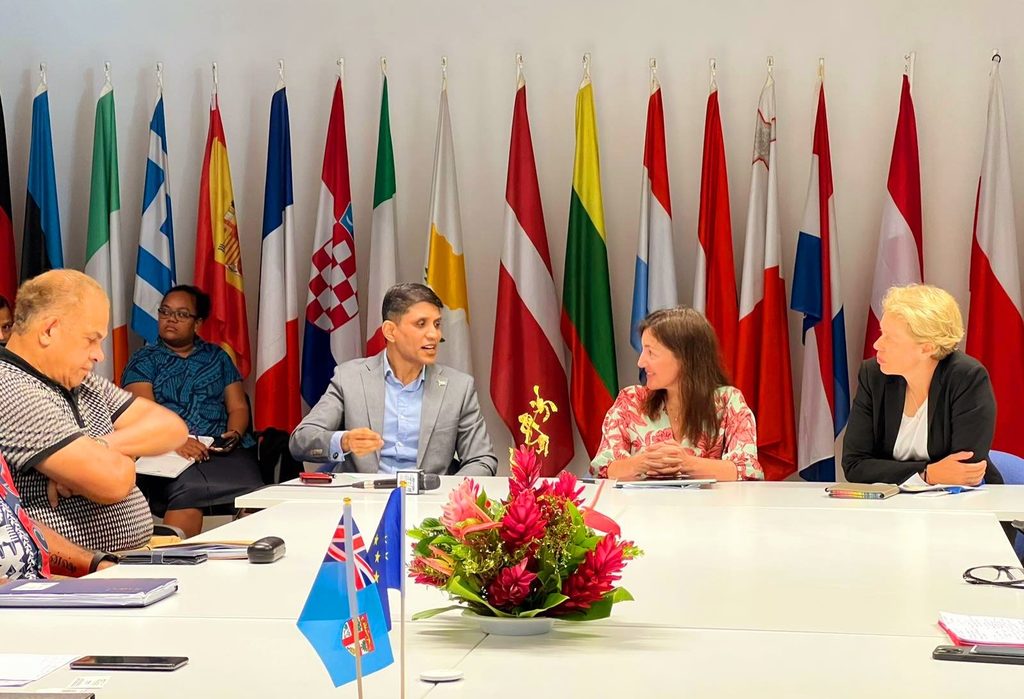
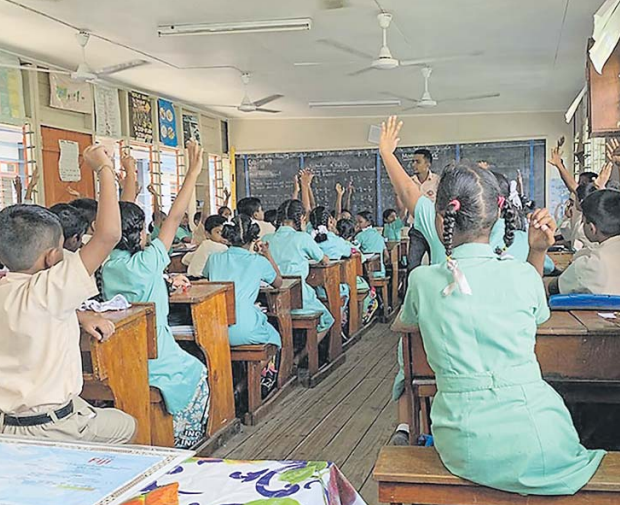
The author with the EU Delegation in Suva discussing kava exports to the EU in 2024. He writes: “The EU interim Economic Partnership Agreement (iEPA) remains underexploited, especially the global sourcing rules of origin on processed fish of the iEPA that was operationalised in 2025 through active engagement.” Picture: FILE
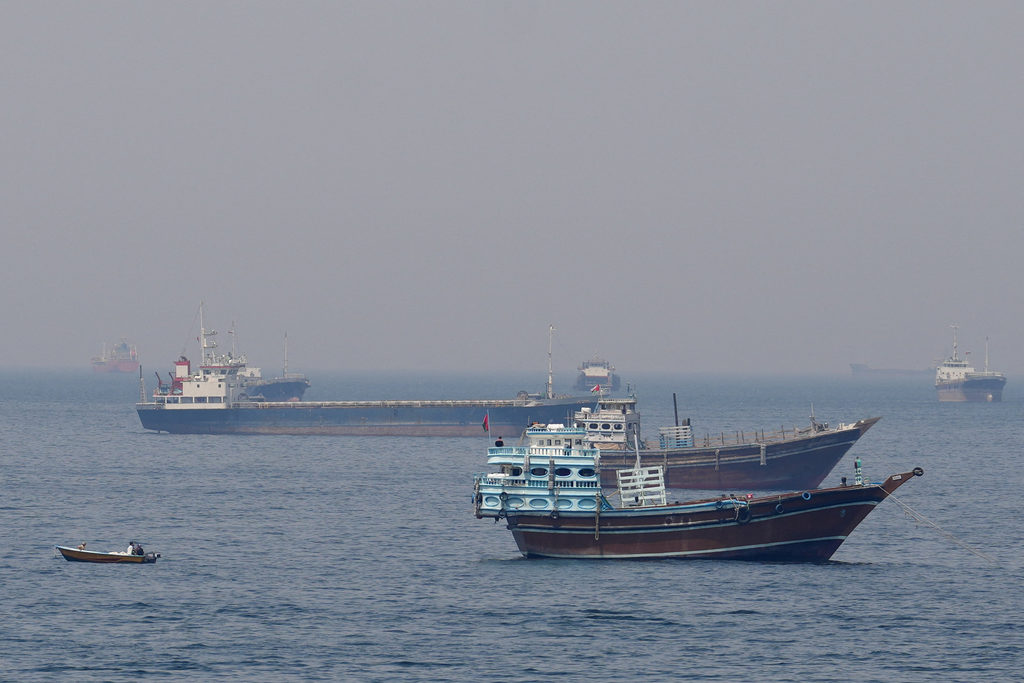
Ships and boats in the Strait of Hormuz off the coast of Musandam, Oman, April 20, 2026. A conflict ten thousand kilometres away is now setting the price of kerosene in Labasa, writes the author, demonstrating how integrated Fiji is to the global economy. Picture: REUTERS