
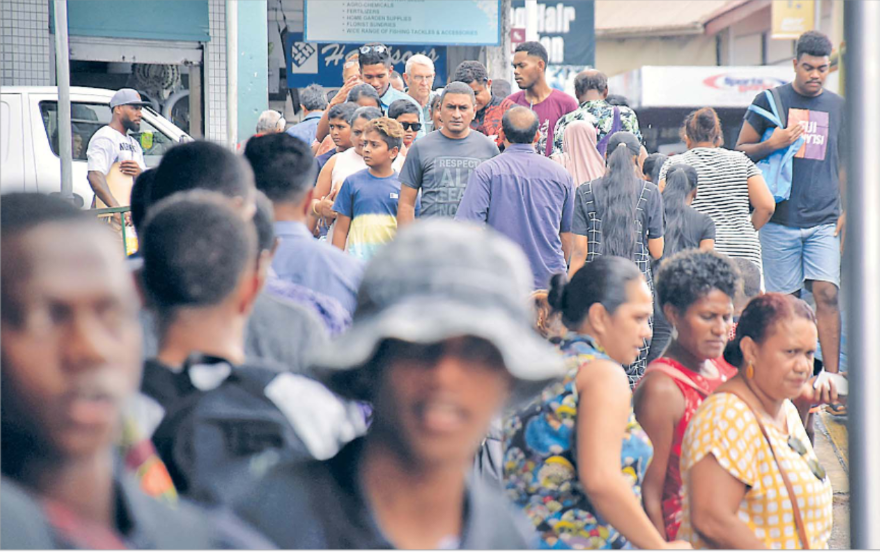
The latest survey by Dialogue Fiji confirms what households already know: Fiji is facing a cost-of-living crisis. Nearly half of respondents identified cost of living as the country’s biggest issue. More than half cited rising food prices as their greatest pressure, while almost 70- per cent described household financial stress as severe or very severe. This is not temporary inflation. It is structural stress rooted in how the economy has been designed. Many families are no longer cutting luxuries. They are cutting essentials.
The structural trap
MANY Fijian households spend 50–70 per cent of disposable income on food, fuel, transport, electricity, and housing – all heavily influenced by imports or external prices. This means Fiji imports inflation directly into household budgets.
At the same time, government revenue relies heavily on VAT, fuel duties, and import-linked consumption taxes, meaning rising prices also increase state revenue. That creates a dangerous contradiction: Parts of the economy become financially tied to the very pressures making households poorer.
Fuel: The First Inflation Engine
Fiji imports roughly $F1.6–1.7 billion in fuel annually. Fuel sits inside almost everything from transport, shipping, electricity, food distribution, tourism, construction, and manufacturing. So when fuel rises it impacts:
Transport and shipping;
Food and electricity costs;
VAT and fuel-duty revenue; and
Cost of living.
This is why global oil shocks quickly become domestic inflation shocks. And because fuel is priced in US dollars, any weakening of the Fiji dollar worsens the impact immediately.
The Fiscal Catch-22
This is where the structural contradiction becomes clearer. When fuel and food prices rise:
households suffer;
businesses face higher operating costs;
but VAT collections and fuel-linked revenues also rise.
In effect, parts of the fiscal structure financially benefit from inflationary imports. That does not mean government wants inflation. But it does mean the current revenue model remains heavily tied to imported consumption. This is why VAT reductions alone cannot permanently solve the problem.
In recent years VAT shifted: 9 per cent 15 per cent 12.5 per cent. Yet households still feel squeezed because the underlying dependency structure remains unchanged.
Electricity: When Fuel Becomes Power Prices
Fiji’s electricity system remains significantly fuel-linked – 37–50 per cent of supply. So fuel volatility becomes electricity volatility.
Fuel
Diesel generation costs ;
Electricity tariffs and surcharges ;
Household costs ;
Business costs ; and
Cost of living
That creates structural vulnerability.
Food: Fiji Imports Inflation Too
Fiji imports more than $F1.1 billion in food annually, including rice, wheat, dairy, oils, meat, fruits, vegetables, processed foods, and feed inputs.
Critics often ask: “If local production is better, why did imports replace it?” Part of the answer is scale.
Large foreign producers can often supply goods more cheaply, but that “cheapness” ignores the macroeconomic cost of dependency. During global shocks:
shipping costs surge,
exchange rates weaken,
supply chains fracture,
and prices become volatile.
COVID and the current fuel shock exposed this clearly. Cheap imports during stable periods can become extremely expensive during disruption. That is the hidden cost of dependency.
The Housing and Urban
Pressure Link
The cost-of-living crisis is also increasingly tied to urban concentration. As local production weakened over time, many rural economies lost economic depth and employment opportunities.
People moved toward urban corridors searching for wages and services. The result:
rising housing demand;
higher rents;
traffic congestion;
longer commuting costs;
and growing pressure on urban infrastructure.
This means fuel dependency, food imports, and weak rural production eventually become housing and transport pressures too. The problem is interconnected.
Tourism’s Double Squeeze
Tourism is also vulnerable inside this structure. Rising fuel, food, electricity, and travel costs increase operating expenses while making Fiji less competitive as a destination. Fuel shocks can therefore simultaneously:
raise domestic costs;
reduce visitor demand;,
weaken foreign-exchange inflows; and
and pressure employment.
Tourism resilience increasingly depends on stronger local production.
The Incoming Risk
By June – or at the latest July – Fiji is likely to feel the delayed effects of the current global fuel shock. A 20–25 per cent fuel increase does not stay at the pump. It cascades across the economy:
Fuel 20–25 per cent
Transport 7–12 per cent
Electricity 20–35 per cent risk
Food 8–15 per cent
Household cost of living roughly 5–12 per cent
The exact outcome depends on:
oil prices;
exchange rates;
shipping costs;
rainfall affecting hydro; and
tourism performance.
But the direction is clear.
The Deeper Structural Shift
Since the economic liberalisation and structural adjustment reforms that followed the 1987 coups, Fiji gradually shifted from a production-led economy toward a tourism, remittance, and import-driven economy.
Imports expanded faster than domestic production, while remittance-supported consumption made imported goods appear artificially affordable. Over time, local production weakened, rural economies hollowed out, and external dependence deepened. That structural shift now sits beneath Fiji’s cost-of-living crisis.
The Real Solution: Reduce Dependency
The long-term solution is not endless subsidies or temporary tax adjustments. It is structural redesign to reduce dependency. Fiji loses roughly $F2.7 billion annually through food and fuel imports. That leakage could instead become two new engines of growth: Food and energy production.
Priority Areas for Structural Reform
Energy
Expand rooftop solar, battery storage, and household energy independence
Reduce fuel imports through local renewable energy production
Build distributed microgrids, smart grids, and resilient energy systems
Introduce fair net-metering, feed-in tariffs, and open-access energy markets
Expand low-interest green financing for households, MSMEs, and village enterprises
Every increase in local energy generation reduces fuel dependence, external vulnerability, and long-term cost pressures on households and the economy.
Food and Production
Reform land laws to expand landowner participation in enterprise and investment
Build landowner-led, village-centered productive economies
Redirect experienced PALM and RSE workers into local industries and rural enterprise
Strengthen supply chains linking village agri-hubs and Blue Pacific hubs directly to markets
Invest in cold-chain logistics, agro-processing, manufacturing, and rural digital infrastructure
None of this happens overnight, but every increase in local production and domestic value creation reduces Fiji’s exposure to external shocks and imported inflation.
The Key Message
The cost-of-living crisis confronting families today is the accumulated consequence of the economic choices made over the last 39 years. It is the result of an import-dependent economy heavily reliant on imported food, fuel, electricity, and external supply chains.
The long-term solution is structural redesign:
producing more food locally,
generating more energy locally,
rebuilding rural productive capacity,
and reducing dependence on imported essentials.
SUNIL CHAND is an engineer and reform strategist with three decades of senior-level experience across manufacturing, regulation, and higher education. The views expressed herein are his and not of this newspaper.

