
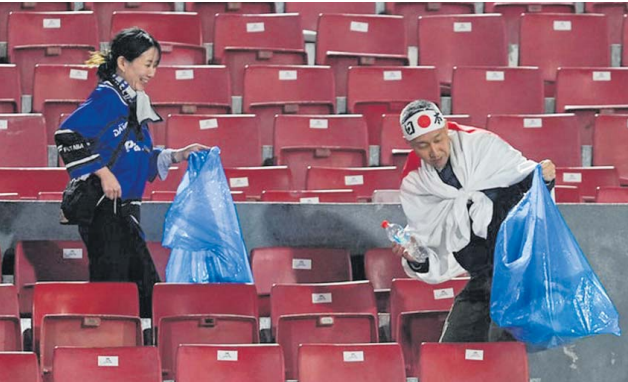
Every time a major sporting event takes place, images of Japanese fans staying behind to clean up stadiums often capture the world’s attention. While thousands of spectators leave their seats and head home after the final whistle, Japanese supporters can frequently be seen collecting rubbish, sorting recyclables, and ensuring that their section of the venue is clean before they depart. To many observers, this behaviour appears extraordinary. In Japan, however, it is considered normal. The practice is rooted in cultural values, education, respect for others, and a strong sense of personal responsibility.
Why it happens
TO understand why Japanese fans and athletes clean up stadiums, one must look at the foundational concepts that structure everyday life in Japan.
Souji (sweeping): Education plays a major role in developing this mindset. Unlike many countries where janitors perform most cleaning duties in schools, Japanese students are actively involved in cleaning their classrooms, hallways, cafeterias, and school grounds. This daily activity is known as souji, or school cleaning time. Students learn to sweep floors, wipe desks, clean windows, and maintain communal areas alongside their classmates and teachers. These tasks are not viewed as punishment. Instead, they are considered an essential part of character development. Through this experience, children learn teamwork, humility, discipline, and responsibility for their environment.
Gomi (waste): In Japan, waste management is treated as a collective discipline. Trash sorting is meticulous, and public bins are intentionally scarce in major cities. Citizens are expected to carry their litter home or keep it until a designated disposal point is available. Carrying waste in a personal tote or a provided bag is second nature, so bringing garbage bags to a sports stadium requires virtually no change in daily habit.
Respect for shared space and hosts: The Japanese concept of atosaiko wo (translating roughly to “a bird does not foul the nest it leaves”) underscores the importance of leaving a space cleaner than one found it. Fans view stadiums not as commercial spaces where cleanup is solely the responsibility of hired staff, but as host spaces that deserve respect. Leaving trash behind is seen as burdening the host and showing disrespect to the facility.
How it happens
The execution of post-match clean-ups is organised, efficient, and deeply ingrained in fan culture.
Preparation before the match: Fans often bring large blue or clear plastic bags (gomi-bukuro) to the stadium. Before the match begins, these bags are used for practical stadium purposes such as protecting personal belongings from rain or spilled drinks or inflate-cheering during the game.
Systematic collection: Once the final whistle blows – regardless of whether the team won or lost – fans open their bags and move row by row through their assigned sections. They collect discarded plastic bottles, food containers, wrappers, and stray papers.
Sorting and disposal: The collected rubbish is not simply dumped in a heap. Fans take the filled bags to designated stadium sorting stations, separating recyclables, plastics, and general burnable waste according to local rules.
Team participation: The mindset extends directly to the players and coaching staff. In international competitions, the Japanese national football team is known for leaving their locker rooms spotless, accompanied by folded towels, organised gear, and handwritten thank-you notes in the local language or English.
Key motivations for this behaviour
One of the most important reasons Japanese fans clean stadiums is the cultural emphasis on respect for shared spaces. From a young age, Japanese people are taught that public places belong to everyone and should be treated with care. Whether it is a park, a train station, a classroom, or a stadium, people are encouraged to leave an area in the same condition, or better than they found in simpler terms, it means that a person should clean up after themselves and not leave a problem for others to solve.
As these habits become ingrained over many years, they naturally extend into adulthood. When Japanese sports fans attend a football match, rugby game, baseball game, or Olympic event, cleaning up afterward feels like a normal and expected behaviour. It is not something done for publicity or praise. Most participants simply see it as a continuation of the values they learned growing up.
Another reason behind the stadium clean-up tradition is the Japanese concept of collective responsibility. In many societies, individuals may assume that cleaning staff will deal with rubbish once an event is finished. In Japan, there is a stronger expectation that everyone contributes to maintaining a pleasant environment. People generally believe that if they create waste, they should also help manage it. This perspective encourages citizens to think about how their actions affect others.
Global impact and legacy
The phenomenon has sparked widespread admiration and inspired similar actions globally. Fans from other nations have occasionally adopted the practice during major tournaments, picking up trash alongside Japanese supporters.
Ultimately, the stadium clean-up is not about grandstanding or performing for cameras. It is the visible manifestation of a culture that prioritises civic duty, mutual respect, and mindfulness. By treating public spaces with care, Japanese fans demonstrate that individual accountability and community pride can transform simple everyday actions into a powerful cultural statement.
And in Fiji
In Fiji, there is a degree of collective responsibility at the village level as generally villages are clean and tidy and there is an aspect of the greater good for the community.
However, in practice this mindset does not extend beyond the village to the rest of the country as it appears the genuineness of this concept of cleanliness, the environment, strong sense of personal responsibility and collective responsibility is different in Fijians compared to the Japanese. In Fiji, there is an inclination to blame others instead of taking personal responsibility.
Fijians tend to give these things lip service instead of substance and personal action.
JAN NISSAR is a chartered accountant who runs his own practice in Sydney, Australia specialising in taxation, accounting, business advisory and superannuation. He is an avid traveller and letter writer who writes thought provoking letters to the editor. He is passionate about the development of Fiji. The opinions provided in this article are his.

