
With the 2026-27 Budget due on June 26, GDP growth revised to 1.5 per cent, public debt at 84 per cent of GDP, and a poverty rate unmeasured since 2009, Fiji is navigating its most consequential budget moment in years using a measurement tool invented in 1934 to count wartime factory output — one that cannot see subsistence farmers, communal fishermen, unpaid carers, iTaukei land value, or the unorganised worker with no federation to speak for him. That 1.5 per cent figure is not the floor. The full force of the Hormuz grapevine impact has not yet reached Fiji’s shores. When it does — with the next three-to- six-month lag that follows this cascading and sustained global supply shock — the numbers will look far worse. The GDP compass is broken. The question is whether anyone in authority understands what a GDP Index cannot see.
The warning nobody heard
In 1934, American economist Simon Kuznets delivered to the United States Congress the measurement tool that would become the global standard for national prosperity. In that same report, Kuznets inserted a warning ignored for 92 years: the welfare of a nation can scarcely be inferred from a measurement of national income. GDP was designed as a wartime production counter — to track whether American factories were outputting enough steel, ships, and ammunition. It was never designed to answer the question every Fijian family asks every morning: are we better off than last year?
At the State of the Fijian Economy Dialogue, Grand Pacific Hotel, Suva, June 9, 2026, Reserve Bank Governor Ariff Ali confirmed GDP growth revised downward from 3 per cent to 1.5 percent — a significant capitulation from earlier projections. Inflation is projected to exceed 6 per cent. Public debt stands at 84 per cent of GDP. Those numbers tell part of the story. The Hormuz closure entered its 94th consecutive day on June 7, 2026 with zero commercial outbound transits recorded.
A WMO-trained meteorologist understands lag effects intimately — weather systems do not strike the moment conditions form. Neither do economic shocks. Fiji is still in the approach path. GDP cannot tell you that either.
What GDP actually measures
GDP is calculated by a formula unchanged since 1934: consumption plus investment plus government spending plus net exports. Every dollar transacted in the formal economy is counted. Every dollar outside it is invisible.
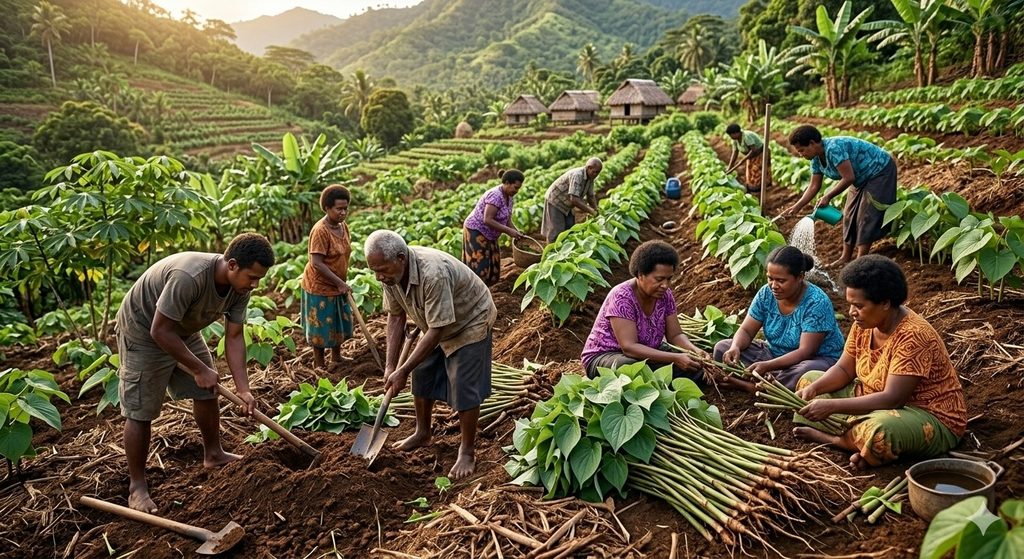
A cyclone that destroys Lautoka and triggers a construction boom increases GDP — the rebuild counts as activity. A cane farmer at Drasa who feeds his family from his own garden, draws water from a communal tank, and repairs his fence with timber from his own land contributes precisely zero to GDP — despite sustaining his household entirely through productive labour. The formula counts the transaction, not the outcome. It measures activity, not welfare.
Fiji’s policymakers have navigated four decades of economic decisions using this instrument. The results are recorded in the public accounts — and they are not encouraging.
The informal economy Fiji never counted
The most consequential flaw in applying GDP to a Pacific island economy is what it cannot see. Subsistence farming, communal fishing, kava cultivation, iTaukei communal land labour, barter exchange in rural communities, and the unpaid care economy carried overwhelmingly by women — all generate real productive value that feeds families, maintains social cohesion, and reduces the burden on state services. None of it appears in any GDP calculation.
The World Bank confirmed at the Suva Dialogue that female labour force participation stands at 40 per cent against nearly 80 per cent for men — unmoved for years. When policymakers read Fiji’s GDP and conclude they understand the economy, they are reading a document that renders invisible the productive lives of a significant portion of the population.
Policy built on that foundation will remain structurally incomplete — because the foundation itself has a missing half.
The three-world basket problem
Comparing Fiji’s nominal GDP per capita of approximately $US6740 against Australia’s $US65,000 in a single analytical basket is not economics — it is arithmetic dressed as analysis. A kilogram of dalo in Suva costs a fraction of its nutritional equivalent in Melbourne. A Fijian family in a rent-free home on iTaukei land carries zero housing cost — and contributes zero to GDP.
Purchasing Power Parity produces a Fiji GDP of $FJ15.66 billion against a nominal $FJ6.26 billion. That gap is a direct measure of how misleading raw GDP comparisons between first, second, and third world economies are. The IMF, the World Bank, and Fiji’s own Treasury routinely present nominal comparisons across the Pacific without adequate PPP adjustment or informal economic correction. That distortion travels directly into budget decisions — and into the lives of people those decisions are supposed to serve.
The Gini silence
GDP growth tells you the economy expanded. It cannot tell you who received that expansion. Fiji grew at 3.2 per cent in 2025. Tourism was strong. Remittances were robust. By GDP’s own metric, things looked healthy. Simultaneously, the cane farmer at Gang 68 in Drasa received $FJ85 per tonne against a cost of production exceeding $FJ115. The Lautoka nurse worked overtime that was never paid on time. The rural teacher acted in a senior role for months without an acting allowance. The road to the village school was not repaired. The Gini Coefficient — measuring income inequality from zero to one — captures whether growth reaches ordinary people or accumulates elsewhere. Fiji’s Gini is not routinely published, not cited in budget documents, and not used to evaluate whether policy is working for the citizen on the street. A government reporting GDP growth while Gini inequality deepens is not reporting progress. It is reporting a half-truth — and calling it a budget speech.
Better instruments exist
The global economics community developed GDP alternatives long ago.
The UNDP’s Human Development Index combines life expectancy, education, and income — Fiji ranks 99th globally at 0.730, reflecting development gaps invisible in GDP alone. The Genuine Progress Indicator subtracts the costs of crime, pollution, and inequality — applied to the United States, GPI has been essentially flat since 1978 despite GDP tripling.
Bhutan’s Gross National Happiness framework, dismissed in 1972 and now studied at Oxford, measures psychological wellbeing, cultural resilience, and ecological diversity. The UN’s System of Environmental Economic Accounting, adopted by over 90 countries, counts natural capital — reefs, fisheries, forests, freshwater — that GDP treats as valueless until destroyed.
Kate Raworth’s Doughnut Economics, now informing policy in Amsterdam and Wellington, replaces GDP entirely with a social foundation floor and an ecological ceiling. Fiji has signed climate and biodiversity frameworks implicitly recognising natural capital. Its budget documents do not.
Toward a Fiji prosperity index
Fiji does not need to wait for a global consensus it will not lead. What is needed is a composite Fiji Prosperity Index — built by the Reserve Bank, the Fiji Bureau of Statistics, and the University of the South Pacific — combining GDP per capita with annually updated Gini measurement, HDI components localised to Fiji’s profile, informal economy valuation using established survey methodologies, natural capital accounting for reefs and freshwater, and a basic needs score covering clean water, electricity, healthcare, and rural education.
Such an index would tell Fiji’s Finance Minister on June 26 not merely that the economy grew at 1.5 per cent — but whether that growth reached the cane farmer, the outer island nurse, the rural teacher, and the unorganised worker who has no employer federation to submit on his behalf to parliamentary committees. It would also tell him what GDP cannot: that 1.5 per cent is not the floor. The Hormuz lag, the fertiliser cascade, the freight cost blowout — these are still incoming.
Fiji’s poverty rate has not been officially updated since 2009 — 17 years ago — when it stood at 31 per cent. GDP is not wrong. It is profoundly incomplete. And in Fiji, that incompleteness has been measured not in percentage points but in unpaid wages, unclean water, no water in taps, unmaintained roads, and a whole multi-generation of workers, both male and female, whose labour contributions to this nation has never once been measured nor accounted for.
The broken GDP compass can be replaced. The will to replace it is the only thing still missing from Fiji’s reserve bank, arm-chair economists, policy makers and political pundits.
DR SUSHIL K SHARMA BA MA MEng (RMIT) PhD (Melbourne) — World Meteorological Organisation (WMO) Accredited Class 1 Professional Meteorologist is the former Associate Professor of Meteorology, Fiji National University, and Operational Meteorologist and Manager, Climate Research and Services Division, Fiji Meteorological Services. The views expressed are those of the author alone and do not represent the views of this newspaper.

