
THERE is something almost unbelievable about the fact that until this week, Fiji’s education system was still operating under a law written in 1966. Think about that for a second. In 1966, Fiji was still four years away from independence. Colour television was a novelty in many parts of the world. There was no internet, no smartphones, no artificial intelligence, no Google Classroom, no inclusive education framework, no serious conversation about mental health, neurodiversity, child protection, cyberbullying, climate anxiety or digital literacy. Yet somehow, generations of Fijian children – including mine – were expected to navigate a completely different century under legislation drafted for another era altogether.
So when Parliament passed the new Education Bill 2025 this week, replacing the Education Act 1966 and several related laws, it was more than just legal housekeeping. It represented something emotional, overdue and deeply symbolic. It was Fiji finally admitting that our children deserve a system built for the future instead of one inherited from the shadows of colonial administration.
But legislation alone does not transform education. Laws can open doors; they cannot force people to walk through them.
As someone who grew up in Kashmir, Lautoka, and who now teaches in Tokyo after teaching in New Zealand, Kuwait and elsewhere, I have spent a large part of my life thinking about what education gave me – and what it almost denied me.
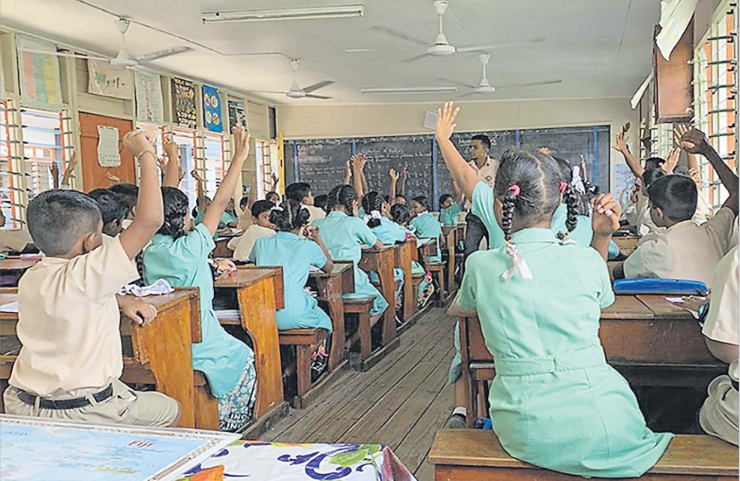
I often think about the little boy I used to be. The one who sat in overcrowded classrooms under ceiling fans that sounded like they were one strong wind away from falling. The one who copied notes furiously because textbooks were shared between students. The one who believed intelligence alone would save him because that was the mythology many of us were raised on.
Study hard. Get good marks. Escape.
That was the dream sold to so many Fiji Indian children growing up in the late 1990s and early 2000s. Education was not simply education. It was survival. It was dignity. It was migration. It was the possibility that your children might one day sit in air-conditioned offices instead of cane fields or factory floors.
And yet there was always fear stitched quietly into that dream.
I remember genuinely believing that university might never happen for me because, growing up, there seemed to be only two pathways: scholarship or wealthy parents. I had neither certainty. I remember hearing adults whisper about fees the same way people whispered about funerals — softly, anxiously, avoiding eye contact. There is a unique kind of stress that enters a child’s heart when they begin to realise how expensive dreams are.
That reality still exists for many Fijian families today.
Which is why the conversation around education reform cannot merely celebrate “modernisation” while ignoring inequality. Because one uncomfortable truth remains: Fiji has never had a shortage of intelligent children. What we have often lacked is equal opportunity.
Some of the brightest students I knew came from homes where electricity bills were overdue, where lunch was roti and tea because payday had not arrived, where one school shoe was always more damaged than the other because replacement could wait “another month.” I knew students who travelled long distances by bus every day while trying to stay awake in class. I knew children carrying adult worries before puberty had even finished introducing itself.
And still they came to school.
That resilience deserves more than inspirational Facebook captions every exam season. It deserves policy.
The new law reportedly introduces broader protections, stronger governance frameworks, an Education Advisory Council, recognition of different learning pathways including TVET and higher education, and attempts to modernise oversight structures. Those are important steps. So is the review mechanism reportedly built into the legislation so it does not remain untouched for another sixty years.
Frankly, it should embarrass us that a law affecting generations of children remained so outdated for so long.
But beyond the headlines, I hope this moment forces Fiji to confront deeper questions.
What kind of learners are we actually producing?
Because for too long, our education system has often rewarded obedience over creativity, memorisation over curiosity, silence over questioning.
Many Fijians of my generation grew up terrified of making mistakes in classrooms. Some teachers were extraordinary and nurturing. Others ruled through fear. You learnt quickly which classrooms felt safe and which felt like courtrooms. A single humiliation in front of peers could stay with a child for years.
That is why discussions around corporal punishment and child protection matter enormously. There are people who romanticise harsh discipline because “it made us stronger.” Sometimes it did. Sometimes it simply made children quieter.
And quiet children are not always healthy children. One of the greatest misconceptions in Fiji is that academic excellence automatically equals emotional wellbeing. It does not.
I have taught children across different countries now. Some of the highest-performing students are also the most anxious, isolated or frightened of failure. Fiji desperately needs an education system that understands the whole child — not just examination scores pinned onto newspaper pages every November.
We also need to talk honestly about teachers. Fiji asks teachers to perform miracles while often denying them the dignity, resources and trust they deserve. Teachers are expected to become counsellors, social workers, behavioural specialists, substitute parents and community leaders – often all before lunch break. Yet public discourse frequently reduces them to exam results.
There were teachers in my life who changed my destiny without ever realising it. Teachers who saw potential in a shy Indo-Fijian boy who often felt too awkward, too emotional or too uncertain about his place in the world. One teacher told me my writing mattered long before I believed it myself. Another pushed me toward public speaking despite my fear. Those moments altered the trajectory of my life more than any policy document ever could.
Today, when I stand in classrooms in Tokyo, I sometimes think about those teachers from Lautoka. Their influence travelled oceans. That is the power of education. Not rankings. Not slogans. Transformation. And transformation must now include inclusion.
The Fiji of 2026 is not the Fiji of 1966. Our classrooms are more diverse. Conversations around disability, neurodiversity and mental health are more visible. Children learn differently. Some students thrive through movement, creativity and collaboration rather than rigid traditional methods. The old “one-size-fits-all” mentality has failed too many children for too long.
I think about students I grew up with who were labelled “lazy” or “problematic” when, in hindsight, they may simply have needed support nobody understood at the time.
How many futures did we lose because our systems could not recognise difference? That question haunts me.
At the same time, modernisation cannot mean abandoning identity. One danger of globalised education is that small nations begin producing students disconnected from themselves. Fiji must be careful not to create children who can analyse Shakespeare but know nothing about Girmit history, iTaukei oral traditions, Fiji Hindi, the Pacific, climate realities or the social complexities of our own communities. Education should not create strangers within their own homeland.
I worry sometimes that many young Fijians are being raised to leave Fiji emotionally before they leave physically. We teach children to seek opportunities overseas – and understandably so – but not always how to build the nation they come from.
And yet, perhaps the greatest proof of Fiji’s educational potential is the diaspora itself.
The son of descendants of indentured labourers can now teach in Tokyo. Others become doctors in Australia, academics in New Zealand, engineers in Canada, entrepreneurs in the United States. Across airports worldwide, you will eventually hear the unmistakable sound of Fiji Hindi or Fijian laughter floating through departure terminals.
That is not accidental. That is what happens when communities place sacred faith in education. But pride should never become complacency.
Because alongside success stories are students still falling through cracks. Rural schools still needing infrastructure. Teachers still burning out. Children still arriving hungry. Families still choosing between bus fare and groceries. Bright students still believing certain dreams belong only to wealthier people.
This new law cannot merely become another document politicians reference during speeches while classrooms remain unchanged.
The real test begins now. Will teachers actually be supported? Will rural schools genuinely improve? Will inclusion become reality instead of conference vocabulary? Will students be prepared for a digital future? Will arts and creativity matter? Will vocational pathways be respected equally? Will poor children truly receive equal opportunity? Will education remain accessible?
Those questions matter far more than ceremonial parliamentary applause. Still, despite my criticisms, I feel hopeful. Because there is something profoundly moving about a country finally deciding that its children deserve legislation written for their own century.
For nearly sixty years, Fiji’s education framework belonged partly to the past. Now the challenge is ensuring the future belongs to all children – not just the privileged, urban or academically gifted ones.
The true success of this reform will not be measured by policy papers or press releases. It will be measured years from now in classrooms across Lautoka, Labasa, Rotuma, Kadavu, Ba and Suva.
It will be measured in whether a frightened child feels seen. Whether a struggling student receives help. Whether a teacher feels respected. Whether creativity survives. Whether poor children still dare to dream.
Most importantly, it will be measured in whether education continues doing what it has quietly done for generations of Fijians: carrying ordinary children toward extraordinary futures.
I know this because education carried me too. From a boy sitting in classrooms in Kashmir, Lautoka, wondering whether university was financially possible, to teaching children in Tokyo beneath neon lights my grandparents could never have imagined.
That journey is not mine alone. It is the story of Fiji itself.

