
I have spent the better part of my thirty-two years on this Earth answering a question that should, by all laws of human existence, be entirely simple.
Where are you from?
And yet, it never was. Because the answer people wanted was not “Fiji”. It was something more precise, more dissected, more palatable for their rigid understanding of how the world should be sorted. It was a question that came with an expectation that I would split myself neatly into parts: One inherited, one imagined, and one imposed.
Growing up, the psychology of identifying my nationality was not just confusing; it was quietly, deeply humiliating. Until 2011, when my family packed up our lives and departed Fiji for the cooler, unfamiliar winds of Auckland, New Zealand, I was categorised by a term that felt like a tether to a ghost: Indo-Fijian.
The “Fijian” part, I understood instinctively. I was born there. Having never left the diaspora during my formative years, I grew up in Lautoka, breathing in the heavy coastal humidity, kicking up the sun-baked dust, sitting under the sprawling shade of mango trees, and falling asleep to the mechanical rumble of cane trucks rolling past fields that seemed to stretch into eternity. Every single fiber in me, my cadence, my memory, my deepest longings, screamed that I was from the islands.
But the “Indo” part sat uneasily on my tongue. It was a prefix that felt like a permanent question mark.
It wasn’t until I was sitting in a primary school classroom that I learned what it actually meant — that “Indo” referred to India, to an ancestry geographically tethered to the vast Asian subcontinent. That revelation did not bring me clarity. It brought only a profound, isolating confusion.
Because I had never been to India. My parents had never been to India. My grandparents had never been to India.
And yet, I was told, repeatedly and systematically by society, by forms, and by passing conversations, that I was somehow Indian. How do you belong to a place that has never held your footsteps? How do you claim a land that has never, for generations, claimed you back?
That glaring contradiction planted a seed inside me — not just of confusion, but of a quiet, simmering anger. A resentment that took root in my chest and has never entirely left me. I do not identify as Indian. My ethnicity, perhaps, traces back to the soil of that subcontinent. But my nationality? Never.
It wasn’t until 2022 that my family visited India for the very first time. I have now been to the subcontinent four times. I have stood before the breathtaking marble symmetry of the Taj Mahal, ticking a grand marvel off my travel bucket list. Each visit was layered, complex, and beautiful in its own distinct way. But never — not once, across four separate journeys — did I feel an unbroken sense of return. I did not feel the magnetic pull of a motherland welcoming its lost son. I was a visitor. A respectful one. A curious one. But a visitor, nonetheless.
Every single time I introduce myself, whether standing in front of a classroom of young minds or walking the streets of a foreign city, I say I am from Fiji. And I mean it with every ounce of my being.
People need to desperately learn to distinguish between ethnicity and nationality. One speaks of ancient origin; the other speaks of lived belonging. One is inherited through distant bloodlines; the other is earned through sweat, tears, and the very air you breathe. To collapse the two is to erase the lived reality of entire communities.
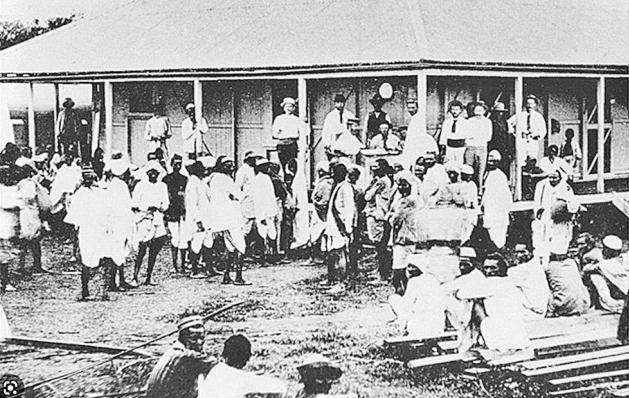
I am actually one of the few fortunate ones who has had the privilege of traveling to India. But there are thousands upon thousands of people — people whose forefathers arrived on the churning decks of the Leonidas, the Syria, the Jumma, or the Sutlej — who have never set foot on the Indian subcontinent. Their fathers and their grandfathers died having never seen India.
These ancestors were not migrants in the modern, voluntary sense. They carried severed histories. They were indentured laborers — girmitiyas — bound by deceptive contracts they barely understood, forced across thousands of miles of unforgiving ocean under the British indenture system to work plantations on a tiny island they had never heard of.
They did not choose Fiji. But Fiji became them.
Their children, and their children’s children, built lives from the mud and the sugar cane. And in doing so, our culture fractured from its origins and bloomed into something entirely new. Yes, our religions might trace back to the Asian subcontinent — Hinduism, Sikhism, Islam — but apart from the sacred texts we read, our culture is remarkably, defiantly different.
Our dialect is different. Fiji Hindi is not the Hindi spoken in Mumbai or Delhi; it is a language shaped by Bhojpuri roots, but transformed by the ocean, by isolation, and by survival. Our food is different. We do not eat butter chicken or rich, heavy korma as part of our daily lives. Our curries are thinner, sharper, unpretentious, and fiercely improvised. The roti my mother, Surita, rolled in our Lautoka kitchen were crafted not from glossy, imported cookbooks, but from an inherited muscle memory of survival and adaptation.
Our culture is not a faded replica of India. It is a brilliant reinvention. And yet, we are persistently asked to justify it.
Why can’t we just accept who we are? Why must our struggles as Fiji islanders be treated as an endless, inescapable loop?
First came the trauma of our forefathers being forced onto a small island thousands of miles away from everything they knew. Then came the sheer, brutal struggle of being girmitiyas, bleeding into the sugarcane fields. Then came the generational struggle of leasing land — living on precarious agricultural leases that could expire at any moment, displacing entire communities not by war, but by the quiet stroke of a bureaucrat’s pen. Then came the immense, emotional struggle of adopting a new culture and fighting tooth and nail to make this soil our home.
And now? Now that we are so deeply assimilated, so undeniably woven into the fabric of the nation, why are we still having this conversation of segregation?
It brings a heavy sadness, and genuine tears to my eyes, knowing that almost 150 years after the first ships docked, we are still struggling with our identities. We are still negotiating our right to simply exist without an asterisk.
This is what makes the current political and social conversations around identity in Fiji so emotionally charged. The term “Fijian” itself has been a historical battleground. For decades, it was used exclusively to refer to the Indigenous iTaukei people, while the rest of us were shackled to our hyphens — Indo-Fijian, Part-European, General Elector. It was only under the 2013 Constitution that a secular state was established, and all citizens were legally recognised as “Fijians”, while Indigenous identity was formally, rightfully recognised as iTaukei.
On paper, this was a monumental move toward unity — a secular, inclusive national identity. In practice, the socio-political reality remains intensely unsettled. Today, the debates continue to rage in Parliament, in the media, and in our homes. With the recent revival of the Great Council of Chiefs and ongoing discussions about the secular nature of the state versus traditional governance, the question of what it truly means to be “Fijian” is constantly, painstakingly interrogated.
Let me be absolutely, unequivocally clear, because this is where the conversation must be handled with the utmost grace and reverence: This is not about blame. I do not, and will never, blame the iTaukei.
Their connection to the land — the vanua — is ancestral, deeply spiritual, and undeniable. They are the Indigenous guardians of the islands, and their identity, their language, and their rights deserve absolute protection, respect, and recognition. Always.
But honouring Indigenous rights and fostering national cohesion are not mutually exclusive. The identity of Indo-Fijians should not be treated as a provisional lease that can expire at the whim of political tides. We are not guests in a waiting room. We are not temporary residents. We are not hyphens waiting for an eviction notice.
We are part of Fiji’s story — not as a footnote, not as a fading appendix, but as a defining chapter written in the exact same ink.
What breaks my heart is that we are still explaining. Still clarifying. Still defending.
It is utterly exhausting. It is exactly like being born in a house, growing up in every single room, knowing the intimate shape of every crack in the wall, tending to the garden outside — and yet being told, gently but persistently, that you are not quite the owner of the home. That your presence requires a caveat. That your belonging comes with terms and conditions.
And the most devastating part? Sometimes, the psychology of it is so heavy that we begin to believe it ourselves.
There is a quiet internal conflict that many Indo-Fijians carry — a dual consciousness that is neither fully accepted by the world nor entirely rejected. We are told by society that we are Indian, but we do not feel Indian. We know we are Fijian, but we are constantly made to feel like we must qualify for it. I explored this very tension recently in an article titled The home in my throat — a reflection on how my voice, my accent, the very way I project myself into the world, carries the heavy, unyielding weight of a home I am constantly forced to defend.
So where do we stand? In between. Always in between.
But perhaps that “in between” is not a tragedy. Perhaps it is not a weakness at all. Perhaps it is a magnificent space of creation.
Because what we have built in that space is something extraordinary. We have forged a culture that is resilient, profoundly adaptive, and breathtakingly its own. We are a people who have survived the displacement of oceans, the brutality of the plantation, the upheaval of political turbulence, the economic uncertainty of expiring land leases, and a century-and-a-half-long identity crisis — and through it all, we still found ways to celebrate, to laugh, to cook, to pray, to love, and to write our own stories.
We are not confused. We are complex. And complexity is never something to be simplified just to make someone else comfortable. It is something to be understood. It is something to be revered.
If there is one profound truth I have learned — through distance, through migration, through travelling the globe, and through deep, painful reflection — it is this:
Identity is not a garment handed down to you fully formed. It is a truth you must claim for yourself.
And I claim Fiji. Not as a borrowed suit. Not as a conditional label. But as a fundamental truth that lives deep in my marrow. It lives in the way I speak. It lives in the words I write. It lives in the sharp taste of the meals I cook, and in the sudden, overwhelming nostalgia that catches in my throat when I close my eyes and think of home.
I am Fijian. Not instead of anything. But entirely.
And the real question we need to ask ourselves — as a nation, as a diaspora, as a people — is not who gets to be called Fijian.
The real, heart-wrenching question is: Why, almost 150 years later, are we still asking that question at all?
_ ASHNEEL JAYNESH PRASAD is a Fiji-born New Zealand citizen currently working as a teacher in Shinagawa-ku, Tokyo, Japan.

