
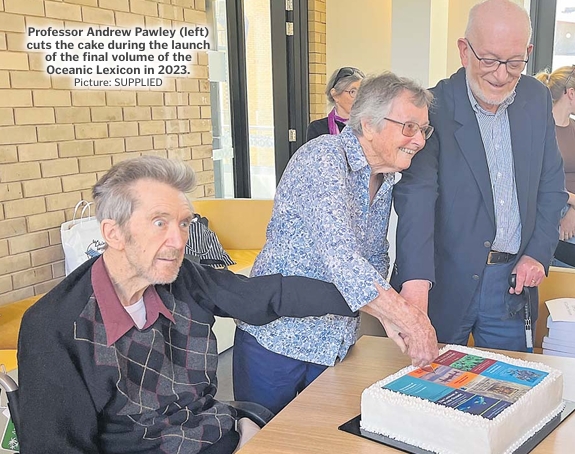
PROFESSOR Andrew Pawley, known affectionately in Fiji as Voli, has passed away in Canberra after a long and distinguished career as a linguist specialising in the study of Pacific languages, including Fijian.
He was born Andrew Kenneth Pawley in Sydney on March 31, 1941, then moved to New Zealand at the age of 12, where he was educated at Napier Boys High School and the University of Auckland.
He studied linguistics in the anthropology department, there being no linguistics department at that time, and carried out important research on two Pacific languages: Samoan, for which he was awarded an MA, and Karam (or Kalam), a non-Austronesian language of Madang province in the highlands of Papua New Guinea, for which he was awarded a PhD.
It was at Auckland that his interest in Fijian languages began, when he came under the wings of Bruce Biggs (later Professor). Dr Biggs had come to Fiji with the New Zealand army during the Second World War, not trained as a linguist but fluent in Māori. He carried out research on communalects of Nadroga, Ba and Ra which was later published, and with his daughter Mary published on the language and traditions of the remote island of Cikobia in Macuata.
Voli assessed this and other research on Fiji communalects, and decided that the language of Waya in the Yasawas was most interesting, so he set out to study it, while teaching linguistics at Auckland and the University of Hawai’i at Manoa in Honolulu.
In 1990 he moved to the Research School of Pacific and Asian Studies at the Australian National University in Canberra, where he continued research and publication on Pacific languages, notably co-authoring the colossal six-volume reconstruction of Proto Oceanic vocabulary that resulted from the Oceanic Lexicon Project.
His main collaborator in Fiji was Timoci Sayaba of Yalobi in Waya, a man he had come to know through his eldest daughter, Merewalesi, who was studying at Auckland.
They not only worked together on the Wayan grammar and dictionary, but also carried out research in other parts of Fiji, and were the first to publish on the communalect of Nabukelevu in western Kadavu, in 1982.
In the early 1970s, they travelled extensively, mainly around Vitilevu, and collected data from about 20 communalects, taking boats or buses to villages of interest and staying for a day or two. Data was recorded from Keiasi (Nadroga), Lewā (Savatu), Naimasimasi (Serua), Rabulu (Ra), Nadrau, Nasoqo, Nabobuco, and Nabukavesi (Namosi).
These studies resulted in a paper that was the first to demonstrate scientifically that there are two major subgroups of Fijian, western and eastern, and that they are so distinct they should be referred to as separate ‘languages’, as different as, for example, English and Dutch.
However, it is for their work on Wayan that Pawley and Sayaba are best known in Fiji. Apart from the grammar and dictionary, entitled ‘Words of Waya’ and published in 2022 by the Australian National University Press, they published a number of research papers, including one arguing that Wayan, unlike standard Fijian and most eastern Fijian communalects, has a word corresponding to English ‘to be’. Another explored the complex possessive system of Wayan, in which, for example, the English possessive pronoun ‘our’ has something like 30 different translations, all with precise meanings.
Since Voli was committed to lecturing in Auckland, Timoci regularly visited him there so they could continue work on the dictionary and grammar.
Timoci passed away in 1987 and Voli continued working with his family and other people of Waya.
Voli was also involved in the establishment of the Fijian Dictionary Project, financed initially by the American actor Raymond Burr, in 1971. It developed into the Institute of Language and Culture. More recently, he was commissioned to be the external assessor of the linguistics program at the University of the South Pacific.
The monumental work ‘Words of Waya’ is now a standard text that is continuously referred to by scholars of Pacific languages and much praised for its accuracy and comprehensiveness. In most respects it eclipses dictionaries of Standard Fijian (‘Bauan’).
It contains definitions, most with scientific identifications, of over 500 plants, 400 fish, and 300 animals and other natural species.
Voli was married to Medina, from the Philippines, and they had two sons, Victor and Matthew, who often accompanied him on his fieldwork in Waya. As lexicographers often do, Voli featured his family in examples of usage in the Waya dictionary, for example: A wavu mai i na gilō o Maciu qa qei tacum i ne isogo ‘Matthew was running this way in the dark and hit his head on the door’, O Vikitā sā dagia na lea itūtū o tamaya ‘Victor is taking on the burden of his father’s position’, and Qi lai dīvia nō mai na leqiau kani vinā iva Medina ‘I will be thinking longingly of the nice meals I enjoyed at Medina’s place’.
He retired in 2006, but continued working at his home in a leafy suburb of Canberra not far from the University. In 2015 he was diagnosed with Parkinson’s disease and managed to carry on working to some extent with medication and exercise, but by 2023 was hospitalised and moved into a care home in Canberra, where he passed away peacefully on 22nd March this year, at the age of 84.
His international honours included being elected Fellow of the Australian Academy of the Humanities (1991) and Fellow of the Royal Society of New Zealand. He was also honoured by the presentation of a festschrift — a book containing research papers by colleagues and former students in linguistics – in 2010.
Voli was a man of many parts. Apart from linguistics he enjoyed sports, especially cricket, and combined the two interests with a ground-breaking linguistic study of cricket commentary.
He was also exceedingly kind and helpful, for example meeting every one of the participants at a conference in Auckland at the airport and driving them to their accommodation, a courtesy few were expecting!
He will be missed not only by his family, now including five grandchildren, but by the hundreds of students of Pacific languages, including myself, who have benefited over the years from his unstinting guidance and kindness.
Incidentally, ‘Moce rē’ is Wayan for ‘moce mada’.
n PAUL GERAGHTY is a significant figure in Fiji’s linguistic and cultural heritage. He has been involved with The Fiji Times as a columnist. Dr Geraghty works for the University of the South Pacific

