
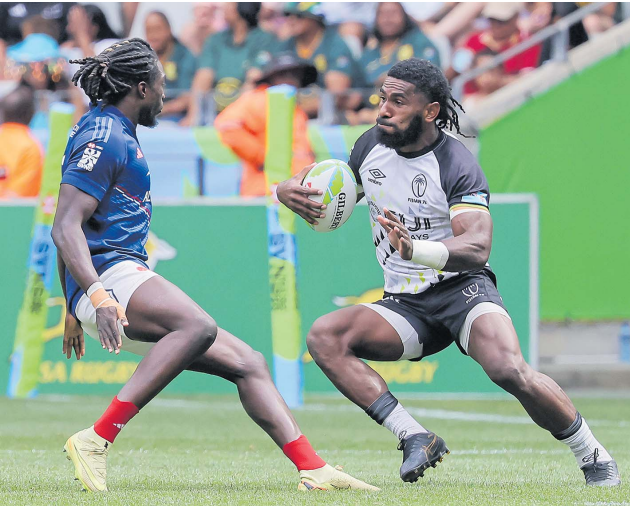
The HSBC SVNS tournaments in Dubai and Cape Town have served as a reminder of a familiar yet disheartening experience for fans of the Fiji Airways National 7s team. Qualifying for cup semi-finals in both and taking out the bronze medal made Fiji the best-ranked consistent performer.
After all, the cut-throat nature of the new series format with eight teams battling for honours in six events makes the going tough. Every pool match is crucial, and it’s like watching finals footy from the start of the competition. There are no easy games or weaker opponents anymore.
For Fiji 7s, there are glimmers of the classic Fijian flair. The dominant pool stage displays, particularly in Dubai and their huge victory over Dubai champions New Zealand in the Cape Town pool (35-5), as well as their pulsating victory over France in the bronze medal match in Cape Town, reveal a side that is beginning to find form. But if a serious tilt at major prizes is to be achieved, technical improvements are needed.
Qualifying for the semi-final in consecutive competitions is a sign of good performance and playing in tough company. It also ensures that we are beating those teams that we are supposed to beat and are holding our own with the best. However, true champions are those who not only take part but also emerge victorious. The closeness of our defeats in the semi-finals in Dubai and Cape Town also shows that it is the small matters that are deciding our outcome.
Focus area
First-up tackles and rugged defence: This is also a major area where leaks are common. Very often, a lone defender has been left all by himself and has not been able to complete a tackle, which has allowed an effortless run-in for a clean break, thereby letting a lot of space open up. There has to be a mandatory standard of robust line speed and “man and ball” engagement in a tackle that has to be ruthlessly enforced. Coach Osea Kolinisau’s emphasis on defence patterns, as pointed out above, has also got to result in their ruthless implementation, but to keep it legal and not to get penalised or carded.
Decision-making: This is true for both attack and defence. Being able to commit to a ruck, a defence line, or an offload in preference to taking a tackle for a quick ball change, when in reality there has been no pressure, represents high-pressure decision-making. Many attack opportunities are blown by players taking indicative offloads and passes.
Work rate and rucks: The breakdown is the essence of Sevens rugby, and for Fiji, it has been very inconsistent. Our success has always been built around attacking from broken play, our offloading ability, and gaining quick, clean possession, but too often, we go for the 50-50 pass or offload and avoid the ruck. Rucking, a vital part of Sevens, requires a lot of effort to maintain a high work rate to gain possession of the ball quickly to supply our potent back line.
Recruit alert
Meanwhile, with these issues being addressed by established players, there are still talented players being discovered from local tournaments. A player who caught my attention, and I firmly believe that this player needs to be given a shot ahead of the next assignment, is Devo Barbarians Etuate Qalibau. He can be the answer in providing some continuity for the playmaking or rover position.
Watching Qalibau play at last week’s Super 7 Sevens tournament, I realised that he is a player with a combination of Fijian flair and rational thinking that isn’t often seen. One of the first things that you notice about him is how slick he seems to be. He slips into a tackle, leaving opponents reaching for air, when it seemed as though no space existed.
However, there’s much more to Qalibau than an attack-bound promise. This player also has plenty of tenacity and prowess as a defender.
Most importantly, in the role of playmaker/half-back or fly-half or rover, his direction in a match seems to be of sharp acumen. Qalibau appears to be playing with an acute understanding of match situations, realising when to speed up, when to slow down, and when to let his flair run. His addition to the long list of players in the squad would bring a much-needed dynamism, as well as a new element of control.
Moving on
The platform for enjoying a degree of consistency has been established with back-to-back semi-final appearances in Dubai and Cape Town. Oscar now has to temper his analytical sword and come up with solutions that will see our side go one better or reach the podium for gold in Singapore on the first day of February.
Incorporating bright prospects like Etuate Qalibau may be all that is needed for a turning from bronze to gold. Let us maintain hope and look forward to the next show from our Flying Fijian sevens.

