
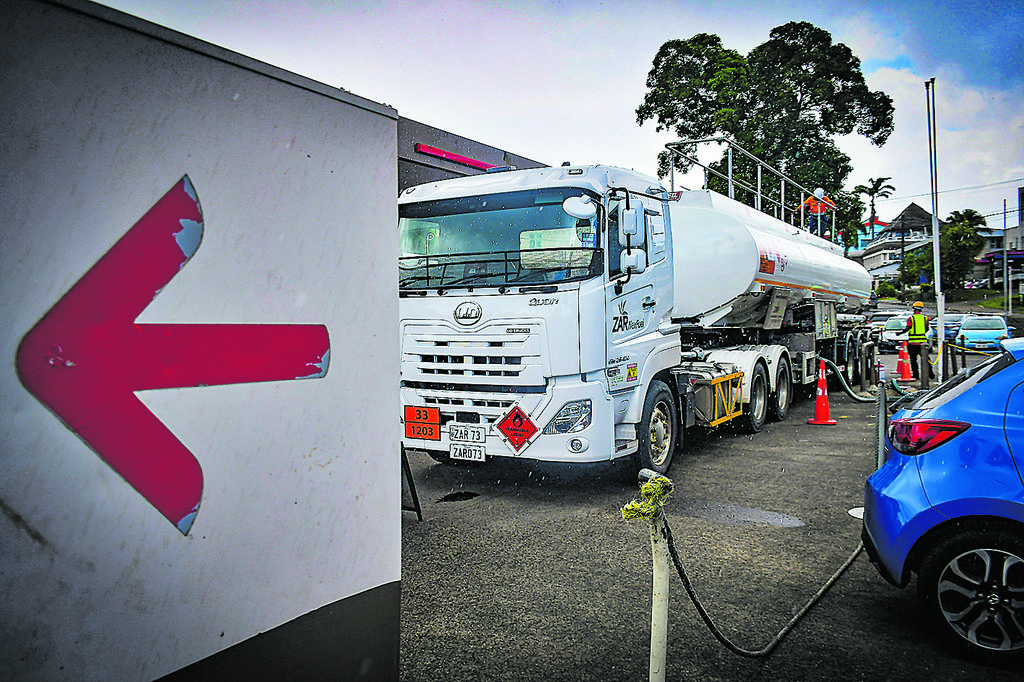
When Brent crude crosses $US127 and diesel reaches $FJ3.82 at the Fijian pump, the Strait of Hormuz is no longer a distant strategic concern — it is a domestic economic condition. Fiji imports every litre of its liquid fuel, carries a national debt approaching $FJ11.70 billion, and has no strategic petroleum reserve, no refining capacity, and no fiscal buffer large enough to absorb a sustained energy shock. The IMF calls it a close call for global recession. Fiji’s institutions must decide whether they are on the right side of that call.
FROM May 1, 2026, Fijians pay $FJ3.82 for every litre of diesel, $FJ2.99 for kerosene, and $FJ3.13 for unleaded petrol.
The Fijian Competition and Consumer Commission confirmed on April 30 that international diesel and kerosene prices rose between 60.38 and 69.60 per cent from March to April 2026, freight rates by 48.72 per cent, and that without its gradual absorption approach, diesel alone would have exceeded $FJ4.50 per litre.
Brent crude, which averaged $US65 to $US70 per barrel before the Strait of Hormuz escalation, reached $US127 before easing marginally. At the IMF Spring Meetings in Washington on April 14, 2026, IMF chief economist Pierre-Olivier Gourinchas warned that the Gulf conflict was “potentially much, much larger” than the Trump tariff shock and that the global economy now faced a close call for recession under the most severe scenarios.
For Fiji, which imports every litre of its liquid fuel, this is not distant diplomacy. It is a structural economic sentence arriving at the pump.
What stagflation actually means
The term stagflation was coined by British Conservative Member of Parliament Iain Macleod in a 1965 address to the House of Commons, describing the combination of economic stagnation and rising inflation that confounded orthodox policy.
It gained devastating global currency during the 1970s oil shocks, when OPEC’s 1973 embargo and the 1979 Iranian Revolution drove crude prices to levels that simultaneously pushed inflation upward and growth downward.
The policy paradox it creates is its defining danger. Standard recessions call for rate cuts and stimulus; standard inflation calls for tightening.
Stagflation makes both tools contradictory: easing fuels inflation, tightening deepens stagnation.
It is a supply-side condition driven by external shocks, most commonly energy price surges that raise the cost of producing everything while simultaneously destroying purchasing power.
The 2026 Hormuz disruption is a textbook negative supply shock of exactly this character, and Fiji, which imports every litre of fuel it consumes, sits at the most exposed end of the transmission chain.
The IMF’s three-scenario warning
The IMF’s April 2026 World Economic Outlook, subtitled ‘Global Economy in the Shadow of War’, presented three scenarios.
The reference scenario projects global growth at 3.1 per cent in 2026 with inflation at 4.4 per cent — already a material deterioration from the 3.4 per cent growth the IMF projected in January before the Hormuz closure.
The adverse scenario, sustaining oil near $US100 per barrel through 2026, drops growth to 2.5 per cent while inflation climbs to 5.4 per cent.
In the severe scenario, extending into 2027, growth falls to 2 per cent while inflation exceeds 6 per cent.
IMF chief economist Pierre-Olivier Gourinchas stated on April 14 that this constituted ‘a close call for a global recession’.
The IMF identified the sharpest pressure as falling on low-income developing economies carrying pre-existing fiscal vulnerabilities. Fiji satisfies both criteria without qualification: it imports 100 per cent of its liquid fuel and carries a debt-to-GDP ratio of 83.3 per cent in FY2025–2026.
UNCTAD: Developing economies most exposed
UNCTAD’s April 2026 assessment of the Hormuz disruption projected global merchandise trade growth decelerating from 4.7 per cent in 2025 to between 1.5 and 2.5 per cent in 2026, with global output falling from 2.9 to 2.6 per cent.
UNCTAD identified import-dependent developing economies as the most severely exposed, describing a compounding mechanism: higher energy prices inflate import bills, weaker currencies amplify those costs, and tighter global financial conditions erode governments’ capacity to respond.
For Pacific Island states, this transmission channel arrives without insulation.
Fiji has no domestic oil production, no refining capacity, and no strategic petroleum reserve.
Every price movement in the Strait of Hormuz registers directly at the Nadi fuel terminal.
When Brent exceeds $US120, shipping costs accelerate disproportionately: fuel surcharges rise, marine insurance premiums climb on conflict-adjacent routes, and tanker scheduling tightens.
Fiji absorbs a dual import cost shock simultaneously: higher commodity prices and higher delivery costs on the same shipment.
Fiji’s economic vulnerability profile
The Asian Development Bank’s April 2026 Asian Development Outlook projected Fiji’s GDP growth moderating to 2.9 per cent in 2026 and 2.7 per cent in 2027, down from 3.5 per cent in 2024, with the Middle East crisis flagged as an explicit downside risk through higher prices and shipping disruptions.
Critically, ADB projected inflation rebounding to 3.3 per cent in 2026 from deflation of minus 1.4 per cent in 2025 — decelerating growth alongside surging inflation is the textbook stagflation configuration.
Fiji’s debt position leaves minimal fiscal room to respond.
The Ministry of Finance’s Medium Term Fiscal Strategy records a debt-to-GDP ratio of 83.3 per cent for FY2025–2026.
Government debt reached $FJ10.309 billion in July 2024, projected at $FJ11.70 billion by July 2026.
A net fiscal deficit of $FJ886 million, equivalent to 6 per cent of GDP, leaves the government with limited capacity to absorb further cost on behalf of its citizens without deepening the structural deficit.
The diesel multiplier across the economy
Diesel at $FJ3.82 is not a single price point.
It is an economic multiplier that propagates through every sector simultaneously.
In transport and logistics, fuel represents up to 40 per cent of operating costs; those costs transmit through landed import prices, wholesale margins, and retail shelf prices.
Every grocery item in a Lautoka store, every bag of flour in a Labasa shop, every cold drink in a Sigatoka kiosk carries embedded diesel at $FJ3.82.
The FCCC’s gradual pricing mechanism converts a single shock into a rolling inflation cycle with no clear stabilisation point.
The sugar industry carries the sharpest exposure.
Over 93 per cent of Fiji’s cane crop moves by road.
The Fiji Sugar Corporation, whose $FJ200.2 million debt was written off by Cabinet, has allowed rail to deteriorate for decades.
A single locomotive replaces 80 to 100 trucks and cuts fuel consumption by up to 75 per cent per tonne.
At $FJ3.82 per litre, the cost of road haulage is approaching the value of the cane itself.
Fertiliser costs have risen 30 to 50 per cent simultaneously, compressing every farmer’s margin before the first tonne is harvested.
Where the recession threshold lies
A recession requires two consecutive quarters of contraction in real GDP across multiple sectors. Fiji is not there.
GDP is growing at 2.9 per cent in 2026, supported by tourism, remittances, and private consumption.
But the path from stagflation to recession is sequential: inflation erodes purchasing power, consumption falls, production slows, investment stalls, and contraction follows.
The Reserve Bank of Fiji faces the stagflation dilemma in its sharpest form.
Raising rates to contain inflation risks strangling the credit growth currently sustaining domestic demand.
Holding rates steady risks allowing inflation expectations to become unanchored.
Gourinchas made the stakes explicit on April 14, 2026: the 1970s lesson was that an energy shock allowed to embed itself as an ongoing inflation problem cost central banks enormously more pain to reverse than an early, disciplined response would have required.
The Reserve Bank of Fiji is not the 1970s Federal Reserve. But the arithmetic is the same.
The verdict for Fiji’s institutions
Fiji is not in recession today. It is in the formation stage of stagflation: GDP decelerating, inflation rebounding from minus 1.4 per cent to a projected 3.3 per cent in a single year, an external energy shock with no resolution date, and national debt approaching $FJ11.70 billion by July 2026.
The pump price is the most visible symptom. The institutional failures underneath it is the disease.
The Reserve Bank of Fiji must issue a formal inflation expectations statement before the end of May 2026.
Silence is not neutrality. It is the abdication of the one instrument the central bank controls.
The Ministry of Finance must table a supplementary budget presenting the full fiscal cost of the fuel shock, including the EFL duty concession and the $FJ56 million redeployment, without cannibalising further capital expenditure to fund what is becoming a structural recurrent cost.
The Fiji Sugar Corporation cannot enter the 2026 crushing season without a Cabinet decision on rail.
At $FJ3.82 per litre, 93 per cent of cane moving by road is not a management problem. It is an existential one.
A Cabinet that wrote off $FJ200.2 million in FSC debt without rehabilitating a single kilometre of cane rail must answer for that omission this season.
And Parliament, which voted itself a 138 per cent salary increase in 2024, passed a 20 per cent cut saving $FJ1 million, and defeated the 50 per cent reduction that would have demonstrated genuine sacrifice, must understand what Fijians understand at the pump every morning. Fiji was built by people who could not afford to wait.
That standard has not changed.
DR SUSHIL K SHARMA BA MA MEng (RMIT) PhD (Melbourne), is a World Meteorological Organisation accredited Class 1 Professional Meteorologist, a former Associate Professor of Meteorology at the Fiji National University and Manager Climate Research and Services Division at the Fiji Meteorological Services. The views expressed are those of the author alone and not of this newspaper.

