

Fiji witnessed something of a surprise, whilst all our attention was distracted by the Energy Fiji Limited (EFL) tariff increase and the FCCC-EFL debacle. A Tender was released too quietly, as if EFL was trying to evade public scrutiny of it in the midst of the nation preoccupied with the price of electricity increase saga, to take effect on 1 January 2026, but now delayed for a 21-day stakeholder submission phase.
On December 29, 2025, the EFL quietly published a two-page tender document, in The Fiji Times, that should have immediately triggered national debate especially when there are two new dams to be built, one is the Qaliwana Hydropower Project and the other Vatutokotoko (Lower Ba River) Hydropower Project. The include significant tunnelling, dam words and powerhouse constructions including major civil, hydraulic and electro-mechanical works. Further work includes connection to the national grid and also complete upgrade of the present system, all bundled and locked into the same five billion dollar project.
Instead, it appeared during the holiday period, when public attention was already consumed by controversy surrounding electricity tariff increases. Yet buried within the technical language of this tender is a proposal of extraordinary scale: a United States dollars two-billion renewable energy and grid modernisation program, to be implemented between 2026 and 2029.
In local terms, this equates to approximately $4.5 to $5 billion. For a small island nation of fewer than 900,000 people, this is not routine infrastructure spending. It is one of the largest financial commitments in any nation modern history; especially so for a nation where the bulk of the population lives below the poverty line. Despite the project’s magnitude, capital injection, design and framework, the program has not been debated in Parliament, examined by a select committee, or subjected to bipartisan scrutiny. Fijians were unaware of its existence until public pressure over tariffs forced greater attention on EFL’s activities.
This opinion commentary is not about tariffs, but the burden via this program that the nation will suffer for generations. Here I look at the nuances of the advertised tender based on the International Procurement Notice, as advertised in the Fiji Times in the December 29, 2025, issues.
The 2026–2029 Renewable Energy Infrastructure Program: What is being proposed
The tender outlines what EFL describes as a “multi-asset” program forming the backbone of Fiji’s transition to approximately 90 per cent renewable electricity by 2035. In plain terms, the multi-billion-dollar project comprises of four major elements. First, there is accelerated expansion of renewable electricity generation, primarily solar and hydroelectricity. Second, there is extensive grid modernisation, including transmission upgrades and system reinforcement to accommodate intermittent generation. Third, there is the integration of energy storage and system-balancing infrastructure. Fourth — and most consequential — is the inclusion of two new hydroelectric developments, embedded within broader language of modernisation and transition.
Each of these components, taken individually and implemented gradually, could be defensible. What is not defensible is compressing all of them into a four-year window, tied to an aggressive numerical target, without transparent explanation of cost, sequencing, financing or risk.
The tender does not clearly state how much of the $US2b relates to each component. It does not explain how financing will be structured, what proportion will be debt, what proportion will be grants, or how repayment will be managed. It assumes inevitability — that this transformation must happen now, at this scale, and at this cost.
That assumption demands scrutiny. The 90 per cent renewable target: A number detached from global reality
The entire program is justified by a single ambition: that Fiji should reach approximately 90 per cent renewable electricity by 2035. This figure is presented as progressive and aligned with global climate responsibility. This is manifestly incorrect. In reality, it places Fiji far outside the global mainstream of energy policy.
Very few countries operate electricity systems at or above 90 per cent renewable penetration. Those that do — such as Norway, Iceland and Costa Rica — possess exceptional geographic and geological advantages, including massive hydro and geothermal resources developed gradually over many decades. They are not comparable to small island systems with limited hydrological redundancy and fragile grids. Australia offers a particularly relevant comparison. Despite its vast landmass, abundant solar and wind resources, deep capital markets and decades of investment, Australia struggles to move beyond the mid-70 per cent range even in long-term projections. These projections depend on enormous expenditure on transmission, storage and subsidies. The political consequences have been severe. Electricity prices have risen sharply, becoming a defining cost-of-living issue. Governments have faced voter backlash and electoral instability precisely because promised price reductions failed to materialise.
Europe tells a similar story. Germany’s much-celebrated Energiewende has required hundreds of billions of euros in investment, yet household electricity prices remain among the highest in the world. Grid instability, industrial competitiveness concerns and public resistance have forced repeated policy recalibration. Across Europe, governments are quietly retreating from rigid numerical targets in favour of affordability-focused, technology-neutral approaches.
Globally, the trend is clear. Countries are reassessing the pace and cost of transition. Many are scaling back earlier pledges. Some have abandoned rigid targets altogether. Against this backdrop, Fiji’s pursuit of a 90 per cent target appears not visionary but disconnected from global experience, and not aligned to science and neither a reasonable proposition for the tiny island nation, where citizens live on a hand to mouth day to day living.
Climate science, natural variability and the manufactured sense of urgency
As a World Meteorological Organization, fully accredited Class 1 Professional Meteorologist, Environmental Research Scientist and a Climatologist with over four decades of experience, I state this plainly: climate change is real – and has been so for millions of years since the evolution of our planet earth. What is increasingly problematic is the way climate science in politicised by politicians and institutions without much thought, often based on climate simulation where models often can not even replicate the present climate, leave aside the scenario in 30-, 50- or 100-years’ time. Novices today are guilty of being influencers advising our politicians, planners and mapping policy directions, often under gloom and doom scenarios, towards policy urgency of nations like Fiji.
Around the world, virtually every flood, cyclone, drought or heatwave is now attributed exclusively to climate change. Natural variability — including ENSO cycles, decadal oscillations and regional hydrological patterns — is frequently ignored.
This selective framing creates a permanent sense of crisis, which is then used to justify rushed, irreversible infrastructure decisions like this one.
Urgency, however, is not a scientific parameter. Climate models do not prescribe a four-year window within which Fiji must commit itself to multi-billion-dollar capital expenditure. They do not demand the immediate construction of new dams. They do not require small island nations to expose themselves to sovereign financial risk in order to meet misguided aspirational targets. Science calls for common sense adaptation, resilience and proportionality, not haste at any cost. Fiji’s emissions and the limits of moral signalling
Even if Fiji were to achieve 100 per cent renewable electricity tomorrow, the impact on global climate outcomes would be negligible. Fiji’s emissions are statistically insignificant in the planetary carbon budget. This is not an argument against environmental responsibility; it is an argument against economic self-harm disguised as moral leadership.
Climate action that impoverishes small nations does not save the planet. It merely shifts costs onto those least able to bear them, while major emitters continue to determine global outcomes. Symbolism must not be mistaken for substance.
Environmental stewardship should enhance national resilience and welfare, not undermine them.
Timing the Transition: Why the Rush Makes No Economic Sense
The timing of the proposed 2026–2029 program is as troubling as its scale. Unlike the 1970s, when the Monasavu hydro scheme was justified amid genuine energy insecurity and oil price shocks, today’s conditions are fundamentally different. Oil prices are relatively low. Battery and storage technologies continue to fall in cost. Grid management tools are evolving rapidly. Fiji has no large-scale AI data centres requiring massive cooling loads, no heavy industrial expansion driving exponential demand, and modest, predictable population growth. Under these circumstances, rational energy planning would prioritise flexibility, staged investment and optionality. Instead, the tender proposes to lock Fiji into a compressed four-year transformation — precisely the type of decision that forecloses future choices and exposes the nation to technological and financial obsolescence.
Even if a major transition were contemplated, delaying it by a decade would allow costs to fall, technologies to mature and alternatives to emerge. Rushing now achieves nothing except risk.
Dams and the global record of cost blowouts
Hidden within the language of “renewable transition” and “grid modernisation” is the most dangerous element of the program: additional hydroelectric developments.
Globally, large dam projects are among the most failure-prone forms of infrastructure ever undertaken. Academic studies consistently show cost overruns averaging between 100 and 200 per cent, with delays stretching into decades. Environmental mitigation costs escalate as river systems are altered. Social compensation liabilities expand as communities resist displacement.
Once construction begins, projects cannot be abandoned. Governments do not leave half-built dams in river valleys. For small island states, this creates a debt trap. A $F5b program can easily become $F8-$10b by completion. Fiji’s own history offers a warning. When the Monasavu hydro scheme was built, electricity tariffs were doubled almost overnight — from roughly seven cents per unit to fifteen cents — justified as a temporary sacrifice. Those prices never came down. Infrastructure costs, once embedded, become permanent.
There is no credible global evidence that electricity prices fall after being elevated to fund large-scale renewable infrastructure.
Paris, net zero and what they actually mean for Fiji
Much confusion surrounds the Paris Climate Agreement and the concept of “net zero,” particularly in small developing states. For ordinary citizens, these terms are often presented as moral imperatives rather than policy choices. It is, therefore, necessary to explain, plainly and without ideology, what these commitments are — and what they are not.
The Paris Agreement is not a binding enforcement treaty. It contains no penalties, no sanctions, and no legal mechanisms compelling countries to meet specific targets. Instead, it operates on voluntary national pledges, known as Nationally Determined Contributions (NDCs). Each country sets its own targets based on national circumstances, capabilities and priorities. These pledges can be revised, delayed or withdrawn entirely without legal consequence. Net zero, similarly, is not a scientific endpoint. It is a policy construct that allows emissions to continue so long as they are notionally “offset” elsewhere. There is no global accounting authority, no universally accepted methodology, and no enforcement mechanism. Many offsets exist only on paper. Even among developed nations, net zero has become a flexible political slogan rather than a measurable outcome. Crucially, the Paris framework explicitly recognises that developing countries must prioritise poverty reduction, economic development and energy access. It does not require small island states to impose high electricity prices on their citizens, nor does it demand front-loaded capital expenditure that risks long-term debt distress. To suggest that Fiji is somehow obligated to pursue a 90 per cent transition towards renewable electricity target, as shown in the tender documents, within a compressed timeframe, is therefore a misrepresentation of the Paris Agreement itself.
Global political retreat from rigid climate targets
Across the world, the politics of climate transition are changing — rapidly and visibly. The era of uncritical acceptance of ambitious numerical targets is ending, replaced by a renewed focus on affordability, reliability and national interest.
In Australia, climate and energy policy has become one of the most polarising issues in modern politics. Electricity prices have surged, driven by renewable subsidies, transmission buildouts and premature closure of dispatchable generation. These costs have flowed directly into household bills, small business closures and industrial contraction. Entire electoral campaigns have been fought — and lost — on energy affordability. The Australian government has announced that all gas and exploitation from this year will require that 25 per cent of the gas is reserved for local use, rather than sold overseas due to the need to lower electricity costs as the rapid transition towards Paris accord targets even at less than 70 per cent has meant that the nation needs to rely on gas and also old coal energy generation power stations to carry on operating for some time in the future after 2035.
In the United Kingdom, successive governments have quietly walked back earlier commitments after recognising that the costs of rapid transition disproportionately burden working families. Even within the European Union, once the epicentre of climate ambition, countries are reintroducing gas, extending coal plant lifespans and reconsidering nuclear power — all while softening earlier timelines. The United States offers the clearest example of policy reversal. “Drill baby drill! Drill baby drill” has become the slogan used by President Trump. Federal commitments fluctuate dramatically between administrations.
Entire climate programs are dismantled and rebuilt depending on electoral outcomes. Major states pursue divergent strategies, reflecting the reality that energy policy is inseparable from cost-of-living politics. The global lesson is unambiguous: no nation sustains ambitious transition targets once electricity affordability becomes politically toxic.
Fiji’s transition is not apolitical
To present Fiji’s 90 per cent renewable ambition as a neutral, technical decision is misleading. Energy transitions are inherently political because they determine who pays, who benefits and who bears risk. In Fiji, electricity consumers are being asked to absorb rising tariffs today in exchange for promises of future stability. Yet those promises are not supported by global evidence. Instead, they mirror the same narratives used elsewhere — narratives that have already failed. The claim that Fiji must “lead by example” ignores the asymmetric reality of global emissions. Leadership that impoverishes one’s own citizens while delivering no measurable planetary benefit is not leadership; it is symbolism at public expense. Transition policy must therefore be judged not by virtue signalling, but by outcomes.
Shareholding, governance and the question of conflict
One of the most troubling silences surrounding the EFL tender is the complete absence of process and procedure for an undertaking of this huge magnitude of proposed transition towards renewable energy. No public discussion about shareholding structure and governance alignment.
EFL is not solely owned by the Fijian public. A significant minority shareholding is held by foreign institutional interests. This creates a potential conflict between national welfare objectives and commercial incentives. Renewable megaprojects globally have proven highly profitable for equipment suppliers, consultants, financiers and developers — often irrespective of outcomes for consumers. The tender document provides no reassurance that project structuring, procurement or financing decisions are insulated from these incentives. Nor does it explain how shareholder interests are balanced against the rights of citizens as captive electricity consumers. In democratic systems, such decisions would be examined by Parliament, audited independently and debated publicly. None of this has occurred.
Democratic deficit
Perhaps the most fundamental question remains unanswered: who authorised this scale of proposed commitment and the tender process towards the procurement notice that was advertised in The Fiji Times in a two-page spread on December 29, 2025. There has been no parliamentary mandate. No select committee inquiry. No independent cost-benefit analysis released to the public. No referendum. No national consultation process. Electricity consumers are effectively involuntary shareholders. They cannot opt out. They cannot choose alternative suppliers. Their only protection lies in governance transparency and accountability.
Yet this tender was released quietly, without public explanation, during a holiday period together with the background of the simmering noise towards the proposed tariffs increase public notice by EFL and news reports on that subject.
In any democracy, committing a nation to multi-billion-dollar infrastructure costs, with decades-long consequences demands explicit political consent. Silence is not consent.
Poverty, inequality and energy burden
More than a third of Fiji’s population lives in or near poverty. Many reside in informal settlements. Many struggle to pay existing electricity bills. For these households, discussions of “net zero,” “transition pathways” and “renewable integration” are abstract at best and irrelevant at worst. High electricity prices are regressive. They punish the poor disproportionately. They increase food costs, transport costs and housing insecurity.
They erode small business viability and employment. In future due to the project of this nature, electricity priceswill be raised on all the citizens irrespective of usage, due to burdens of the transition -its ony a matter of time -as users remain captive to EFL unlike other nations where there are often a number of competing energy suppliers. To argue that such households must bear rising tariffs to fund aspirational infrastructure projects is ethically indefensible. Climate policy that ignores social equity is not progressive — it is punitive.
The ministerial question that must be answered
EFL has indicated that its transition strategy aligns with government policy in the tender document. If this is so, then responsibility does not rest with EFL alone. It rests squarely with the Minister responsible for energy.
The public is entitled to clear answers: (1) When was the 90 per cent target adopted? (2) What evidence supports its feasibility? (3) What alternative pathways were considered? (3) What cost ceilings exist? (4) What protections are in place for consumers? (5) What happens if costs double — as global history suggests they will? Apart from this of course there will be many more questions as to the process, procedure and complete lack of transparency on this matter and the other question if the Fiji Government was at any stage consulted, if the cabinet ever discussed this project given its size and the fact that the EFL is majority owned by the people of Fiji.
Rational path forward
Fiji does not need a revolutionary energy transition. It needs evolutionary improvement.
Incremental upgrades to existing infrastructure. Targeted solar where it makes economic sense. Grid resilience investments without megaproject commitments. Deferred decisions until technologies mature and costs fall. A focus on affordability, reliability and national welfare — not international applause.
Even with a small modest token renewable increase by 2035 would place Fiji among responsible global actors, without exposing it to existential financial risk. This would be in contrast with nations like USA who have refused to be even part of the Paris accord and have gone the other direction -maybe Fiji should take a back seat and observe events globally before taking an adventure in suicide.
Conclusion
This is not an argument against renewable energy. It is an argument against recklessness. A four-year, $F5b or more infrastructure gamble, justified by a target no comparable nation pursues, without democratic mandate or transparent financing, is not leadership. It is hubris. Fiji must pause. Reassess. Debate openly. Align energy policy with national, regional and global reality, not imported ambition.
Once committed, this path cannot be undone. That is precisely why it must be questioned — now. Climate action that impoverishes small nations does not save the planet — it merely shifts costs onto those least able to bear them. What is increasingly problematic is not climate science itself, but the way it is politicised and operationalised into rushed policy.
Disclaimer: Dr Sushil K. Sharma BA MA MEng (RMIT) PhD (Melbourne) is a World Meteorological Organisation (WMO) accredited Class 1 Professional Meteorologist, and is an Associate Professor of Meteorology FNU. The views expressed are that of the author and not necessarily shared by The Fiji Times.
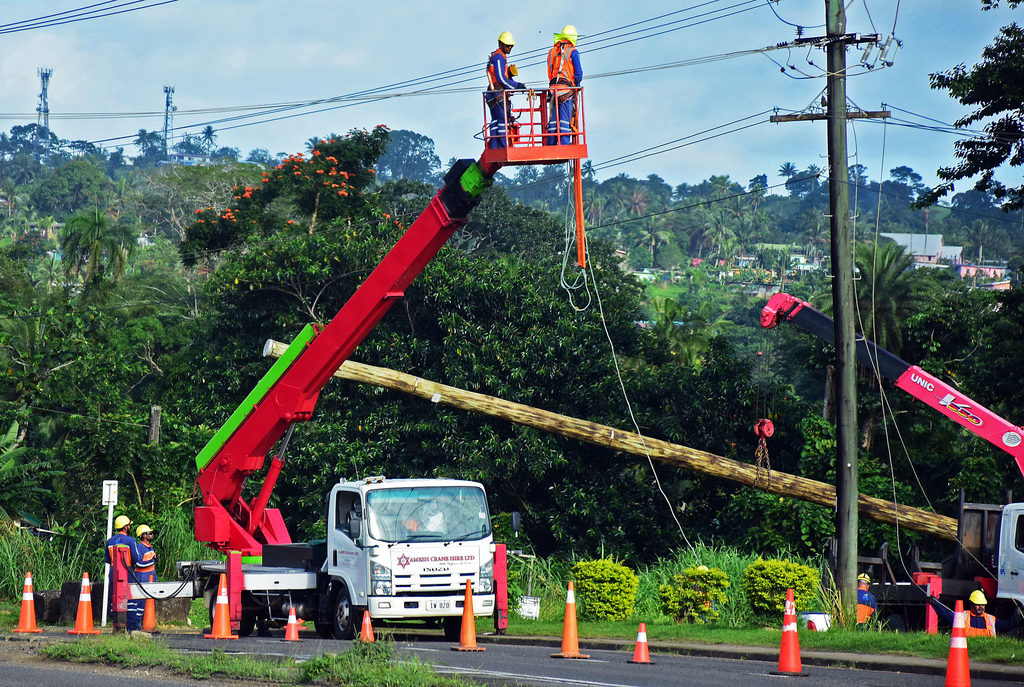
EFL workers working on power lines in Lami. Picture: FILE
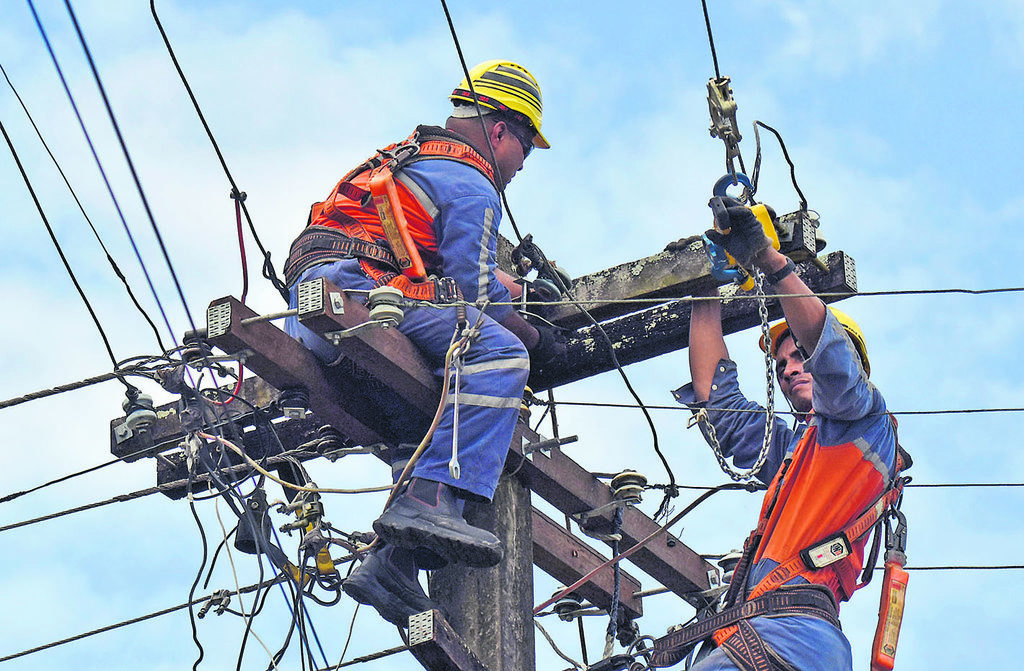
EFL workers working on power lines at Toorak in Suva. Picture: FILE

