
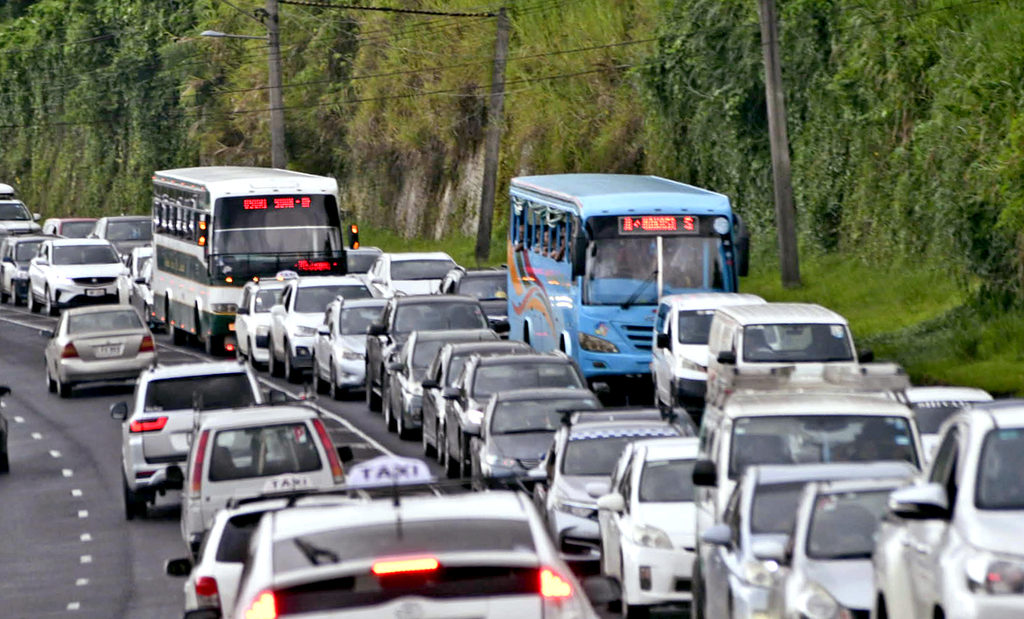
Traffic jams in the Suva–Nausori corridor and Nadi’s choked roads are not a transport failure.
They are an economic distress signal, and we are ignoring it.
Anyone who has inched along bumper-to-bumper in peak hour knows the real cost: lost hours, missed opportunities, rising fuel bills, frayed tempers, and a steady erosion of productivity. For many Fijians, congestion is no longer occasional, it is daily.
At first glance, the explanation seems obvious: too many cars, poorly timed lights, not enough roads. So we reach for familiar fixes — staggered working hours, ferry proposals, traffic optimisation, incremental upgrades.
They may ease the pressure briefly, but they do not solve the problem because they are treating the symptom, not the system that created it.
Traffic is not the problem. It is the signal.
And the signal is telling us something we have been reluctant to confront.
Before we spend more millions trying to move vehicles faster, we must ask a far more uncomfortable question: Why are so many people being forced to move in the first place?
A problem we keep managing — but never solve
Congestion now defines daily life along Suva–Nausori, Nadi–Lautoka, and increasingly Lami–Suva. Commutes stretch from minutes to hours. Fuel is burned idling. Productivity is lost before the workday even begins. Quality of life is quietly eroded.
Government responses focus on managing the flow — adjusting hours, optimising signals, exploring alternatives.
But they act only after the pressure has already built. They do not reduce the pressure itself. And that pressure is no longer a minor inconvenience.
It is a structural economic cost — draining time, fuel, income, and national productivity every single day.
The people behind the traffic
Look past the vehicles, and the real pattern comes into focus.
Today, 60 per cent of Fiji’s population lives in urban centres, a dramatic shift within a single generation. Most are first or second generation migrants from rural communities, with the movement driven heavily by young people.
This is not traffic growth. It is population displacement.
People are not simply choosing to move, they are being pulled by opportunity and pushed by the absence of it at home. Villages are thinning out. Land is underused. Skills are leaving.
Meanwhile, cities are absorbing pressures they were never designed to carry — more people, more demand, more strain on roads, housing, and services. What we are seeing on our roads is not just congestion. It is the movement of a nation.
The real driver: Economic design
Why would anyone leave fertile land for uncertain urban life? Because opportunity has been concentrated in the wrong place. This is not a matter of preference. It is a matter of design.
We have built an economy that rewards movement toward consumption, instead of building production where people and land already exist.
In doing so, we have inverted the natural logic of development: People leave productive land to chase income, while the country imports what that land could produce. At the same time, Fiji now spends over $F2.7billion every year importing fuel and food, the very essentials of life.
This is not trade. It is structural dependence.
The equation we cannot ignore
Import more » produce less » people move » cities choke.
That is not a coincidence. It is the system, reduced to its simplest form. Every arrow represents a policy choice. Every outcome is predictable. And until this equation changes, nothing else will.
The cycle that follows
As import dependence rises, the consequences unfold in sequence:
Local production declines;
Rural jobs disappear;
Youth migrate (to cities or overseas via PALM/RSE);
Villages hollow out;
Urban populations surge;
Informal settlements expand;
Infrastructure buckles;
Traffic congestion worsens;
And the cycle does not stop there — it compounds.
Remittances provide short-term relief, but much of that income quickly pays for imported goods and leaves the economy after a single cycle. Consumption rises. Imports rise. GDP appears stronger on paper. But the foundation weakens. Real production declines. Self-reliance erodes.
Meanwhile, imported diets replace local food. NCDs rise. Healthcare costs escalate. Household pressure increases. Inequality deepens. National vulnerability grows. This is not a broken system. It is a self-reinforcing one.
Not a panning failure — a system outcome
It is easy to blame infrastructure, but that is only the surface.
The deeper truth is this: We have designed an economy that pulls people off the land, and pushes them into traffic.
Opportunity is concentrated in a few urban corridors, while productive land across the country remains underutilised. So people move. Pressure builds. Cities choke.
This is not a failure of roads, signals, or planning. It is the predictable outcome of economic concentration. The issue is not how many vehicles our roads can carry. It is how many people our system is forcing into them.
The missing piece: Execution
Fiji does not lack plans. We have agriculture strategies, food security frameworks, land resources, and deep reservoirs of traditional knowledge.
What we lack is execution. Policies remain fragmented. Coordination across ministries is weak. And too often, incentives tilt toward imports and urban consumption rather than local production.
So while the strategy speaks of food security and rural development, the system continues to pull in the opposite direction. We plan for production, but we fund and reward dependence.
And as long as that misalignment persists, the rural-to-urban drift will continue, not because people want to leave, but because the system leaves them little choice.
The way forward: Fix it upstream
Real solutions do not begin on the road. They begin in the system. If congestion is the symptom, then production is the cure.
We must rebuild economic activity where people already live — activating land, supporting village enterprise, and creating viable rural livelihoods that remove the need to migrate in the first place.
Two immediate system shifts can begin to unlock this pathway:
Build landowner-led village enterprise systems — mobilising Fiji’s 1193 villages as productive economic units by linking land, labour, and capability. This requires evolving existing land frameworks so landowners can participate directly — not just as lessors, but as partners and shareholders — in farming, agro-processing, and rural enterprises.
Many of Fiji’s land and governance systems were shaped during the colonial era to prioritise protection and administrative control. While they succeeded in preserving ownership, they were not designed for organised, large-scale economic participation. The result is a system that protects land, but does not fully enable it.
Updating these frameworks to support direct landowner participation, enterprise partnerships, and merit-based local leadership can reconnect authority with accountability and production with opportunity. In pre-colonial practice, leadership was not only inherited, but affirmed through service, capability, and community confidence. Reintroducing space for merit, participation, and local choice within modern governance can strengthen both economic performance and social cohesion.
The objective is simple: Turn idle land into active production — supported by finance, training, and the skills already developed through PALM/RSE experience.
Create the institutional bridge between production and markets — aligning supply with demand so production is not speculative but assured. This means building coordinated value chains that connect village producers directly to national demand — tourism, supermarkets, schools, hospitals, and processors.
This must be backed by enabling infrastructure — irrigation, storage, logistics, and local agro-processing — alongside targeted, time-bound tariff support where necessary to allow domestic production to scale and compete.
Because farmers do not produce into hope. They produce into markets.
This is not about isolation from trade. It is about reducing dependence.
It is about shifting from a consumption-driven model to a production-led economy.
When villages produce, migration slows. When migration slows, pressure eases. When pressure eases, congestion reduces. Fix the system upstream — and the downstream problems begin to solve themselves.
A signal we cannot ignore
Traffic is not just a problem. It is a warning. A visible signal of a system under strain.
Fix the system that keeps pushing people into traffic, and congestion will ease.
Ignore it, and rural-to-urban drift will continue concentrating pressure exactly where it is already breaking us — in our roads, our cities, and our social fabric.
The problem is not the traffic. It is the economic model that keeps feeding it. We must break out of the default reflex to build more roads and optimise traffic flow.
And ask a deeper question: Are we building an economy where people can thrive where their roots are — or are we simply managing the migration it produces?
Signals like this do not fade. They intensify until they become crises we can no longer manage.
SUNIL CHAND is an engineer and reform strategist with three decades of senior-level experience across manufacturing, regulation, and higher education. The views expressed herein are his and are not of this newspaper.

