
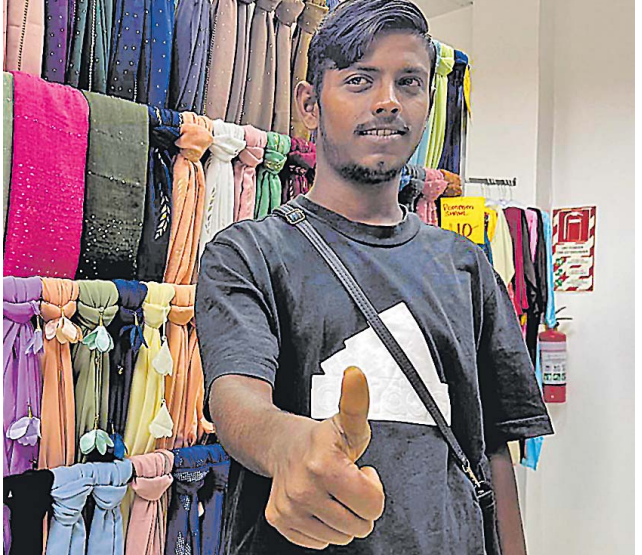
TO many, he is simply known as Musa, the young Labasa man who was reported missing by police, but sighted a few days later at a function in Bua.
Many more would learn after he was reunited with his family that he spoke the Bua dialect and was quite at ease talking about his “escapades” with villagers in the days he was listed missing.
Yesterday, the affable young man shared how, for five years, he lived as one of them — waking to village routines, sharing meals cooked over open fires, speaking a dialect that was not his own, and calling two strangers ‘mum’ and ‘dad’.
For five years, he slept under a roof that was never meant to be his, ate food he did not help grow, and answered to a name that was not written on his birth certificate.
The years he spent living in a village far from home would quietly shape the man he is today. He was taken in by an iTaukei family from Navakasiga in Bua at a time when life had become unbearable with his own family.
Here, with Kavaia and his family, Musa found more than just a shelter. He found belonging.
Musa, whose real name is Mohammed Muzammil Hussain, shared how his life has been shaped by quiet suffering, illness, loss and the rare kindness of people who opened their hearts when his own world was falling apart.
“I lived the way the family lived,” he said softly.
“I shared their meals. I shared their life.”
Life of hardship
The third of five siblings, he was raised in Benau by parents who taught their children early that nothing comes easy.
“We didn’t grow up with a silver-platter life.”
His father was from Savusavu, his mother from Dogoru.What they had was love — but not much else.
As the years passed, illness crept into the family. One brother now battles cancer.
Musa and his mother live with diabetes, a condition that demands constant care, constant travel and constant money — something the family has never had in abundance.
“To visit the hospital, we need money.”
So he worked — selling roti, beans and seo, sometimes walking long distances to make a few dollars. When he could not sell them himself, he sent the food to Bua. The family raised ducks and chickens, doing whatever they could to survive another week.
When grief arrived
Life became even more difficult last year when his father passed away.
The loss was painful, but it also placed more responsibility on Musa’s shoulders.
At home, there is also his younger sister, who is still in primary school and depends on the family for her education and daily needs.
“We have to look after her. She still has a future ahead of her.”
At one point, tensions at home became too much, leading Musa to move out.
With nowhere else to turn, he was taken in by Kaiyava’s family from Navakasiga in Bua, a gesture Musa says changed his life.
“They accepted me as I was,” he said.
No questions, no conditions
What started as a temporary stay became a five-year chapter in his life.
“I lived the way the family lived, shared their meals and daily routines, and learned their customs.”
During that time, he picked up the Bua dialect and came to understand the culture deeply.
“The husband and wife became my parents.
“They treated me as their own child.”
The quiet strength of kindness
The experience taught him the value of kindness and unity, especially during times of hardship.
He said the support from close family and friends, along with the care he received from the Navakasiga family, helped him endure some of the hardest moments of his life.
“Without their support, I wouldn’t be where I am today.”
Despite everything, he remains grateful for the support he has received over the years.
He believes that without the help of family, friends and kind-hearted people, life would have been far more difficult.
“My family is my priority. Especially my mother and my sister.”
Today, Musa continues to move forward, doing what he can to support his family and manage his health.
He hopes that by sharing his story, people will better understand the silent struggles faced by many ordinary Fijians.
For his mother, the greatest relief is knowing that her son is safe.
For those who only knew him as Musa, his story now stands as a powerful example of endurance, compassion, and hope in the face of adversity.

