
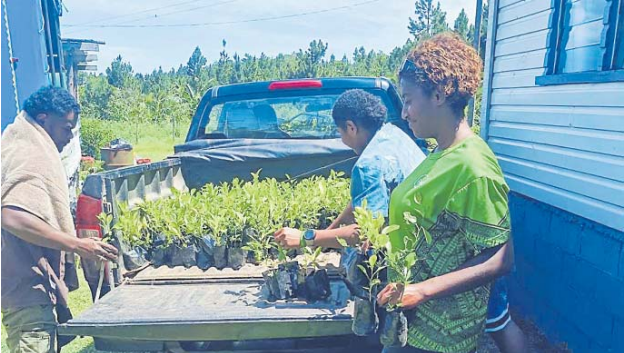
A sapling may be small, but the message from the Ministry of Forestry this week was anything but.
As officers fanned out across Fiji’s Central and Eastern division, more than 1400 kumquat seedlings changed hands – from government trucks to farmers, vendors and households quietly building livelihoods one plant at a time.
It is a modest fruit with an outsized purpose: putting income, resilience and opportunity directly into communities.
For the Ministry of Fisheries and Forests, the distribution marked more than an agricultural exercise. It was a snapshot of a year the Government says has fundamentally reshaped how Fiji manages its forests, land and people-centred development.
Minister for Fisheries and Forests Alitia Bainivalu said the initiative reflected a deliberate shift towards practical, ground-level support for ordinary Fijians.
“This is about strengthening household livelihoods and giving communities practical tools to earn sustainably,” Ms Bainivalu said.
“When we support small-scale growers with quality planting materials, we are investing in long-term income, food security and resilience.”
The seedlings were distributed across several key locations in the division.
Four hundred were delivered to Mr Johnny of Uluibeka in Colo-i-Suva, another 400 to Mr Matana at Vicorocoro settlement in Tailevu.
A further 400 were collected from Sawani Village for Mr Laisiasa Kubu and Mr Kaminieli, while 200 seedlings were delivered to Mr Kaminieli Turagalada along Qiolevu Rd.
Many of the recipients are already active vendors, supplying local markets and roadside stalls where kumquats prized for their flavour and versatility fetch reliable returns.
For some families, the fruit represents an opportunity to diversify income at a time when living costs remain tight.
But the kumquat rollout is also symbolic of a much larger picture.
According to Ms Bainivalu, 2025 has been a “highly productive and transformative year” for the forestry sector, anchored by sweeping legal reform that has been decades in the making.
At the centre of that reform is the Forestry Act 2025, which replaced outdated legislation and modernised the governance of Fiji’s forest resources. The new law strengthens enforcement powers, enhances environmental safeguards and formally recognises emerging areas such as community forestry, trees outside forests and climate-responsive forest management.
“This legislation gives us a much stronger foundation,” she said.
“It ensures forestry development aligns with sustainable development principles, climate resilience, landowner equity and long-term economic value.”
The passage of the Forestry Act is widely regarded within the sector as the most comprehensive reform in decades, closing gaps that had long hindered effective conservation, compliance and community participation.
Alongside this, the Ministry successfully facilitated the tabling of the Mahogany Bill 2025 for its first reading in Parliament following Cabinet endorsement.
The Bill proposes a new governance framework for Fiji’s mahogany industry, replacing structures that critics have long argued were outdated and opaque.
Mrs Bainivalu said the proposed reforms would strengthen transparency, ensure sustainable management and improve landowner participation in one of the country’s most valuable forestry assets.
Beyond timber, the ministry has also pushed hard on diversifying forestry-based livelihoods.
Throughout 2025, targeted work was undertaken to advance Non-Timber Forest Products (NTFPs) as a strategic pillar of forestry development.
Bamboo, forest-based handicrafts and other value-added products have been prioritised, with policy direction, capacity-building and enterprise development rolled out in partnership with communities.
“These initiatives are about livelihood diversification.
“They support community-based enterprises while aligning with our national climate resilience and green growth objectives.”
The Ministry has not been without challenges.
Balancing competing land-use demands remains a persistent issue, particularly in areas where agriculture, housing and conservation interests collide.
Compliance and enforcement in remote locations including parts of Taveuni, where encroachment into forest reserves has been an ongoing concern has also tested capacity.
Managing stakeholder expectations, especially among landowners and industry operators, has required careful navigation.
Mrs Bainivalu said many of these challenges were being addressed through continuous engagement and the clarity provided by the new Forestry Act.
“With the Act now in place, roles, responsibilities and processes are clearer.
“That strengthens compliance and gives communities greater confidence in how decisions are made.”
Economic development, she stressed, has not come at the expense of environmental stewardship.
While harvesting activities have continued to support industry and jobs, these have been balanced through replanting and rehabilitation initiatives, particularly under the Reforestation of Degraded Forests (RDF) projects.
These projects aim to restore forest cover, improve ecosystem resilience and ensure harvested areas remain productive for future generations.
The ministry has also expanded its focus beyond plantation forestry.
A week-long mangrove planting programme at the Walu Bay foreshore, held as part of the build-up to Fiji Day celebrations in October, highlighted the role of forestry in coastal protection, biodiversity enhancement and climate change adaptation.
“Mangroves are one of our strongest natural defences.
“They protect communities, support marine life and help mitigate climate impacts.”
Looking ahead to 2026, the ministry’s priorities are firmly focused on implementation.
Key tasks include developing subsidiary regulations under the Forestry Act 2025, strengthening institutional capacity and bolstering compliance and enforcement on the ground.
Progressing the Mahogany Bill through Parliament and operationalising its provisions including new governance mechanisms and landowner benefit structures will also be a major focus.
The ministry will continue investing in reforestation, community forestry programmes, climate resilience initiatives and value-added forest industries. Work on REDD+ and results-based financing, including emission reduction payments, will also remain central to Fiji’s international climate commitments.
“2026 will be about translating reform into real outcomes.
“We want forests that are managed sustainably, contribute meaningfully to the economy and deliver lasting benefits to landowners and future generations.”
Back in Colo-i-Suva, Vicorocoro and Sawani, those ambitions are already taking root – one kumquat seedling at a time.

