
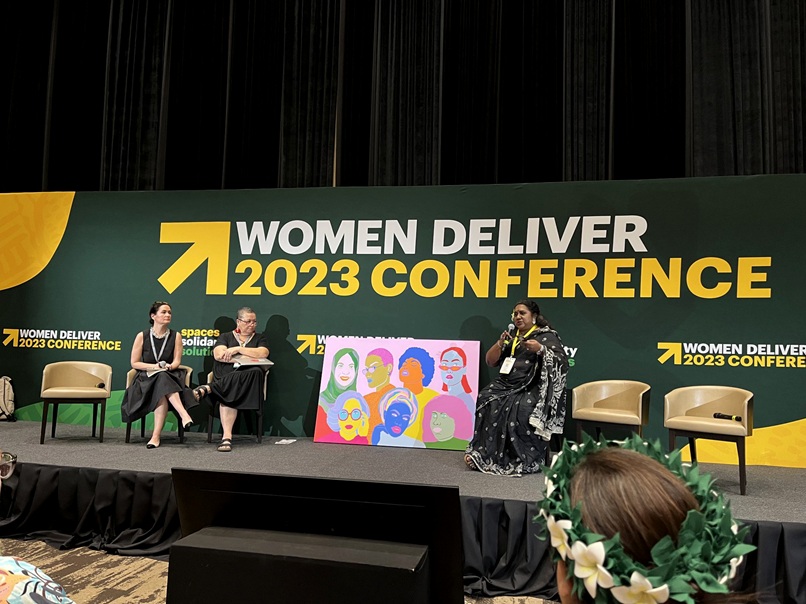
When Nalini Singh walks into the Women Deliver Conference in Naarm (Melbourne) this year, she will not be going as a grateful guest. She will be going as an agenda-setter, and she wants the world to know the difference. As executive director of the Fiji Women’s Rights Movement, Singh carries with her the weight of a region that holds some of the highest rates of gender-based violence on the planet, faces an escalating climate emergency, and yet remains persistently marginal in the rooms where global decisions are made. That, she says, is precisely why a conference like Women Deliver matters and precisely why showing up is not enough. “For me, the Women deliver conference Naarm is a critical platform for Fiji and the Pacific because it creates space for our voices, realities, and solutions to be heard on a global stage that too often sidelines small island contexts,” she said. “This conference is not just about visibility, but about shifting power, ensuring that Pacific feminists in all our diversity are not simply participants, but agenda-setters.”
A region on the frontlines of everything
The Pacific is no stranger to crisis. Communities across the region grapple daily with the compounding pressures of climate change, economic precarity, and entrenched gender inequality what Singh calls a “poly-crisis”. Yet for all the complexity of these challenges, the solutions being built at the community level are rarely afforded the global recognition they deserve. Ms Singh wants that to change. Women deliver 2026, she argues, is an opportunity not just to tell the Pacific story, but to use it to challenge funding priorities and reshape narratives that have long been written by others. “It is an opportunity to challenge global narratives, influence funding priorities, and assert that lasting change must be informed by those of us working on the frontlines in our own communities.” The conference’s four-part theme: Disrupt the now, build the vision, align for action, and sustain the movement gives Singh and the FWRM a framework that resonates deeply with the work being done on the ground in Fiji.
Disrupting the comfortable
The call to “Disrupt the now” is not an abstract rallying cry for Singh. It is a direct challenge to the pace and politics of gender equality progress in Fiji — progress she describes as incremental at best, cosmetic at worst. “Disrupt the now’ speaks to the urgency of challenging the systems and norms that continue to hold women, girls in all our diversity back in Fiji. “For me, it means moving beyond incremental change and confronting the root causes of inequality — patriarchal norms, rigid gender roles, and institutional gaps that allow violence and discrimination to persist.” Her frustration with the status quo is pointed. After decades of investment and programming, women are still being asked to carry the burden of change while harmful masculinities, she argues, go largely unaddressed. “It is about questioning why, despite decades of investment and programming, women are still expected to carry the burden of change while harmful masculinities remain largely unaddressed. “Disruption in this context requires us to be bold, to rethink who holds power, and to push for approaches that transform – not just accommodate existing systems.”
Building a Fiji where equality is foundational, not an add-on
If disruption is the method, the vision is equally ambitious. Ms Singh describes a future Fiji in which gender equality is not a policy footnote but the structural foundation upon which society is built — a vision that is particularly urgent, she notes, as the country navigates its current constitutional reform process. “The future I believe Fiji should be working towards is one where gender equality is not treated as an add-on, but as foundational to how our society functions. “This means a Fiji where women and girls in all our diversity live free from violence, have full bodily autonomy, and are able to participate equally in economic, political, and social life.” Crucially, Ms Singh’s vision does not stop at women’s advancement. It demands a reimagining of masculinity itself – of what it means to lead, to parent, to share power. “It also means reimagining the roles of men and boys, particularly in caregiving and leadership, so that equality is not achieved at the expense of women carrying a double burden. “The vision must be transformative — one that reshapes power relations in homes, communities, and institutions, rather than simply improving women’s position within unequal systems.”
Partnership, not tick-box consultation
For Ms Singh, one of the sharpest fault lines in Fiji’s gender equality efforts lies in the relationship between government, civil society, and communities. Too often, she says, women’s rights organisations are treated as implementers, handed down agendas from governments or donors, rather than recognised as equal partners in shaping them. The conference theme “align for action” calls for stronger collaboration, but Ms Singh is clear: collaboration has conditions. “Meaningful collaboration in Fiji requires a shift from consultation to genuine partnership, where civil society, especially women’s rights organisations are recognised as equal actors rather than just erroneously just seen as implementers of government or donor agendas.” She also sounds a warning against the kind of coordination that quietly burns out the organisations it claims to support. “Collaboration must not come at the cost of overburdening feminist organisations that are already stretched thin.” Her preferred model is integrated and whole-of-society – one where responsibility for gender equality is spread across education, health, justice, security, faith communities, and government alike, rather than siloed into the portfolio of a single ministry or a handful of underfunded NGOs.
The funding problem no one wants to talk about
Sustaining a movement is not a matter of passion alone. It requires money — consistent, long-term, flexible money that allows organisations to build, adapt, and absorb the inevitable setbacks that come with challenging deeply held social norms. That kind of funding, Ms Singh says, remains stubbornly elusive. “Too often, funding is short-term and project-based, which limits the ability to drive lasting change. “We also need to prioritise intergenerational leadership, ensuring that young women and girls in all our diversity are supported to step into advocacy and decision-making spaces.” Sustaining the movement also means being honest about resistance — the backlash that comes when gender equality efforts push against the grain of tradition and entrenched power. “Sustaining the movement means addressing backlash and resistance, particularly as gender equality efforts challenge deeply held norms. “This requires not only resources, but political will and a commitment to protecting and amplifying feminist voices over time.”
Feminist leadership: Strong in civil society, missing in power
When asked about feminist leadership, Ms Singh does not hesitate. It is, she says, “absolutely central” to driving meaningful change precisely because it disrupts the hierarchies that have long defined who get to lead, and how. In Fiji and across the Pacific, that leadership is visible and powerful within civil society. But Singh points to a persistent gap between the grassroots and the formal structures of government and institutional power. “We are seeing strong feminist leadership, particularly within civil society, but it is still not sufficiently reflected in political and institutional spaces where key decisions are made. “There remains a gap between grassroots leadership and formal power structures and bridging that gap is critical.” The implications stretch beyond politics. “We need to see more feminist principles shaping not just advocacy, but good governance, policymaking, accountability, rule of law and resource allocation across the region.”
FWRM at the table and in the room where it happens
The FWRM arrives at Women Deliver 2026 not as a late addition to the programme, but as an organisation that helped shape it. FWRM has been part of the Regional Steering Committee that organised the conference — a committee chaired by regional feminist stalwart Noelene Nabulivou. “Fiji Women’s Rights Movement has been an integral part of the organising of this Women deliver as part of a dynamic regional steering committee “FWRM will play an important role in bringing grounded, evidence-based feminist analysis from Fiji and the Pacific into global conversations.” Ms Singh is clear about what that role entails: sharing lessons, challenging narratives that do not reflect Pacific realities, and building solidarity with other movements around the world. It is also, she says, an opportunity to pull the levers of global influence in directions that actually matter for women and girls at home. “It is an opportunity to build solidarity with other movements and influence global agendas in ways that are meaningful for women and girls in Fiji.”
From rhetoric to accountability: What Singh wants to see
As the conference approaches, Ms Singh has a clear-eyed sense of what success looks like and it is not a communiqué full of well-worded commitments. She wants accountability. She wants money to follow promises. And she wants the Pacific’s community-driven model recognised not as a footnote, but as a legitimate, leading approach to gender equality. “What I would like to see from Women deliver 2026 is a shift from rhetoric to accountability, particularly in how global commitments translate into real change at the national and community levels.” That means increased and sustained funding for local women’s rights organisations. It means a stronger emphasis on violence prevention that actively engages men and boys. And it means resisting the temptation to frame women’s empowerment as a standalone solution to problems that are, at their core, about power and who holds it. “I also hope to see outcomes that challenge the current paradigm — moving beyond empowering women in isolation to addressing the systems and power structures that drive inequality.” “Ultimately, the conference should result in tangible commitments that are responsive to the realities of women and girls in Fiji, not just global priorities.” For Ms Singh, that distinction between global priorities and lived Pacific realities is the whole point. And she is heading to Melbourne to make sure nobody in the room forgets it.
- Note: The Women Deliver 2026 Conference will be held in Naarm (Melbourne), Australia from April 27-30.

