
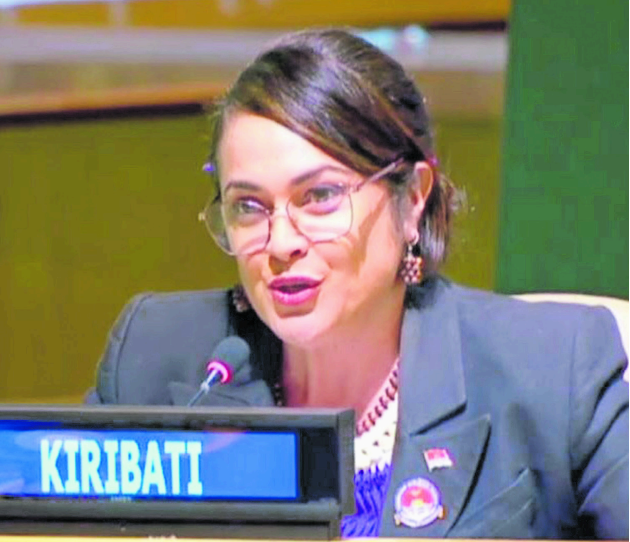
In July last year, something happened at the International Court of Justice in The Hague that had never happened before.
The world’s highest court handed down a landmark advisory opinion confirming that states carry legal obligations to protect the climate system. It was a ruling that climate advocates had been fighting to achieve for years. And the campaign that got it there did not begin in a European capital or at a Washington think tank.
It began in the Pacific Islands, driven in large part by Pacific law students, including young women, who had decided they were not prepared to wait.
“What began with a campaign launched by law students,” says Ruth Cross Kwansing, a member of parliament for Kiribati, “culminated in a landmark advisory opinion confirming states’ obligations under international law to protect the climate. Women were among its most prominent voices.”
Ms Kwansing tells this story with a particular kind of precision.
She is not prone to hyperbole, which makes her direct assessments all the more striking. She represents one of the most climate-exposed nations on Earth: Kiribati, a low-lying island republic in the central Pacific whose land sits barely two metres above sea level at its highest point, and whose future is being decided in rooms where its people are rarely given a seat.
That is what she intends to change.
It does not shape life equally
Ms Kwansing does not speak about climate change as a looming threat. In Kiribati, she says, it is already happening in compounding and overlapping ways, and it is not happening to everyone in the same way.
“Climate change is not a future risk to be modelled. It is a present reality shaping daily life. And it does not shape it equally.”
When climate impacts hit communities in Kiribati, she explains, they arrive together: water insecurity, food disruption, land loss, the collapse of health services, economic dislocation. All at once. And the weight of managing those crises falls, as it historically has, on women and girls.
“Access to reproductive health and maternal care is disrupted at exactly the moment it is most needed.”
But she pushes back against any reading of this as simply a story about geography. The vulnerability of Pacific women is not an accident of where they live, she argues. It is the product of systems.
“These vulnerabilities are not simply produced by geography. They are produced by systems; economic, political, colonial that have long under-resourced the most exposed communities, particularly remote and outer island communities. The climate crisis compounds injustices that were already there.”
In Kiribati, women are the primary managers of household food and water security. They are the first to adapt when resources are disrupted, and the custodians of community knowledge about how to do so. For Ms Kwansing, that is not incidental. It is the entire point.
“Sustainable climate solutions have to be built around that knowledge and that role. Not designed elsewhere and delivered to communities.”
Building a framework that lasts
Ms Kwansing is measured when she describes what Kiribati has done at the policy level, speaking more like someone reporting an honest assessment than mounting a PR exercise.
“Our Kiribati Climate Change Policy explicitly names gender inclusion as a core principle. Our National Gender Policy and our Eliminating Sexual and Gender-Based Violence Policy both name climate change and disaster risk as priority areas. The connection between gender equality and climate justice is embedded in our national framework. We are not making it up as we go.”
She also points to social protection as a climate resilience tool that international actors consistently underestimate. Kiribati’s social protection system, she says, reaches a significant portion of the population. In her view, that is climate policy.
“When people have a safety net, when they know that if a climate event disrupts their livelihood or their food supply there is something to catch them, they are better placed to absorb that shock and recover from it. Supporting people’s wellbeing today builds their capacity to withstand what is coming tomorrow.”
The government is also partnering with Kindling Kiribati, a small business development initiative, on the basis that financial empowerment is itself a form of climate resilience.
“The evidence is clear: when women are financially empowered, they become genuine decision-makers in resilience planning. Not just recipients of it.”
The young women who went to The Hague
Ask Ms Kwansing about the generation coming up behind her and the precision in her voice softens into something closer to awe.
“Young people across our region are doing extraordinary things. I have watched them achieve what those of us in formal institutions have not managed.”
The Pacific Islands Students Fighting Climate Change, a youth-led regional movement that included young women, is her primary exhibit. Their campaign drove the resolution that led to the ICJ advisory opinion, and it passed the UN General Assembly unanimously, by consensus. The first time any such resolution had done so.
“Young Pacific people stood before the world’s highest court and made the case for climate accountability with a clarity and conviction that moved the entire process forward.”
She is equally insistent that the broader ecosystem of Pacific feminist organising deserves recognition it rarely receives. She names organisations like DIVA for Equality in Fiji, the Pacific Islands Feminist Alliance for Climate Justice, and the Kiribati-based Nei Mom Uprising, a women’s organisation whose membership spans stay-at-home mothers, single mothers, teen and young mothers, and elders.
“Leadership does not begin at a conference table. It begins in a community.”
In 2025, Nei Mom Uprising conducted consultations that brought women together across Tarawa to articulate what the climate crisis means to them. What emerged was not abstract.
“It was about the safety of girls travelling to school, about food security, about the loss of land and what that means for identity and culture. Women who had never before described themselves as climate advocates came away understanding that this is their issue and their fight.”
The barriers that money and privilege do not fix
Ms Kwansing is careful not to let the success stories obscure the structural reality facing young Pacific women who want to participate in global advocacy.
For young women on outer islands, she explains, participating in international forums means ocean crossings, visa applications, and costs that are entirely prohibitive without external support. For young women with disabilities, the barriers arrive earlier.
“The barriers begin long before they reach any venue, in the assumptions made about their capacity to lead, in economic marginalisation, in the absence of accessible information, and in the reality that for many, simply getting to a platform is not possible without support systems that do not exist.”
There is also the weight of caregiving, the expectations that tell young women to defer, and the absence of mentoring and sponsorship networks for those from outer islands and remote communities. And then there are the structural realities of international processes themselves.
“The way international processes are designed, how funding flows, whose frameworks tend to dominate these, make meaningful participation genuinely difficult for communities like ours. These are not problems any individual young woman can solve on her own. They require systemic responses.”
What Women Deliver must deliver
Women Deliver 2026 will be held in the Pacific for the first time in its history. For Ms Kwansing, the significance of that is not merely symbolic.
“For the first time, Women Deliver is regionally hosted by the Oceanic Pacific. That is a signal about whose knowledge and leadership belongs at the centre of these conversations.”
But she is frank about what she expects beyond the optics. Amplification, she says, is not the same as power.
“You can broadcast someone’s voice and act on none of what they say.
“What Pacific women deserve from WD2026 is for our testimony to be connected to transformative change.
“Not just policy tweaks, but a genuine redistribution of who holds power in climate governance, in development finance, in the institutions that make decisions about our futures.”
She wants the WD2026 Declaration to contain real commitments on climate finance, loss and damage, and direct resourcing of feminist organisations at community level. She wants accountability mechanisms. And she wants an honest confrontation with the power imbalances embedded in how international processes are designed.
“Without accountability, declarations are gestures.”
The reversal she is not embarrassed to admit
When Ms Kwansing turns to what she wants from governments and international bodies, she is, by her own description, direct. The Pacific, she says, has been patient for a very long time. She calls for climate finance that is genuinely gender-transformative as a structural requirement, not an add-on. She calls for commitments to nations bearing the greatest burden of a crisis they did not create, framing them as obligations rather than charity. And she calls for the resourcing of movements, not just governments.
“The programs that protect women from gender-based violence, build economic independence, and fund community resilience are not peripheral.
“They are the foundation on which everything else is built. When funding to gender and climate initiatives is cut or frozen, it is always these communities that pay the price first and longest.”
On one issue, she makes a public concession. She has changed her position on temporary special measures for women’s political representation.
“I have done a complete reversal from where I started, and I am not embarrassed to say so. The evidence is clear — in countries with legislated gender quotas, women’s parliamentary representation is significantly higher. We need that same intentionality at international climate bodies. And we need women from the frontline nations in the rooms where decisions are made.”
Resource the movements, not just the meetings
Her final call is perhaps the most pointed.
The conventional funding architecture, she argues, is not reaching the people who need it. The Pacific Feminist Fund, she says, exists precisely because it was not. The PIFA4CJ network operates on the same principle: movement-led grantmaking that puts communities in the driver’s seat.
“These are not peripheral experiments. They are proof of concept. What is needed now is sustained, flexible, trust-based funding to organisations like these at a scale that matches the urgency of the crisis.”
She returns, at the end, to Nei Mom Uprising and to the women in Tarawa who participated in their consultations and came away seeing themselves, for the first time, as climate advocates.
“That shift, from receiving information to claiming leadership, is exactly what this kind of resourcing makes possible.
“That is a question for all of us in positions of influence — donors, international institutions, and governments like mine — to answer with action. Not just intention.”
-Note: Women Deliver 2026 will be held in Melbourne later this month. The theme is: Change calls us here.

