
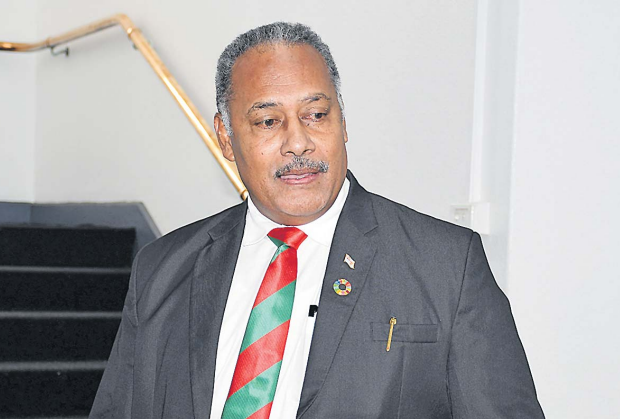
The Government will not approve the controversial Vuda waste-to-energy project without strict legal, environmental and public scrutiny, Foreign Minister Sakiasi Ditoka says.
In a detailed response to former journalist Charlie Charters, Mr Ditoka has laid out in the clearest terms yet what must happen before the proposed 900,000-tonne incinerator can move forward.
His message is firm: Fiji will examine the project, but it will not rush it.
The comments come amid growing public criticism of the planned facility for Vuda–Saweni, with communities, landowners and environmental advocates demanding answers on its potential impact.
At the centre of the debate is a key distinction the Government wants the public to understand – consideration does not mean approval.
“Cabinet endorsed the normal due diligence process to proceed. It did not endorse the project itself to proceed,” Mr Ditoka said.
That process, already underway, is expected to determine whether the project is viable, lawful and in Fiji’s national interest.
What happens next
Mr Ditoka reiterated what Environment Minister Lynda Tabuya said – that Cabinet has not approved the project.
Instead, the proposal was only presented to Prime Minister Sitiveni Rabuka, who directed investors to follow formal government channels.
The project now sits in its early assessment phase.
A full environmental impact assessment (EIA) funded by the private proponents is currently under review by the Ministry of Environment.
This will be followed by public consultations involving Vuda-Saweni residents, nearby landowners and traditional custodians.
Only after those steps are completed will the proposal return to Cabinet for any decision.
For Mr Ditoka, this process is not a formality — it is the safeguard.
“A proposal of this scale… must be tested rigorously,” he said.
Legal, environmental and public hurdles
Mr Ditoka made it clear that like any other proposal, the project will face scrutiny across multiple fronts.
That includes legal compliance, particularly around international obligations such as the Waigani Convention, which restricts the movement of hazardous waste into Pacific Island countries.
“If there are questions… they must be addressed plainly and early,” he said.
Environmental risks, including emissions, water safety and coastal impacts will also be examined in detail through the EIA process.
Equally critical will be public confidence.
Mr Ditoka pushed back against remarks attributed to project proponents dismissing critics, saying communities have every right to question a development of this magnitude.
“That is not selfishness. That is citizenship.”
A growing waste problem
While defending the need for scrutiny, Mr Ditoka also explained why the Government cannot ignore proposals like this.
Fiji’s waste crisis, he says, is real and worsening.
From burning dumps at Vunato to illegal dumping and weak collection systems in outer areas, the signs are visible across the country.
Even where landfill capacity exists such as at Naboro, it does not solve the broader national problem.
“Naboro is not the whole country,” he said.
“It does not answer for poor disposal practices elsewhere.”
The issue, he argued, is not whether to act, but how.
Not the only solution
Mr Ditoka agreed with critics on one point: a single large incinerator is not automatically the answer.
“I have never argued that ‘anything is better than nothing’,” he said.
Instead, he framed the proposal as one option among many that must be tested against science, economics and long-term national priorities.
“Exploration is not endorsement.”
Energy and development pressures
Beyond waste, the Government is also weighing Fiji’s future energy needs.
Mr Ditoka said ambitions to grow the economy including more industry and manufacturing will require a more reliable and diversified energy base.
Hydropower from Monasavu alone will not be enough.
At the same time, reliance on imported diesel leaves Fiji exposed to global price shocks, already being felt through rising fuel costs.
This broader context, he said, is why projects that combine waste management and energy generation are being considered.
Private investment under the spotlight
The Vuda proposal is backed by private investors, raising questions about the role of public-private partnerships (PPPs) in Fiji’s development.
Mr Ditoka said such partnerships are a reality for countries seeking to build major infrastructure. But he warned they must be handled carefully.
“Openness to partnership is not a waiver of judgment.”
For any PPP to proceed, it must demonstrate clear public need, environmental safety, legal compliance and community support.
Investors, he added, must also meet expectations of transparency and accountability.
Learning from overseas
The Government is also looking at international examples.
Waste-to-energy technology is already used in countries such as Singapore, Japan and Switzerland, where modern systems convert non-recyclable waste into electricity under strict environmental controls.
But Mr Ditoka stressed Fiji would not adopt any model blindly. Instead, those systems will be examined carefully to understand what, if anything, could work locally.
Pacific responsibilities
The debate is also tied to Fiji’s wider role in protecting the Pacific environment.
Under regional commitments, including the Blue Pacific Ocean of Peace concept, countries are expected to strengthen environmental protection and reduce pollution.
Mr Ditoka said poor waste management on land ultimately affects the ocean through runoff, leakage and microplastics.
A stronger national waste system, he argued, is essential not just for Fiji, but for the region.
A personal stance
Mr Ditoka also made clear his position is shaped by long-standing concerns.
He pointed to everyday scenes of roadside litter and landfill fires as evidence of a problem that has gone unresolved for too long.
“My concern… did not begin with this proposal, and it does not end with it.”
The bottom line
For now, the Government’s position is unchanged.
The Vuda waste-to-energy project remains under assessment. No approval has been granted.
And no decision will be made until all checks are completed.
That means:
-A full Environmental Impact Assessment
-Legal and regulatory review
-Public consultations with affected communities
-Economic and energy viability assessments
Only then will Cabinet decide whether the project proceeds or is rejected.
Mr Ditoka said Fiji must strike the right balance.
“The nation is best served not by reflex approval or reflex rejection,” he said.
For communities watching closely, the message is clear: the project is not a done deal, but it is not off the table either.
What happens next will depend on evidence, law, and the voices of the people most affected.

