
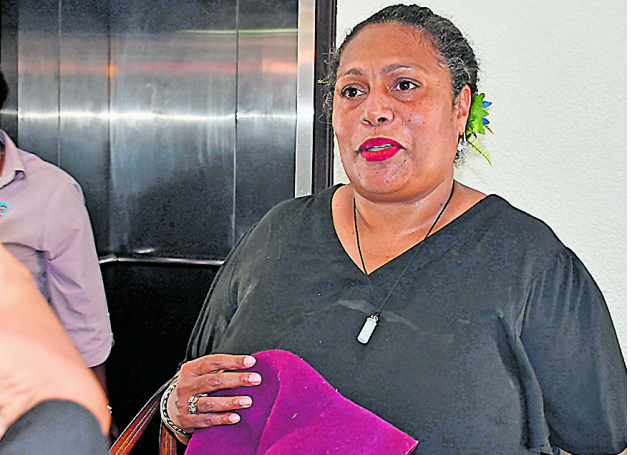
Barbara Malimali was accused of failing to disclose that she was under active investigation by the Fiji Independent Commission Against Corruption (FICAC) and that she had been denied the right to practise law in Tuvalu — allegations that ultimately unravelled her appointment as FICAC Commissioner and triggered one of the most damaging crises in the agency’s history. These allegations were among the findings of the Commission of Inquiry (COI) into her appointment, referenced this week in a High Court ruling by Justice Dane Tuiqereqere. In that ruling, the judge not only declared her controversial dismissal unlawful but also laid bare a chain of failures, conflicts of interest and questionable legal advice across key government offices and the COI itself. Ms Malimali is separately challenging the COI’s findings in court.
In his February 2 judgment, Justice Tuiqereqere traced in meticulous detail the events leading to Ms Malimali’s appointment as FICAC Commissioner and the extraordinary circumstances that followed, culminating in the revocation of her appointment less than nine months later. The events, and their aftermath, appear to have consumed the Government and shaken it to its foundations.
Ms Malimali was appointed on September 4, 2024, after emerging as the top candidate from a Judicial Services Commission (JSC) recruitment process. However, even as the formalities of her appointment were being finalised, an unresolved complaint against her was already lodged within FICAC — the very institution she was about to lead.
Ignored complaint revived
Justice Tuiqereqere noted that on April 8, 2024, a complaint had been lodged with FICAC against Ms Malimali, who was then chair of the Electoral Commission. The complaint alleged she had acted without authority by writing to the Constitutional Offices Commission seeking the removal of the Supervisor of Elections. While the complaint was acknowledged, registered and referred for legal assessment, it lay dormant for several months.
That changed abruptly on August 30, 2024, when Acting Deputy Commissioner Frances Puleiwai learned that Ms Malimali was the successful candidate for the top FICAC position. Ms Puleiwai had also applied for the role but was not shortlisted. Within hours of the appointment becoming known, FICAC revived the complaint, obtained a legal opinion and concluded there was a possible case. Investigators executed a search warrant at the Electoral Commission, and Ms Puleiwai wrote to the President and Prime Minister advising them that Ms Malimali was under investigation.
Justice Tuiqereqere noted that the COI found Ms Puleiwai was not acting with improper motives when she initiated these actions. However, he observed that the correct inquiry was whether Ms Puleiwai had a conflict of interest upon learning of Ms Malimali’s appointment, given she had been an unsuccessful applicant for the same position.
Appointment proceeds despite investigation
Despite the investigation, the appointment proceeded. On September 4, the President formally appointed Ms Malimali as FICAC Commissioner. She was introduced to staff that day and left the office, intending to begin work the following morning. That night, investigators agreed there was sufficient evidence to interview her and potentially lay charges.
On her first day in office, Ms Malimali was arrested inside FICAC headquarters. Justice Tuiqereqere described how she was approached, cautioned and escorted to interview rooms by her own staff before senior lawyers and the Chief Registrar arrived at the premises. The COI later accused those lawyers of conduct amounting to bullying, intimidation, obstruction of justice and interference with the FICAC investigation. Ms Malimali was released later that day, and by the end of the day Ms Puleiwai had resigned.
Two of the lawyers criticised by the COI — Law Society president Wylie Clarke and former president Laurel Vaurasi — have since filed their own court proceedings challenging the COI’s findings against them. Their case, along with three other legal challenges to the COI, remains before the High Court and will also be heard by Justice Tuiqereqere.
Following Ms Malimali’s appointment, there was, as the judge described, “somewhat of an uproar amongst some”. At the time, The Fiji Times reported uncertainty over whether she had formally resigned as chair of the Electoral Commission before taking up the FICAC role. When questioned by the media, Prime Minister Sitiveni Rabuka and Opposition Leader Inia Seruiratu, both members of the Constitutional Offices Commission, said they had not seen any resignation letter.
Commission of Inquiry
Ultimately, in October 2024, the President — acting on the advice of the Prime Minister — established the Commission of Inquiry. Supreme Court judge David Ashton-Lewis was appointed Commissioner, with New Zealand lawyer Janet Mason as counsel assisting. The COI hearings were conducted in secret between January and March 2025, and its report was issued in May.
Midway through the hearings, Ms Malimali dismissed a FICAC officer whom the COI considered an important witness. This sparked another legal confrontation, with the COI demanding that Ms Malimali be suspended. The Judicial Services Commission, which under the FICAC Act appoints the Commissioner and would have to advise the President on suspension, refused.
The COI then sought legal advice from New Zealand constitutional lawyer Professor Philip Joseph KC, who advised that the JSC’s powers over the FICAC role were unconstitutional and that it was the Prime Minister’s responsibility to advise the President. That opinion would later play a pivotal role in subsequent events.
The COI’s findings were controversial. While Justice Tuiqereqere stressed that he had not ruled on the correctness of those findings, he noted that the report claimed Ms Malimali’s appointment process was tainted by failures within the JSC. It also accused senior officials — including the Attorney-General, Chief Registrar, Solicitor-General and Acting Chief Justice — of an abysmal failure to act professionally and ethically.
According to the COI, Ms Malimali failed to disclose an active complaint against her at FICAC, failed to disclose material information when applying for the position — including being denied the right to practise law in Tuvalu in 2016 — and repeatedly failed to properly disclose her status in Tuvalu in multiple applications for a practising certificate in Fiji. The COI concluded she had not been truthful in her evidence and recommended her appointment be revoked.
The COI also found political influence and vested interests in the appointment process, claiming Ms Malimali had close relationships with senior politicians under FICAC investigation and intended to shut down complaints involving high-profile figures.
In May 2025, acting on the COI report, the Prime Minister advised the President to revoke Ms Malimali’s appointment. She was dismissed on June 2. Based on the same findings, the Prime Minister also dismissed then Attorney-General Graham Leung.
Ms Malimali challenged her dismissal in court, arguing that only the JSC — not the Prime Minister — had the authority to advise the President. The Prime Minister relied on Professor Joseph’s legal opinion in his defence. After an extensive legal analysis, Justice Tuiqereqere rejected that advice, agreeing with Ms Malimali and ruling that the Prime Minister lacked the authority to advise on her dismissal.
Once that lack of authority was established, Justice Tuiqereqere said the matter was determinative. The judgment now stands as a historical record of one of the most turbulent chapters in FICAC’s history. However, with multiple legal challenges still underway — including cases brought by Ms Malimali, senior lawyers, Mr Leung and the Judicial Services Commission itself — the fallout from the COI saga is far from over.

