
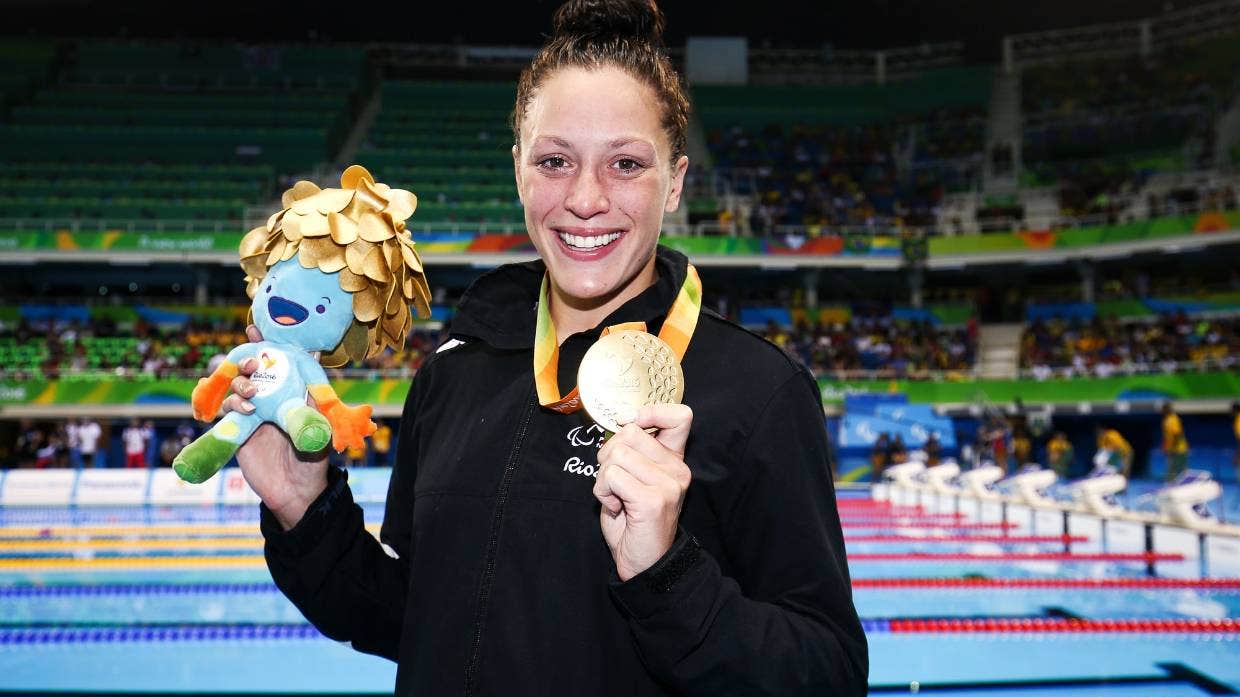
Should Sophie Pascoe add a 10th gold medal to an already illustrious collection at this year’s Paralympics, the champion swimmer will come away from Tokyo with the same amount of cash as Olympics hero Lisa Carrington.
This year’s Games, which gets under way on Tuesday, marks the first time in history that Kiwi para-athletes will have pay parity with their able-bodied counterparts. That comes in the form of performance enhancement grants (PEGs) from High Performance Sport New Zealand (HPSNZ).
A gold medal won by an individual (athletes get paid one PEG, not multiple) sees them earn $60,000 (before tax) – essentially a salary that is geared towards supporting their buildup to their next major event.
Previously this would be $50,000 for Paralympians, but is now on level-footing, thanks to the initiative announced in 2018 by Prime Minister Jacinda Ardern.
“It’s only fair that Para athletes will be rewarded for their outstanding achievements in an equitable way,” Ardern said at the time, when PEGs for Paralympic athletes instead used to be administered by Paralympics NZ.
”Kiwis love to take on the world and win. Of course, with that comes all of the hard work to get to the world stage.”
Silver or bronze medallists are paid $55,000 (previously $35,000 for Paralympians), while a fourth to sixth-place finish nets $47,500 (previously $25,000 for Paralympians).
Small discrepancies remain. A seventh to eighth place finish gets an Olympian $40,000 and a ninth to 12th effort nets $30,000, but there’s nothing for Paralympians beyond sixth place, due to what HPSNZ general manager performance partnerships, Eddie Kohlhase, notes is a “depth of field” factor.
The other difference is for team sports. Members of Olympic teams are paid $35,000 for gold, $30,000 for silver or bronze, and $25,000 for fourth to eighth, but HPSNZ does not invest in Para teams as such. The Wheel Blacks (wheelchair rugby) are the only Kiwi team at this year’s Paralympics.
New Zealand is in good company with its pay-parity scheme, with the United States taking on the historic move this year, too, with their gold medallists taking around NZ$55,000. Previously the US Paralympic champions got only about NZ$11,000. Their 2018 Winter Paralympians were retroactively paid the equal amount.
Speaking to Stuff, Kohlhase was proud of the country’s progressive approach.
“The athletic endeavour of our Paralympians is no different to our able-bodied Olympians,” he said.
“It’s a significant achievement for the New Zealand sports system.”
But, somewhat ironically, the PEG system is in its final few months of operation, as from January next year it will be transformed into TAPS (tailored athlete pathway support)
Under the new system, there will instead be 240 to 260 high performance athletes, nominated by their national sports organisations (NSO), who will receive a minimum $25,000 base training grant, along with a further 140 to 160 high performance ‘potential’ athletes who will get $10,000.
Then there will be an excellence grant which will top up the better performers’ earnings.
“There’s a realisation that PEGs essentially is a point-in-time performance, nominated by the sport, whereby the athlete needs to achieve a certain goal,” Kohlhase said.
“Notwithstanding that there’s pressure to perform, but the pressure to perform, and receive a monetary payment, was putting too much pressure on athletes.
“What we’ve done is said ‘the wellbeing of our athletes is paramount’.”

