
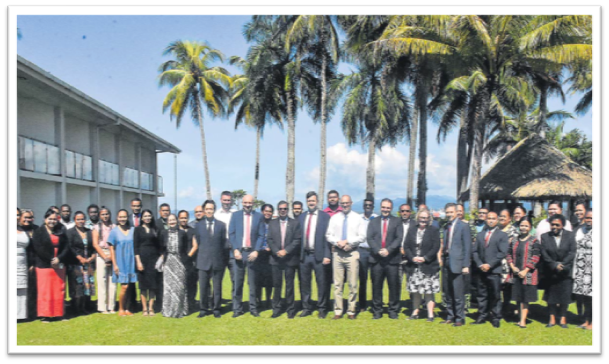
DEPUTY Prime Minister and Minister of Finance, Strategic Planning, National Development and Statistics Professor Biman Prasad, stressed the urgency of addressing climate change, noting that the Pacific region is facing unprecedented challenges.
Speaking at the opening of the IMF Macroeconomics of Climate Change course, Prof Prasad said the course comes at a critical moment when the region’s resilience and strategic vision are being tested by the ongoing impacts of climate change.
“The knowledge shared in this course will be essential for strengthening our policymaking and enabling informed, effective policy decisions,” he said.
The two-week course, which is being delivered for the first time in the Pacific by the Pacific Financial Technical Assistance Center (PFTAC), brings together regional leaders and experts, addresses vital topics such as climate risk assessment, fiscal strategies for adaptation, and transitioning to clean energy.
Prof Prasad underlined the need for proactive fiscal policies that can anticipate and mitigate the risks of climate-related disasters.
He further highlighted the role of green financing in addressing climate challenges, stating that Pacific nations must collaborate and leverage multilateral support to unlock the potential of sustainable financing.
“Through collaboration and innovative approaches, we can unlock the potential of green financing,” he said.
Professor Prasad also acknowledged the ongoing support from PFTAC’s donors, including Australia, New Zealand, the European Union, and others, and welcomed Japan and the United Kingdom as new contributors.
Looking to the future, Professor Prasad called for a concerted effort to transition to clean energy, viewing it as both an environmental necessity and an economic opportunity.
“Investing in renewable energy is not only a climate imperative but also an economic opportunity,” he said.
As the course progresses, it is expected to equip Pacific nations with the necessary tools and knowledge to confront the challenges of climate change and chart a path toward a sustainable, resilient future.

