
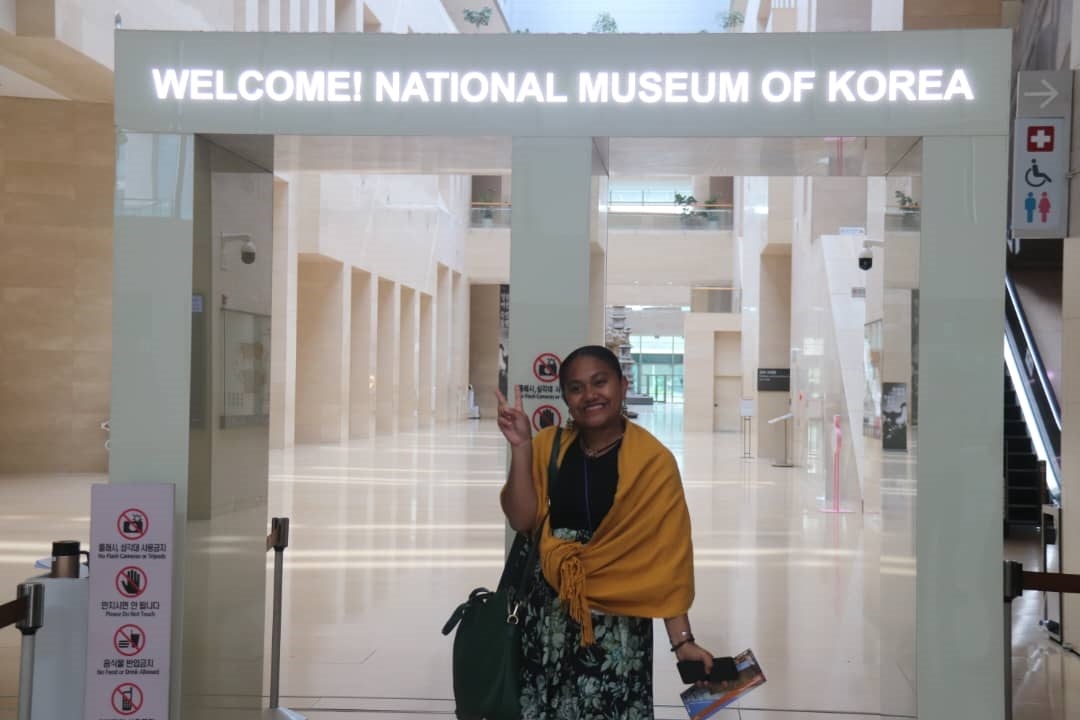
The National Museum of Korea is one place I fell in love with during my recent one-week stay in South Korea.
Every time I visit our Fiji Museum I am always filled with excitement — even my older sister works is a curator at the Auckland War Memorial Museum — so the fascination must be in the blood.
In Korea, located at 137, Seobinggo-ro, Yongsan-gu, Seoul, the National Museum houses a vast collection of more than 420,000 artifacts from ancient times to the modern era, covering a wide range of topics, including art and culture.
The museum houses a children’s museum, where visitors can learn more about the nation’s history through educational programs and experiences.
The outdoor grounds feature Korean’s pagodas and other stone artworks too large to be on display inside.
In addition to galleries with a wide array of national and international pieces, the museum is a stage for several cultural activities related to collection, preservation, research and analysis, social training, academic publications, intercultural exchange programs, concerts, and more.
What blew my breath away upon entering was the 10- storey stone pagoda from Gyeongcheonsa Temple.
Taking the escalator to the second floor had me thinking I would be looking down at the pagoda but to my surprise it was still taller. While most Korean stone pagodas were made from granite, this massive ten-storey pagoda is the first to be made from marble.
It once stood on the grounds of Gyeongcheonsa Temple, located at the foot of Mt Buso in Gwangdeok-myeon, Gaepung-gun, in the Gyeonggi-do Province.
Its base and the main body is elaborately decorated with carvings of Buddhas, bodhisattvas, and floral designs, and there is an inscription engraved on the body of the first storey, stating that the pagoda was built in 1348.
On the second floor we were taken to a room that observed pin drop silence. The only two that were allowed to talk were the tour guide and interpreter. Questions were only allowed to be asked once we exited the room.
This room was the ‘room of quiet contemplation.’ This space exhibits two pensive Bodhisattva statues, which are widely regarded as two of the world’s finest masterpieces of their kind.
Engraved with mysterious smiles on their faces and immersed in deep contemplation, these statues are meant to accompany the visitors going on a special spiritual journey. Another item that took my breath away was the large Buddhist hanging scroll from Janggoksa temple.
Now, the fact that it was painted in 1673 (the 14th year of King Hyeonjong of Joseon) but still looked like it was painted yesterday tells you something – it had been kept away safely. No breaks, nothing at all, it looked perfect.
At 5.99m in width and 8.609m in length, the scroll was painted by five monk painters, including Cheolhak, in the hopes of long lives for the kind, queen and prince.
Because we were running short of time, we had to quickly make our way to the National Museum of Korean Contemporary History.
TO BE CONTINUED NEXT WEEK

