
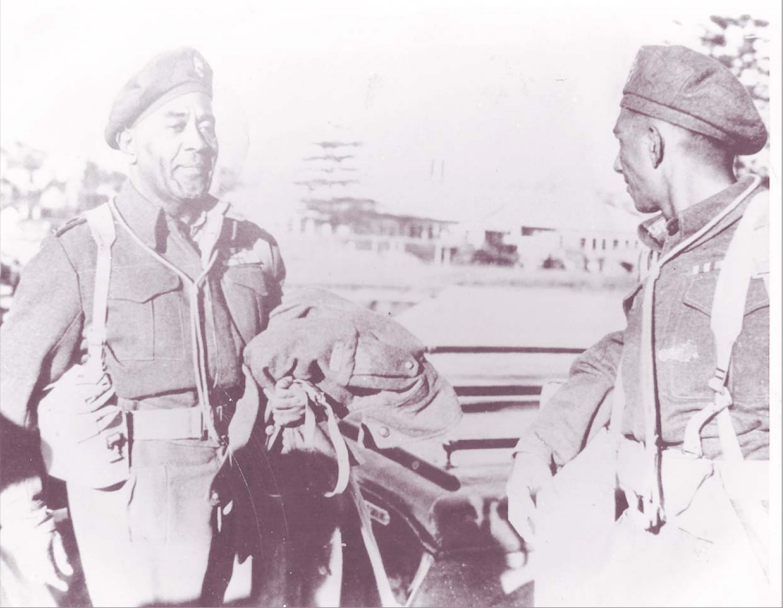
The Ratu Sukuna Day celebration was an extra special day for the Lobendahn family. The celebrations coincided with a historic family day where the medals and memorabilia of Paul Fernando Lobendahn were launched for display. This day was an emotional and poignant day for the family as it was a day for reflection, remembrance and tribute to Paul and others who have left us, said family spokesman and grandson, Vincent Lobendahn (Jr). “It has been a long one in coming and we thank the Fiji Museum and acting director/head of special projects, Dr Katrina Igglesden and her staff for their patience and professionalism in getting us to this point.”
The unsung hero
Paul was a war hero from the Solomons’ campaign. Upon his passing, about 40 years ago in June of 1985, his medals and other memorabilia were handed over to his son Gilbert Lobendahn in Sydney, Australia. “My only memory of my grandfather is there were a lot of people at his funeral, heavy rain, and the last post being played by a soldier from the Fiji Military Forces,” said his grandson Vincent (Jr). “The wartime souvenirs remained in Australia for over 20 years before a good majority of the medals and memorabilia were finally returned to Fiji to Vincent Lobendahn’s (Sr) safekeeping in Lami. The set remained in Fiji for approximately 10 years before Vincent’s passing. “Then it was moved off to Europe for a few years then returned to New Zealand for another five years. Attempts to donate the medals to the Auckland War Memorial Museum in New Zealand proved futile, and maybe for good reason. In all its travels, the consignment remained totally sealed in a closed box. Sealed to the family and to the public under the pretence of ensuring its safekeeping by its guardians.” Paul’s story is one of the untold narratives – he was a very quiet, humble and unassuming gentleman. It is no surprise that it has laid dormant for almost 40 years since his passing.
Paul’s background
Paul Fernando Lobendahn was born on June 7, 1906, in Suva, Fiji. He was the third eldest of 14 siblings. He had eight brothers and five sisters. Paul and his sibling were raised in Oneta in Ono, Kadavu. When Paul was eight or nine years of age, he was brought back to Suva to begin school. When the siblings arrived in Suva all they could speak was the Samoan language and the Fijian Kadavu dialect. He began learning English after arriving in Suva. Paul worked in the Government Printing Service. The Lobendahn name had long been associated with the printing industry in Fiji, both in the government service and the commercial field (The Fiji Times & Herald). Paul’s father, Vincent Fredrick Lobendahn, was the original Lobendahn who came over to Fiji in 1894 and worked as a compositor for the Government Printers in Suva. His mother was Mary Selemena from Samoa. The Lobendahn were Dutch Burghers of German Origin. In keeping with their father’s background, Paul and his brothers Harry, Dick and later their sons (Richard and Wayne) followed their father into the printing industry and established themselves as sought-after experts in the field of printing and binding in Fiji. Similarly, with printing, the Lobendahns also have a long association with the Public Works Department with Fredrick, John, Hector and Paul’s son, Walter Lobendahn, working across various sections as welders, boilermakers, roading and building works.
The Solomons campaign
With the onset of the Pacific theater of war at Fiji’s doorstep in early 1940, the Lobendahns responded to the call of duty to the country with Paul and some of his brothers joining the Fiji Military Forces and Navy to serve in the Solomons’ campaign. Paul enlisted in the Fiji Defence Force as a private on February 23, 1940 and was promoted through the ranks and commissioned as an officer on December 1, 1943. Paul was awarded the Military Cross for his bravery and leadership of troops operating behind Japanese lines. The citation for the award of the military cross he received on December 9, 1944 stated: “In a series of operations beyond the Torokina perimeter against the enemy between April and 24 June 14, 1944, 2nd Lieutenant Paul showed outstanding ability as a platoon commander, and by his personal example inspired his men. When operating attached to A Company 132 US Infantry, between April 27 – May 1 his platoon killed 17 Japanese and was largely responsible for the company’s return to friendly lines with few casualties. Between May 29 and June 14, 2nd Lieutenant Paul led a series of fighting patrols into the rear of known Japanese positions in the upper Laruma River Valley which were being engaged by the remainder of the Battalion. On one three-day patrol 2/ Lieutenant Paul succeeded in working right around the Japanese positions and from the information he supplied the depth and extent of the Japanese-held area was definitely fixed. The 2nd Lieutenant Paul showed no regard for his personal safety and was at all times up with his forward elements. The success of his platoon in all these engagements must be credited to their leader” Paul was also selected to attend the Victory Parade celebrations in London in 1946. He was honoured to represent Fiji and also took the time to participate in victory engagements and also visited some of London’s key tourist attractions. Part of the wartime memorabilia handed over to the Fiji Museum is Paul’s officer’s notebook dated 1943 with his signature. Being a meticulous craftsman at bookbinding, the notebook appears simple on the outside, but the pages are an impressive collection of battle maneuvers; arms inventory; camp information; enemy positions; first aid notes and more. In 1951 Paul also applied to the Fiji Military Forces to serve in the Malaya campaign with the 1st Battalion, but was turned down because of his age.
Post-war service
Following the war, Paul returned to the Government Printing Office and retired in 1967 as superintendent (binding) after 45 years of service. He then took charge of the binding section of the new commercial printing works of The Fiji Times and Herald Ltd in Suva. Here, he joined his brothers (Richard (Dick) and Harry) and nephew (Richard), heralding three generations of the Lobendahn family working in The Fiji Times and Herald. Paul also had a close association with Ratu Sir Lala Sukuna through his good friend Ratu Sir Edward Cakobau, who Paul served within the Solomons campaign. Ratu Sukuna requested that Paul assist Reverend Father Marion Ganey in driving the credit union movement in Fiji. Paul was a trustee of the Fiji Credit Union League and the Bergengren Credit Union Training Centre for many years. Paul served for 37 years as a member of the ex-servicemen’s after-care fund — the last 13 years as its chairman. Paul also served as a board member of the Suva Grammar School Board of Governors for many years. In 1956 Paul was awarded the Certificate of Honour in the Queen’s Birthday Awards and again the Imperial Service Medal in 1967 for 45 years of Meritorious and Outstanding Service as a Fiji Civil Servant.
Lasting legacy
“Paul’s respectful and humble nature is a reflection of a true gentleman. His service to our nation is truly commendable, not only in responding to the call of duty in the Solomons but also in his attempt to participate in the Malaya campaign with the 1st Battalion. “In addition to his long-term service with the Government Printing Department, Paul also worked with the community in helping with the credit union movement and serving on several committees or boards (Ex-Servicemen’s after-care fund and the Suva Grammar School Board). His leadership and gallantry on the battlefield was driven by his sense of responsibility as a leader towards his fellow soldiers in his care. His meticulous approach to any task and his resourcefulness also helped to guide his military duties in the Solomons.” The family spokesman added: “The donation of Paul’s memorabilia to the Fiji Museum by the Lobendahn family of Lami was not only for safe-keeping but also to ensure that Paul’s legacy and the family history are preserved for future generations. With the Lobendahn family residing all over the world, this would ensure that their young ones can visit Fiji to view this humble and significant bit of our history on display at the museum.” “Paul’s legacy, however, is not only our family’s history, but Fiji’s history too where our brave Fiji men and women served in theatres of war and gave their very best for country and families. His bravery, leadership, and service to our beloved nation is truly something that we want to inspire the future generations of Fiji to navigate through the many challenges of the modern world and walk into the future with confidence and civic pride. “The return and public display of the medals and memorabilia in Fiji after almost 40 years confirms its rightful place in Fiji’s history.”
- VINCENT LOBENDAHN is a grandson of Paul Lobendahn. The views in this article are his and not necessarily of the newspaper.

