
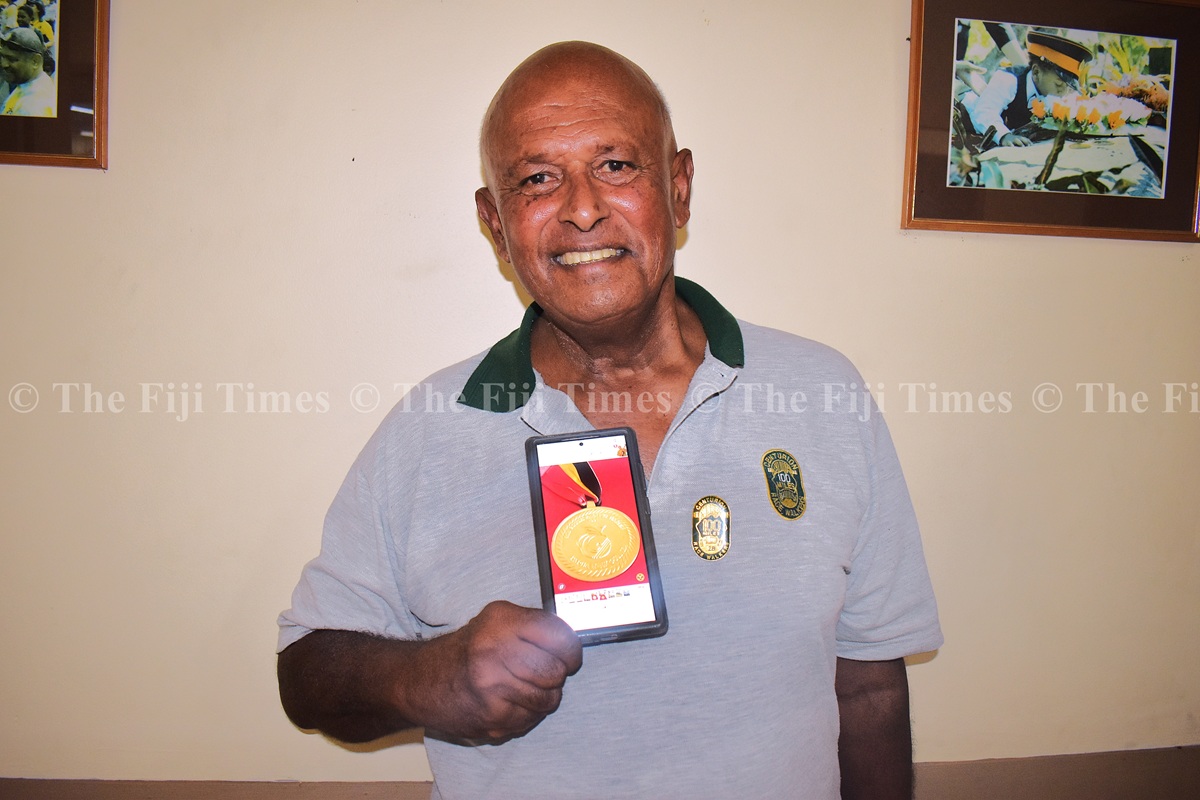
Caleb Maybir is now 72, without a kidney, a spleen, parts of his intestines and a stomach placed incorrectly and yet, continues to have the physical strength and mobility of a young man in his 20s.
He is a former race-walking athlete and has represented Fiji on various occasions to the South Pacific Games and other international meets.
His most notable achievement is being the first Fijian to finish a 100-mile racewalking event in under 24 hours, at the Queensland Race Walking Club 24 Hour Walk held in Brisbane, Australia from September 28-29, 1996.
He finished with a time of 23 hours, 34 minutes and 20 seconds and earned a special medal for his efforts in the race where he was named Centurion No. 28.
In the race, he walked a total of 161.1km which around a 400m track, meant walking 402 laps around with an additional 134.16 metres.
But at an age where his horizons have widened and wisdom acquired from life’s experiences has been vital in his life’s expansion year after year, he harbours a story that may surprise many.
In the early hours of Monday, November 3, 1980, he was involved in a tragic car accident along the Queens Highway where the trajectory of his life was changed forever.
Early athletics journey
Like most young boys in Fiji growing up in the 1950s and 60s, physical activity was not a luxury, it was the bare minimum.
Sitting idle around the house and doing nothing was not desired unless and until one had carried out their fair share of work and daily chores for the day.
And between seven to eight years old, a young Maybir ran a race at Suva Primary School that never seemed to end once he crossed the finish line and his teacher had to tell him it was done and he had won it only after he ran into the bushes.
“My athletic journey started at an early age in primary school, when my mother came out one day to watch me run a 50-metre race, and I ran right through the bush at the end and the teacher told me to stop and he said I had already won the race,” Maybir recalled with a chuckle.
He recalled telling his teacher he just wanted to make sure he did.
If that wasn’t enough, his athletic prowess developed further when he attributed being ahead of the congregation at the Assemblies of God church, where his family has been a member for seven generations.
“I remember Sundays walking up from the bus stand to the Assemblies of God church where we’ve been members for seven generations. I always used to get to church ahead of everybody and my mother used to tell me that I was walking too fast and I said ‘Mom, I can’t walk any slower’,” he said.
Striding onwards
He bloomed in his athletic ability to race walk however it did not fully materialise as an opportunity for him to make his mark in it until he participated in walk-a-thon meets around Suva held in 1969 and 1971.
The walk-a-thon in 1969, was organised by the St John Ambulance Brigade to raise money.
“I competed in that and completed the 30 miles. I can’t recall the time, but I did it in a fairly good time,” he recalled.
“We had to do 215 mile loops of Suva (346km) and with sponsorships, I was able to raise a fair bit of money.
Meanwhile, the second walk-a-thon was 30 miles long and held in 1971 as part of efforts to raise money for the 1971 South Pacific Games in Papeete, Tahiti.
It wasn’t until late 1975 when competing in a 1500m race-walking event that his abilities to flourish in the event were spotted by two American Peace Corps workers who organised the competition by requesting those who were keen to send in an expression of interest.
“I came forward with many other athletes, including names like Joe Rodan and some of the athletes that I can’t recall at this time but Rodan’s name was the main one there and we took off in the 1500m walk,” he said.
“I beat everybody by such a big margin, the Peace Corps workers told me that I had such a natural ability without ever knowing the rules of walking and having been under any proper training.”
As much as he appreciated the compliments and continued working on himself since, the car accident in 1980 was the turning point in his life that made him realise what he was truly capable of.
The car accident
The Fiji Times reported on Tuesday, November 4, 1980 that Maybir and his three cousins were returning to Suva in a Toyota Dyna van when it crashed into the back of a parked cargo truck at Navua at 4.30am on Monday, November 3.
His cousin Desmond died in the crash, which took place near Batinikia along the Queens Road about five kilometres from Navua, towards Pacific Harbour.
Maybir was 26 at the time and rushed with driver Anil Kumar, then 19 and Christopher Richmond Maybir, also 19 then, to the Navua Health Centre before being conveyed to the Colonial War Memorial Hospital in Suva.
What Maybir recalled nearly 46 years later was that the accident may have been caused due to speeding and fatigue.
“The driver was supposed to wake me up, he didn’t and by speeding, we hit a stationery truck that was parked on the road,” he recalled.
“Our vehicle was in excess of 100km an hour at the time it was estimated, and we were lying on the road for quite a while before any help arrived, and it was raining. A passing motorist saw the carnage.”
They were rushed to the Navua Health Centre and referred to the CWM Hospital due to the critical state they were all in.
The driver, according to Maybir, passed away when he was being taken from the intensive care unit (ICU) to the operating theatre to undergo brain surgery and what Maybir also recounted was that every other person admitted in the ward with him had passed on too.
“They thought I would die first because I had the worst injuries and I pulled through.”
He did not know some organs in his body were removed until much later.
Missing organs revelation
When Maybir was operated on in 1980 to save his life, he was unaware of the virtuous efforts undertaken by surgeon Dr. Satya Nandan and intern registrar Dr. Dave Brown to ensure he pulled through.
It wasn’t until 1996 when he participated in the 24-Hour Walk, finished the race and rushed to the Princess Alexandria Hospital due to intense dehydration that he finally found out what had been so different about him in the 16 years since the incident.
“Dr. Seniwaratne came back very alarmed and mentioned to me that my stomach was not in the normal way a person’s stomach should be.”
It was placed upside down.
When Dr. Brown, who operated on him got in touch with him, Maybir and Dr. Seniwaratne finally put the pieces together as the race-walking athlete marvelled at how he survived 16 years since the crash.
When Times Sport spoke to Maybir last Friday, he stressed all the organs were never replaced however, he was told to never consume alcohol of which there have been no recurring issues with his remaining organs since.
Life in the present day
Through the highs and lows, Maybir, now living in Australia, has maintained a lifestyle that is largely devoted to being physically active and being mindful of what he consumes.
“I have not changed a lot; I’m still walking eight to 10km a day now. I do recycle collection because it’s big in Australia and I do the collection for the depot and I keep all my daily exercise that way.”
He has also coached various athletes there.
“I still got a very youthful thinking; and I just saw something I read yesterday (last Thursday); sometimes your brain age is ahead of your natural age and I feel I’m in that category because I meet all the younger people back home, talk to them, inspire them and they can’t believe that I can still talk to them on their level.”

