
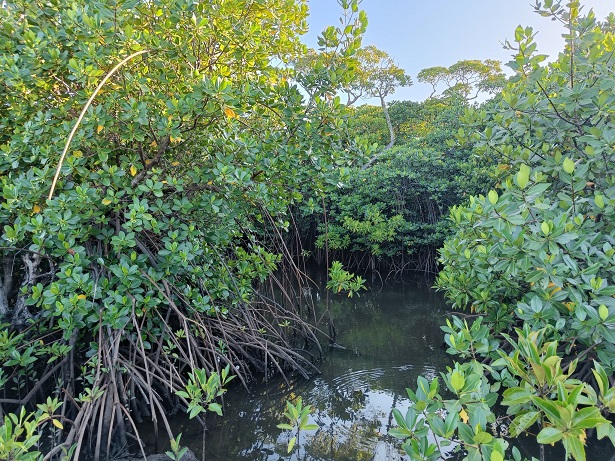
Thirty-five years ago mangroves grew a few kilometres along the coastline of our 130-square kilometre family estate.
This was many moons and suns ago, when this write was still learning to read and write and climate change had not yet been a global phenomenon.
Also, there were no American iguanas on Qamea Island. The estate was susceptible to water shortage during long dry spells so dried up creeks and streams, where we sourced our water from, were common.
When this happened, we depended on the ‘tuvu’ in the mangrove forest, low tide pools of brackish water usually found when the tide went out.
Whenever the drought grew severe, we’d use water collected in those pools for bathing and washing.
They didn’t lather very easily with soap, but they were always the best chance we had until the rain filled the streams and creeks again.
Today, piped water systems have replaced streams and creeks but the mangrove swamp and the tuvu remain.
Whenever I had macake or thrush, I was instructed to fetch the tip of young mangrove aerial roots called titi ni dogo.
This was crushed and mixed with a few drops of warm water and drunk to treat fungus on the tongue and throat, often the result of eating too much sugary foods.
We boiled the bark of mangrove tree trunks for use as medicine. Our nau (grandmothers) extracted natural dye used in masi printing called kesakesa by boiling mangrove bark for many hours.
The mangrove swamp was a great place to have an adventure. I particularly loved chasing mudskippers and small crabs, watch sese (kingfisher) chorus on mangrove boughs and chase qala (a type of bird).
The swampy world of the mangrove bushes was also a great source of protein seafood meat such as cockles (kaikoso and qeqe).
Seas nearby were breeding grounds for dairo, nuqa, damu and other fish communities plentiful in the bay that depended on mangroves nurseries as a food warehouse.
They were also the best places to look for giant mud crabs that women would keep for Sunday lunches.
Life on the estate was laid back and we depended heavily on copra to survive.
When there was a shortage of dry firewood used to fire up our copra driers, which happened during spells of heavy rain, we used mangrove tree trunks and stems.
The resin in mangrove stems burned easily and made it one of the best fuels for drying copra, even when cut down and fired straight away.
In those days, mangrove stems were also used in the construction of bure, where they were used on the roof and on the walls.
And despite their many uses, there were always enough mangrove trees in the wild.
On Wednesday this week, the world celebrated the International Day for the Conservation of the Mangrove Ecosystem, adopted by the General Conference of UNESCO in 2015 and celebrated each year on July 26.
According to UNESCO, the day aimed at raising awareness on the importance of mangrove ecosystems as “a unique, special and vulnerable ecosystem” and to promote solutions for their sustainable management, conservation and uses.
Children in the towns and cities who do not live by the sea, do not fully understood mangroves as rare, spectacular and prolific ecosystems on the boundary between land and sea.
They lack the knowledge of this extra ordinary ecosystem and how they contribute to the wellbeing, food security, and protection of coastal communities all around the world.
By the time I learned about mangroves further, in Basic Science and Biology, I already had a fair understanding of the plant because I lived only a few metres from the sea’s edge and saw it, felt it and smelled it, every day.
Today, as we discuss about climate change and are made more aware of its adverse effects on marine life, weather, coral reefs, sea-level rise and the sea, it would be equally nice to support any initiative that protect, preserve and conserve our mangrove trees.
Mangroves should be safeguarded for their rich biodiversity, valuable nursery habitat for fish and crustaceans, natural coastal defence ability against storm surges, tsunamis, rising sea levels and erosion.
Their soils are highly effective carbon sinks, sequestering vast amounts of carbon.
Despite their significant uses, mangroves continue to disappear, three to five times faster than overall global forest losses that result in ecological and socioeconomic impacts.
With the familiarity I have with mangroves, I cannot imagine a future without them. I cannot fathom how maritime island communities would survive and how beachfronts and coastal zones would look like without them.
Needless to say mangrove forests are a beautiful gift of nature endowed with many life-giving benefits.
Not only are the forests a wondrous patch of green on the coast to behold but their benefits are immeasurable and as custodians of the earth, we must see that we protect, preserve and conserve out mangroves, wherever they may be.
Until we meet on this same page same time next week, stay blessed, stay healthy and stay safe

