
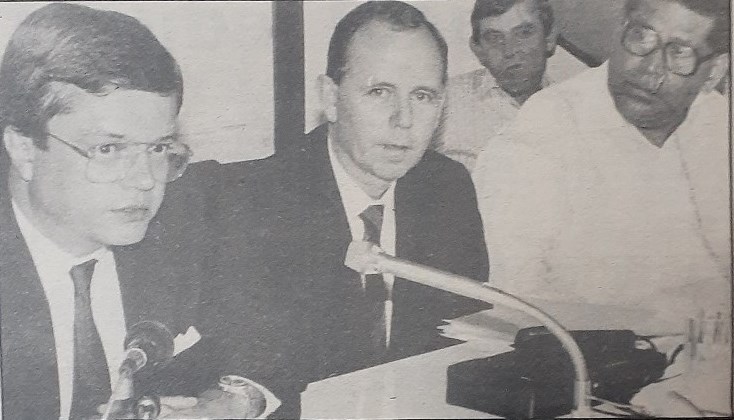
On August 13 back in 1986 a press conference was held over the big commotion relating to a 12-year monopoly granted to Pacific Television Ltd in which 12 other companies applied by denied.
The minster back then Peter Stinson made it clear to the press why he did what he had to do in a very strong statement in which he blemished Chanel Nine, who supposedly poked at the government for unfairness in their decision.
The report reads below. The Government did not seek detailed submissions from four television companies because it had already accepted an offer from Australia’s PBL Pacific Television Ltd, the Minster for Economy Planning, Peter Stinson said in Suva yesterday (August 16, 1986) Mr Stinson told a news conference, called to announce the singing of a 12-year agreement between Government and PBL, that originally seven companies had applied to set up a TV service.
Four of them were three or four page letters and the Government did not ask for more details from these companies.
Of the three detailed submission received, Mr Stinson said one from NBN of Newcastle, Australia, was not impressive while the locally Television South Pacific Ltd did not have adequate resources for finance.
“The 400-page submission from PBL (Pacific Television Ltd) was the best,” he said.
Asked why detailed submission were not sought from other companies, Mr Stinson said a decision had already been made in principal to accept the PBL offer.
“A lot of people jumped in late, other channels jumped on the band wagon when we had made a decision,” he said.
“I think the answer to that is a sense of propriety. You open offers, receive offers, you agree in principle to agree with a company and then I think it’s inappropriate to seek detailed submissions from other companies,” Mr Stinson said.
Mr Stinson admitted that the Government has asked for more details from PBL after receiving its original proposal.
The managing director of Channel Nine, PBL Mr Lynton Taylor, who was also at the press conference, had come to Fiji to have an initial meeting with the Government official before PBL presented its proposal.
The meeting was not an unfair advantage, but a result of the company’s “entrepreneurial spirit,” Mr Taylor said.
Mr Stinson said the Government had not only accepted an offer from PBL, but had negotiated hard and got the best deal possible.
“I wish to assure you that the Government, through the Television Facilitation Committee, negotiated strongly and boldly for an agreement that would ensure a competent television service for the people of the country,” he said.
He said the 12-year monopoly grant to Fiji Television Corporation applied to commercial television and the government could setup a non-commercial television network at any time.
“Even if the press does not like the way we went about the whole thing, I don’t’ think they can deny we got a damn good deal,” Mt Stinson said.
“I frankly think Channel Nine are a pack of clowns to accept the tough agreement we have thrown at them,” he said.
“Why the hell they want to come in here, I don’t know “I certainly wouldn’t invest in it,” he said.
Mr Taylor said he expected the television to go on air in September 1987.
Programs would be on air only between 4pm and 12 midnight.
He said staff appointments would be announced soon, but the first chief executive of FTC would not be a local person.
Mr Taylor announced the appointment of Fiji Television Corporation first three trainees technicians.
They are Simon Fong of Radio Fiji and Joseph Wong of the Fiji Electricity Authority, both of Suva – and Akariva Vana of Nadi.
All three have diplomas in telecommunications from the Fiji Institute of Technology. They will leave next month month for Australia for specialised training.
They will study at North Sydney Technical College to qualify for the New South Wales electronic engineering certificate.
This will be followed by on-the-job training as television technicians in Australia and Fiji.
Mr Taylor allayed fears that about half of television sets now used for video viewing would have to be modified before they could be used for local television viewing.
He said television sets designed for both New Zealand and Australia would easily pick up VHF (very high frequency) and UHF (intrahigh frequency) by FTC.

