
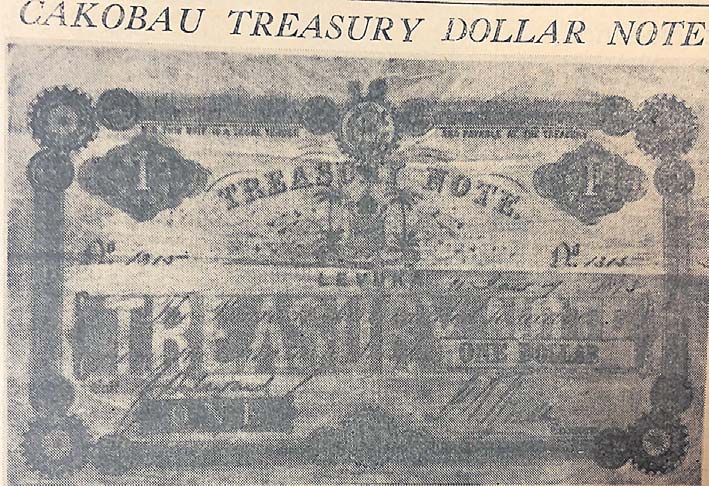
On July 16, 1963, The Fiji Times, published an article on the colorful days preceding the Deed of Cession of 1874 and the money that came into existence during Ratu Seru Cakobau’s rule.
It was reported that during the reign of Cakobau’s government, there were difficulties faced in financing the young kingdom and in the possession of Mrs A Ragg of Amy Street, Suva was a set of Fiji dollars and a pound initially introduced at that time (1871-1874).
“In spite of her advanced age Mrs Ragg can still draw easily upon her rich store of memories of the past and particularly of early Suva,” the article read.
“The set consists of one dollar, five dollar, ten dollar and a 2 dollar note.
“With the exception of the 10 dollar, dated 1872, the remaining dollars are dated a year later.”
The Fiji Times said the five dollar note was signed by G. Wood who played a prominent part in the Cakobau’s government but the other names were almost obliterated by age except for the signature on the 25 dollar note which might have belonged to J.Grimbsy.
A one pound note was also in the collection. It was an unusually large note printed on good parchment.
“The top line reads, ‘Levuka, Ovalau, Fiji’, followed by a motto- ‘Concordia, Integrity, Industria’.”
“There is also a design showing four hands clasped together. The imprint is ‘C. T. Standon, Stationer, Sydney’.”
The article stated that it was possible that the note was one which was to have been issued by a Bank of Fiji. The provisional directors were F W Hennings, J C Smith, Otty Cudlip and Alex Barrack, but apparently according to historian R.A.Derrick, the bank was not established.
“In August 1873 the Fiji Banking and Commercial Company was established and Derrick records that it had a monopoly of banking in Fiji for 14 years.” T
he fact that the pound note in the possession of Mrs Ragg had not been signed seemed to indicate that the notes were brought to the proposed bank, which failed to materialise.
According to Derrick, William Hennings, a partner in F & W Hennings & Company, engaged among other things in banking , and his notes were known as ‘Hennings’ shin-plasters,” probably because of their size.
“The note were in the possession of Mrs Ragg’s father, Mr H.A Smith who at the time of cession owned a hotel at Natovi, which was a half-way house for boats sailing between Suva and Levuka.
“Actually it is opposite Ovalau but it was a convenient stopping place, particularly for boats coming down the Rewa River. Also included in Mr Smith’s papers were certificates for 600 £1 shares issued by the “Gold Mines Gold Mining Co” with a capital of £24,000.

