
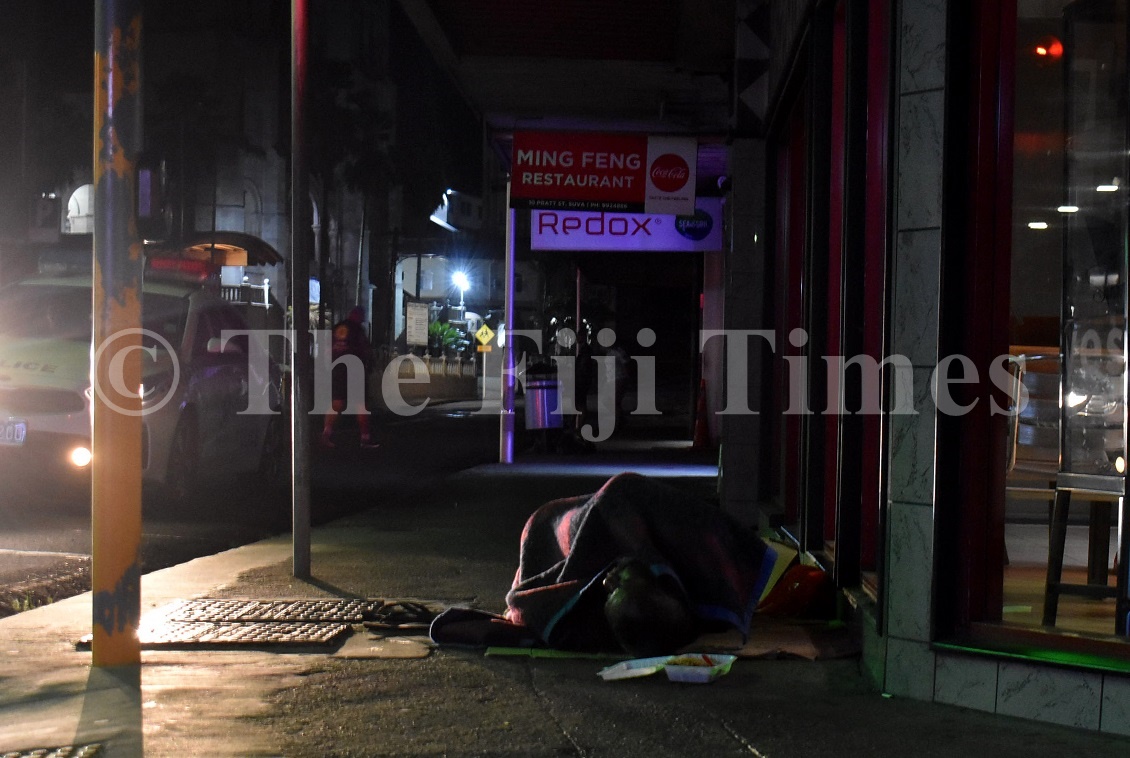
Fijians who call the streets of the capital their home may be bound by their traumatic pasts, yet this companionship does not shield them from the ugly reality of drugs, abuse and discrimination they face each day.
During a “Sleep Rough” campaign over the weekend, this newspaper witnessed the harsh circumstances in which some of our people live.
Speaking to this newspaper, Lute (not her real name), a sexworker in her 20s, said she had left a broken home, as many of the street dwellers did, because being on the streets seemed better than living in an environment where they felt unwanted, undervalued, and unloved.
Lute said there were four age groups, the kajis (10 years and under), the pre-teens, teenagers and youths (18 to 35 years), and those regarded as elders (35 years and above), who made up the population of street dwellers.
They congregate in age groups around the city, with the kajis finding shelter around the market area and the Stinson Pde bridge, and the elders at the bus stand and around the Suva CBD.
The teens usually slept around the bowling club and seawall, and the youths at Thurston Gardens.
She said some of the elders started out as kajis and spent their whole lives on the streets, and the eldest were two brothers who were told to leave their village after family issues arose.
They came to Suva and made the streets their home for the past 25 to 30 years and now work as security guards.
Lute said attempts to return some of these people to their homes are unsuccessful because they were taken back to an environment which they left in the first place, as families were either unwelcoming or were dealing with their own issues and taking it out on them.
She noted an instance of another sex worker who was taken home a few times, but kept coming back to the streets because when she was taken home, her brother – who had mental health issues – would beat and rape her.
She resorted to drugs and alcohol as a way of coping with the trauma of what her brother was doing to her.
When The Fiji Times went on walkabout in Suva with Lute on Saturday night, most of her friends were in other parts of the city waiting for the nightclubs to close before they came to look for places to sleep.
We were told that some were inside nightclubs looking for drunk, knocked out party goers that they could pickpocket. According to Lute, this was one way some of them got money to buy food.
In the instance they did not have food, Lute said they would inject themselves with ice (methamphetamine) so they could stay awake longer to look for more money.
Lute said ice subdued their hunger long enough until they managed to get enough money to buy food. She said that ice could be bought for $15 per scoop – smaller serving than the usual $50 bags – and everyone was doing it.
She also outlined that they usually shared what little they had among themselves and provided a support network to each other in times of need, like bouts of fits.
She said two brothers, who work at the hot dog stands, have carried her to Totogo Police Station during her fits so she can be somewhere safe until she ceases to shake.
Stories like Lute’s is prevalent throughout the streets of Suva, and these deeply ingrained societal issues are not likely to be solved overnight either.

