
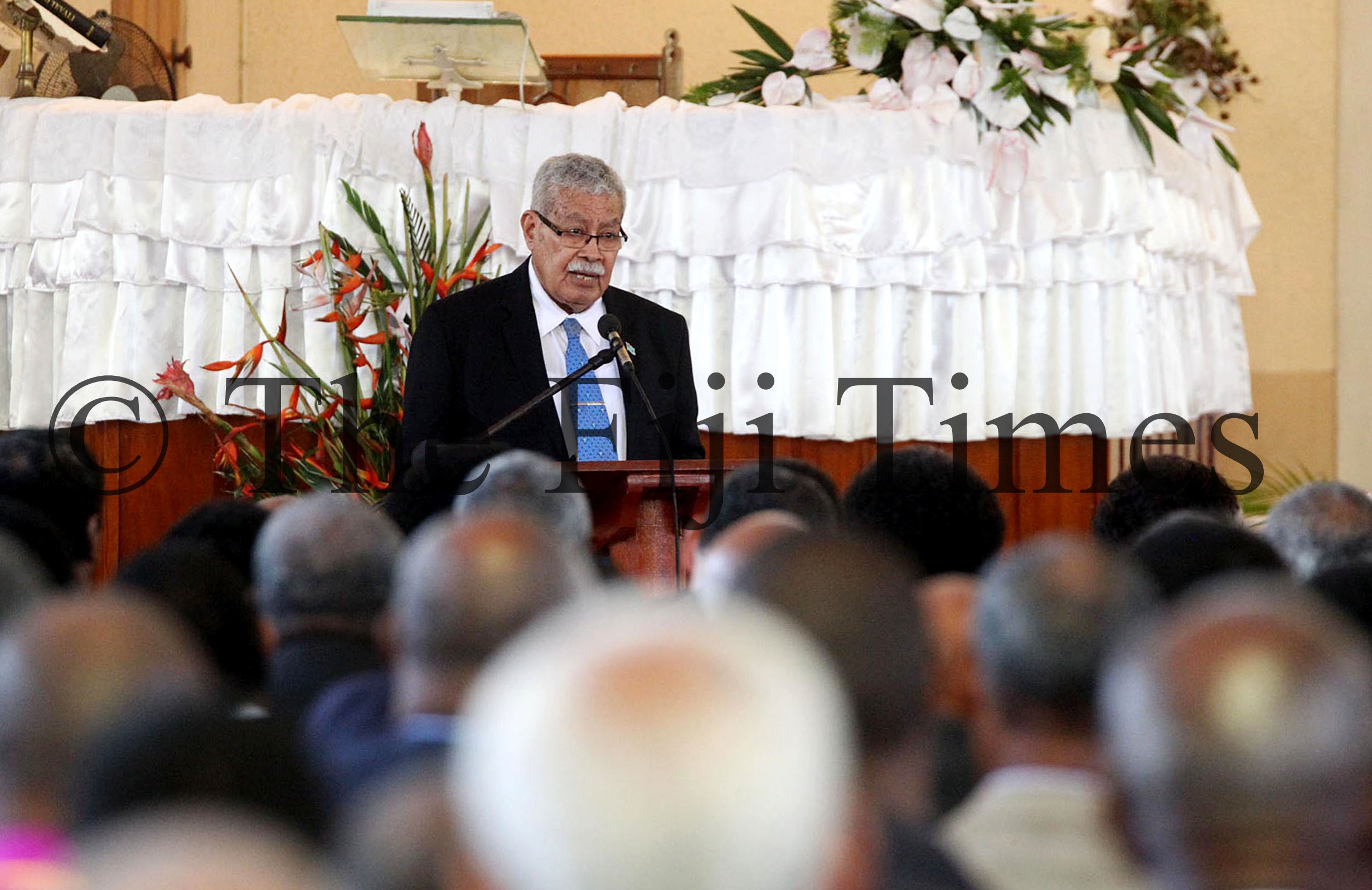
Laisenia Qarase’s life
Former PM Laisenia Qarase, at the age of 70, passed away at the Oceania private hospital on Tuesday after a short illness.
In the most professional way, The Fiji Times paid tribute to a great leader who has left behind a strong legacy.
Known for his role in founding the Soqosoqo Duavata ni Lewenivanua party, the late Mr Qarase served as Fiji’s sixth PM from 2000 to 2006, the year which he was ousted.
It was heart-warming to read the tributes paid to the late Mr Qarase by Fiji Labour Party leader Mahendra Pal Chaudhry, National Federation Party leader Prof Biman Prasad and Methodist Church president the Rev Dr Epineri Vakadewavosa.
Thousands of people also paid their respects to our former PM via social media.
Reading about the late Laisenia Qarase’s contribution to Fiji’s economy as a politician and statesman makes me rise and salute this gentleman for his dedication, passion and commitment.
Rest in peace, sir!
Until that glorious morning, ni moce mada!
My deepest condolences to the grieving family!
Rajnesh Ishwar Lingam, Nadawa, Nasinu
Stay at home
Time and time again the Prime Minister and health officials in Fiji advise citizens to be responsible and stay at home and maintain social distancing when in towns and cities.
Yet there are some irresponsible people that do not take heed of the advice and do the total opposite.
Fifty years ago, people fought wars to protect their nation, now we protect our nation by staying at home.
Do the right thing!
Maintain social distancing please.
Raynav Chand, Nakasi
Worst to come
WHO has again reiterated its warning that the worst of coronavirus is yet to come.
It means, rather than becoming complacent, we need to prepare ourselves for the worst-case scenario.
It requires a paradigm shift in our behaviour and habits especially when it comes to socialising.
The restrictions are placing a lot of constraints in our daily lives but they are there to protect you and your family members.
We have to endure this short-term pain for long-term gain.
We cannot afford to let down our guards.
On the contrary, we must remain vigilant and strictly adhere to all the health advisories.
Remember that no vaccine or medicine has been discovered yet to cure the disease so our best protection now is to avoid getting sick.
Unfortunately, the lifting of lockdowns seems to have sent across the wrong message.
It is evident from the increasing incidence of curfew breaches that some may have mistakenly construed it as if things have returned to normal again.
People including children are still seen loitering in towns for no good purpose.
Some may feel that they are being imprisoned in their homes.
Hence, they may want to go out once in a while.
Do it but with responsibility and utmost regard for the safety of others.
I know some parents are unable to leave their children alone at home but at least one parent can stay behind.
Selwa Nandan, Lautoka
Best in humanity
Even though COVID-19 might be globally seen as a pandemic, a deadly virus, it has brought out some of the best in humanity that had somehow been overshadowed by global capitalism that promotes materialistic greed and individualism.
The globe all over is working in solidarity and cease fires among war-torn countries are now able to materialise, thanks to COVID-19.
The world all over is helping each other at all levels and sharing human, medical and other resources, thanks to COVID-19.
Humans all over are dedicating their very lives to the service of another and sacrificing their own loved ones for others, thanks to COVID-19.
With these few points highlighted, I would like to congratulate Rohit Deo and The Fiji Times for relating a beautiful example from the Danford family of how wonderful humans should be (FT: 21/04).
Sailosi Danford and his two daughters are missing their mother, Lusiana, who is a staff nurse at Navua Hospital and has been caring for COVID-19 cases brought to Navua.
They will be apart for more than a month.
Nevertheless, Mr Danford bravely coins it by saying: “We understand that there are people who need her more than we do right now and that is why we are patient.”
I commend such support shown by the Danford family, not forgetting other families and individuals who are bringing out the best in humanity in difficult times such as these and my only hope and prayer is that humans will continue to do so, caring for each other even after COVID-19 becomes history.
Kositatino Tikomaibolatagane, Vuninokonoko Rd, Navua
Social distancing
After the lockdown, most people have forgotten about social distancing.
The Government and our health authorities daily remind people about social distancing but if you go to Lautoka City, you will find people walking, eating, sitting and even having meetings in groups.
It’s time for people to take advice by Government seriously.
John Brown, Drasa, Vitogo, Lautoka
Bed bugs
Please allow me to register my concern with regards to bed bugs at the Lautoka bus station.
During the lockdown, many homes got an overhaul of cleaning, mine is one of them.
I usually travel by car but because I am on shortened hours at work, I travel by bus to economise my finances.
When waiting at the Natabua bus stand I noticed the bugs on the seat.
These bugs cling to our clothes and we take them home.
I have since travelled a few times and I hope I haven’t taken any home.
We have emphasised social distancing and hand washing, could the bus stand be given a thorough cleaning for bugs, please?
And do it often.
Rahul Prasad, Lautoka
Qarase profile
Just adding to the profile of our late Prime Minister Laisenia Qarase, he received his early education at both Ratu Kadavulevu School and Queen Victoria School before joining Suva Boys Grammar School where he matriculated to Auckland University.
He was also a former director of the Co-operatives Department.
May he rest in peace.
Taniela Senikuta, Tailevu
Brain drain
As many have perished in other nations (including relatively young medical personnel in developed nations), once the COVID-19 pandemic ends and people become confident to travel again, Fiji could experience a departure of qualified, trained and experienced personnel for greener pastures.
It is no secret that our nation struggles with brain drain.
Although people would be hesitant in early days, COVID-19 could boost brain drain by opening more opportunities for those who are looking forward to emigrating.
Mohammed Imraz Janif, Natabua, Lautoka
Stay safe
On and on, just like a broken record, if the next person tells me to stay home to stay safe, I’ll just, well I’ll just continue to stay home and stay safe.
Nigel Fiu, Owls Perch, Lautoka
COVID-19 reality
One reason that some people break the curfew and lockdown restrictions might be that they are unaware of the deadly reality of the COVID-19 virus because they focus on the world fatality figures for other diseases.
Of course they are correct when they claim that compared to other diseases this new virus seems trivial.
But to compare COVID-19 to, for example, a stroke, a heart attack, or flu is to compare pineapples and mangoes.
We cannot catch a heart attack or a stroke because they are not contagious diseases.
That is why such diseases are known as NCDs or non-communicable diseases.
So what about the flu?
Yes, the flu is a contagious disease that has killed millions, but there is an annual inoculation available to ensure immunity from flu, and there are drugs available to fight the flu if one gets it.
Coronavirus aka COVID-19, on the other hand, is a new disease about which we know very little.
We know that it is highly contagious and that social distancing and wearing a mask definitely help to keep down the number of infections.
We know that the virus can live for some time on certain surfaces.
We know that there are carriers who have no symptoms.
We know that it can take up to 28 days to evolve to detection.
We know that those who recover from the virus might do so with compromised livers, hearts, lungs or kidneys.
We should also understand that a lot of speculation about this virus is simply speculation.
There is no inoculation or vaccination against this COVID-19.
There is no known medication.
Ventilators, as well as doing good can also, in a few cases, do harm.
It is so deadly that carers must clothe themselves in space-suits!
COVID-19 is not the same as the common cold or flu – until science gets to the bottom of it COVID-19 remains deadly.
The Fiji Times has undoubtedly done its best, as have our radio and TV stations, in support of our authorities — but somehow, the message does not seem to be getting through.
Probably due to the age old human…’It won’t happen to me’…syndrome?
Sue Cauty, Pacific Harbour
Curfew laws
It seems like there are some in our society who continue to flout directives given by the police force.
Despite repeated reminders by the commissioner of police, people still find it difficult to obey the law.
The instructions appear to be hitting a brick wall.
Some take curfew laws casually.
Humans are regarded as social animals who would like to interact with each other but we must realise the situation we are in.
I believe authorities could use the carrot and stick approach to reduce the number of curfew law breaches.
It is appreciated as part of the stick approach, authorities have imposed heavy penalties and stringent monitoring to decrease the breaches.
Conversely, authorities could also adopt the carrot approach by decreasing the curfew hours in those areas where are no curfew breaches for a number of days.
This would act as a reward.
This model has been adopted by few countries as well.
Pranil Ram, Votualevu, Nadi

