
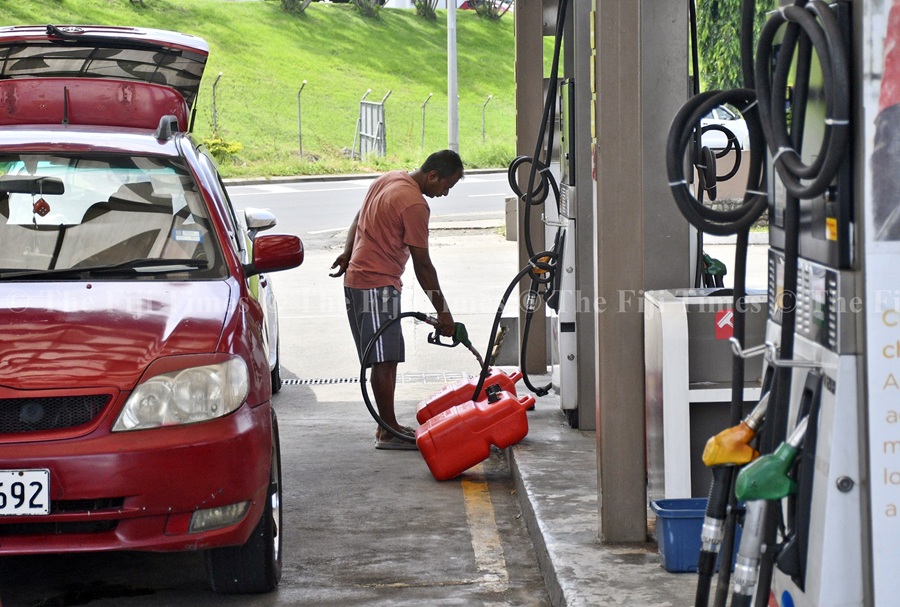
Fuel rush!
Despite assurances by the State and authorities in power, there has been a fuel rush in the days. It’s worrying to see that some gas stations are not supplying fuel. This is creating unnecessary fear and consumers are lining up service stations resulting in panic buying. I thank the Fiji Fuel Retailers Association (FFRA) for urging customers to only take what’s needed and avoid speculative buying. I agree with FFRA that stockpiling would lead to an artificial crisis and potentially turn a manageable situation into a real shortage. I believe gas stations should not be selling fuel in bulk to give fair access to all motorists. I also believe customers must remain calm and avoid storing large quantities of fuel in containers in a closed area due to safety risks. Finally, fellow Fijians, let’s not rely on all the sources of information that are shared on social media. Please rely on verified sources of information. Rajnesh Ishwar Lingam Nadawa, Nasinu
Fuel shortage?
There has been growing concern in Fiji since Monday about a possible fuel shortage. This is happening even though the Government has assured the public that there is enough fuel available for the next few months. The situation became worse when some fuel stations in the Central and Western divisions put up “out-of-order” signs on their pumps. This made people worry that fuel was running out. The Consumer Council of Fiji has advised people not to hoard or stockpile fuel. However, many consumers, especially business owners, are still buying fuel in large amounts. Some service stations are also allowing customers to purchase excessive quantities, which adds to the problem. At the same time, some politicians appear to be using the situation to push their own political agendas, making statements that may increase fear rather than calm the public. Fuel stockpiling can lead to unfair access, where some people cannot get fuel when they need it. It also increases panic, as people assume there is a real shortage. If there is enough fuel in the country, then it should be shared fairly. When people take more than they need, they end up creating the shortage themselves. DINESH KUMAR Ba
Bible translation
Your “culture” feature of Sunday, March 15 mentions a Methodist representative asking in 2007 whether the government had recognised the pioneers who translated the Bible from English to Fijian. The early Methodist Bible translators — mostly Cargill, Hunt and Hazlewood — do indeed deserve great credit, but they didn’t translate the Bible from English to Fijian. They translated it from the languages it was written in, namely Hebrew and Greek, as do all serious Bible translators. It was largely because of his expertise in classical languages, an MA from the University of Aberdeen, that Cargill was appointed along with Cross to initiate the mission in Fiji. Unfortunately, there seems to be a perception in Fiji that the Bible was written in English, and this may be why some preachers will read a passage in Fijian and then follow it with its English translation, thinking that the congregation will believe it more authentic or consider the preacher more educated. The simple fact is that the Bible was written in Hebrew and Greek and was translated into English and Fijian for the benefit of speakers of those languages. At last count I believe there are over a hundred translations in English, and the number in Fijian is about 10, some partial. As to which is the best, I leave that question to Bible scholars more competent than myself! Paul Geraghty USP, Suva
Domestic politics
Thank you for so much love towards one political party out of so many existing and some more to come. That freak from his wonderland has so much time to express on NFP, dragging my name in it almost every second day. I wonder if his problem is NFP or me? Does he realise his party FFP betrayed all those who voted for them — not only their leaders ran away from Parliament but those that remained voted for a pay rise — where NFP being in Parliament and in the Coalition voted against it. The real bad people of Fiji politics today are former FFP leaders and the remnants that are left in Opposition. So next time one wonders about writing on issues without knowledge, will be better to check their own first. The fact is clear that NFP is still intact while FFP does not exist anymore. What does that tell us? Once again vinaka for the love of my name and the position I should be undertaking. Kirti Patel Lautoka
Political party
Proposed Fijians First Party submits application for registration. It’s good to see another political party surface to serve the Fijian people. So how many parties are there in Fiji today with the stated objective of putting the people first? The less than one million people who make up the Fijian population are truly blessed to have so many political players dedicated to serving them. It makes one wonder though where the public perception that our political leadership is a self-serving mob has come from? Could that be on account of the current gang in Parliament giving themselves a 130 per cent-plus pay rise and additional perks when half the country is living in grinding poverty and struggling to make ends meet? Rajend Naidu Sydney, Australia
Out of order
I did enquire what it really means. All I got in return was “sechi”. I suppose that could be the name of one of the Iranian Generals. Mohammed Imraz Janif Natabua, Lautoka
Roadside verges
Lautoka City Council, after you’ve cut the roadside verges on residential areas, why aren’t you raking and collecting the grass clippings? Who you expecting to collect it, your father? Leaving it scattered all over the verge and road makes one wonder if you even have civic pride. Lautoka City Council, are you cost cutting? Sobo! Wise Muavono Balawa, Lautoka
Coalition Government
Yes, indeed, there have been delays in Government’s decision making. But while we have challenges in economic hardship as experienced the world over, the fact remains, the democratic process is alive. I believe, no one in their right state of mind would want the FijiFirst regime to return. Dan Urai Lautoka
New York Sevens
Ok, again, I am not going to say anything about the New York Mickey Mouse SVNS tournament, except to say that no one in Australia knew about it. But for the Fijian Mickey Mouse fans and players, it must have been thrilling to pretend they were playing and watching an important tournament to empty stands. Jan Nissar Sydney, Australia
Municipal elections
A question for Ana Mataiciwa, SOE and Seema Sharma, Local Government permanent secretary. Doesn’t one have to be a ratepayer to be able to take part in Local Government Elections? Vijay P Madhavan Borron Rd, Suva
Lead role
There is a dire need to establish combined neighborhood organisations in each district by the community and the community police officers. For example, Nabua, Raiwaqa, Samabula and Suva can be the Suva crime prevention committee. Representatives from each area with the police community officers can be part of this committee. The police community director can take the leading role. Eventually a national organisation can be established. It has to commence now and coordinated accordingly by the police. Asish Vinay Prasad Park Rd, Raiwasa, Suva
Burden of heavy borrowing
The challenge of our national debt!
A question that deserves honest national reflection is this: which government has presided over the largest accumulation of debt in Fiji’s history? Technically, the current Coalition Government now carries a national debt estimated to be around $11–12 billion, the highest figure ever recorded for the nation. On the surface, that statistic appears damning and distressing. But numbers without context can be misleading. The reality is that a substantial portion of that debt was accumulated during the years of government under Voreqe Bainimarama, Aiyaz Sayed-Khaiyum and the FijiFirst administration before the 2022 general election. In simple terms, while the present government now carries the weight of the debt, much of the foundation for that burden was laid over many years of heavy borrowing and spurious spending by Bainimarama and Sayed-Khaiyum. Borrowing, of course, isn’t unusual. Governments across the world borrow to build roads, schools, hospitals and vital infrastructure. When managed prudently, such investment can strengthen a nation’s long-term development, progress and stability. But responsible borrowing must always be matched with a country’s capacity to repay the debt without putting strains on managing the national economy. That’s where legitimate questions begin to arise. During the FijiFirst years, billions were spent not only on infrastructure but also on a range of politically popular programs and subsidies that many citizens understandably embraced and welcomed with open arms as the kindness of a compassionate and generous government. However, “freebies”, while attractive to the populace, come with strings attached – someone somewhere has to pay the cost. Because when it’s all said and done, there’s no such thing as a “freebie”! Yet much of this reckless spending was sustained by steadily increasing levels of national dinau. For a small island economy like Fiji, this approach carries inherent risks. When government expenditure consistently outpaces national revenue, a country begins living beyond its means. Debt then grows faster than the economy that must support it. And when that happens, the burden does not disappear when governments change hands and a new administration takes the helm. A ship of state full of holes can’t navigate the turbulent waters of a stormy and unpredictable global economy. The debt burden then simply passes on to the next administration and ultimately to the people – you and your family through higher taxes. The current Coalition Government now faces the difficult task of managing the largest debt in Fiji’s history while attempting to restore fiscal discipline and still meet the needs of the nation. Debt is never just a number on a balance sheet. It represents obligations and commitments that future taxpayers must eventually meet. For a developing nation like Fiji, leaving behind billions in debt inevitably raises an uncomfortable but necessary question: were short-term political gains allowed to take precedence over long-term national responsibility? Because when governments spend beyond a nation’s means, it’s rarely the politicians who bear the brunt of the consequences. It’s the country and the next generation that must carry the cost and the heavy burden simply because the drivers of the nation’s debt have “left” the building or in some instances – deregistered their party so there’s no blowback. In some cases, deregistered political parties relabel themselves with a new brand hoping no one will notice because they’re of the belief that people are just plain stupid. But you can never really tell what people are really thinking, can you. That’s why Liu muri aagee peechee politicians are spin merchants living off the people’s ignorance. Or so they think! Colin Deoki Australia

