
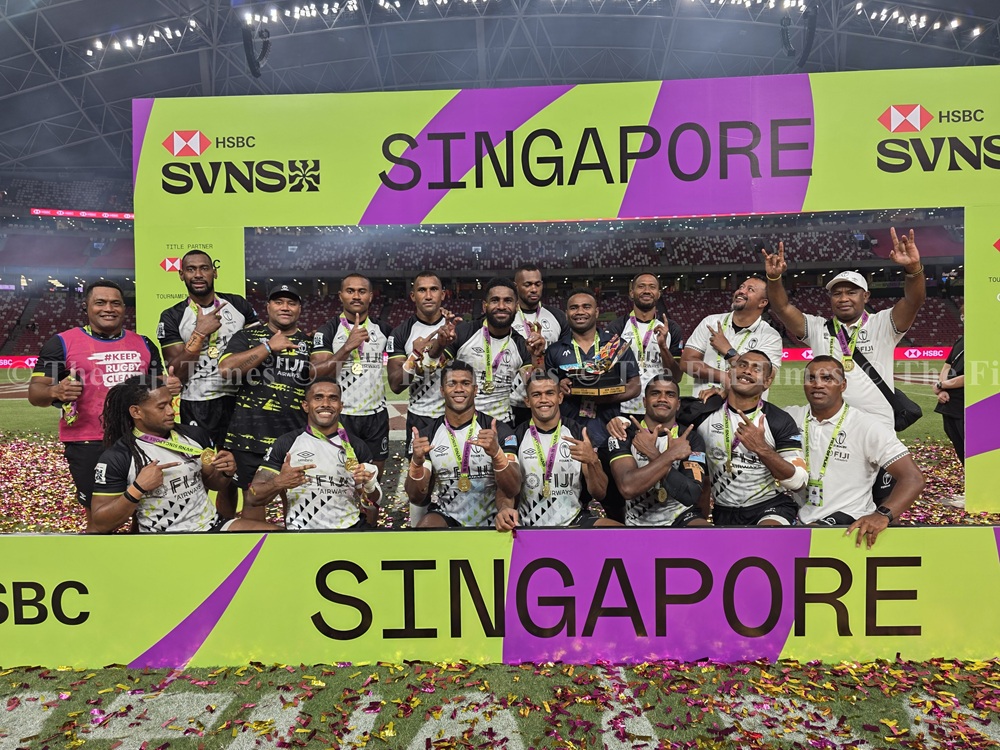
Singapore 7s victory: Well done boys
We won it!
We are the champs again and won the Singapore 7s, “because they gave it to them for them, and played where the ball is, you must be is”. Go Fiji go! Moce Jo! Luke Kulanikoro Savusavu
Creating history!
Fans witnessed breathtaking and champagne rugby as Fiji came from 12-0 down to gun the Les Bleus 7s. Fiji was unsuccessful in defending the Singapore 7s title won the previous year. Fiji won the Cup title in Singapore in 2006, 2018, 2022 and last year, defeating England 40-21, Australia 28-22, All Blacks 28-17 and Kenya 21-12, respectively. However, in 2019, Fiji finished runners-up to South Africa 20-19 and in 2023, Fiji finished third after beating Samoa 24-19. The win gave Fiji the lead on the HSBC SVNS men’s points table. The best part of the victory was that Fiji never gave up, fighting from behind to claim victory over South Africa 24-19 in the last pool match and then coming from 14-0 down to beat the All Blacks 7s 21-14 in the semi-final. The hard yards taken here at home paid off. When the Fiji Development team finished in the Bowl competition and Wame Ratuva was not included in the team to Singapore, I was critical, but head coach Osea Kolinisau and the boys proved me wrong. Speedster Vuiviawa Naduvalo, who was named Player of the Final, reminded me of Alasio Naduva who gifted us the 2018 title. As the national anthem was sung, Naduvalo and rugged flyer George Bose were seen with their tears rolling down their faces and I knew something special was coming and when the ball boy was hoisted, the writing was clear. Fiji played like men possessed. The boys made mistakes and crumbled under pressure, but when we got the first try, nerves were settled and the big hits and our offloads put the men in blue under pressure. In the end, smiles unfolded as Fiji lifted the trophy. A unique back-to-back Singapore 7s and great momentum heading to Perth. Vinaka vakalevu boys! Rajnesh Ishwar Lingam Nadawa, Nasinu
Singapore victory
Congratulations to the Fiji mens 7s team for the victory in the Singapore 7s. Well done boys. Great start to 2026! DINESH KUMAR Ba
Where did this come from?
Whenever there is a donation received, the donated items are wrapped in reams of tapa cloth. Case in point is the shiny Honqi H9 given to the President and the ambulances donated to the Red Cross. Even a footbridge in Nadarivatu was wrapped in tapa cloth. How many donated boats and dinghies have been wrapped in tapa cloth in times gone by? Should I mention the culture of the kalavata? When did these traditions creep into the culture of the country and is it necessary? Or is that a way of reassuring people that they really live in a Third World country and that is where they should remain? Jan Nissar Sydney, NSW, Australia
Opposition claims
Inia Seruiratu’s claims of the Coalition Government in ‘chaos’ (FT 31/1/26), was absurd. The Opposition Leader should be the very last human in this country to ever make such comments, in my opinion. During the eight years of FFP’s governance, I believe he was one of the ‘oppression pillars’, who were effectively towing the ‘dictatorial leadership’ of the Bainimarama-Khaiyum regime. I believe even though he understood the people’s inhuman circumstances at the time, I am certain, he totally ignored the scenario. In fact, I believe financial gain, with distinguished status was his priority. Not the people. Even today. And as Mr Tuisawau has stated, without Bai and Khaiyum, his current and former FFP MPs, including himself, would not be in parliament. They are, in my view, legally ‘fake’ MPs, for they did not attain the 5 per cent threshold required. On whose ‘watch’ did it happen? Samu Silatolu Nakasi
Fix the system
The Ministry of Environment and Climate Change’s plan for tiered waste fines — much like the LTA’s recent hike in traffic penalties — relies on a flawed logic: that punishment can fix a broken system. While fines act as a deterrent, they are not a solution. Our leaders should take a page from W. Edwards Deming, the “Father of the Quality Revolution”. Deming famously argued that 94 per cent of problems are systemic, while only 6 per cent are caused by individual workers. When we see bus drivers fined for illegal parking at overcrowded stops, or rubbish piling up in Kinoya, we aren’t seeing a “lack of discipline” — we are seeing a system failure. It is futile to penalise individuals for failures created by inadequate infrastructure and poor management. Instead of focusing on revenue-heavy fines, the Government must prioritise fixing the underlying systems. Until the “how” and “where” of waste disposal and traffic flow are addressed, these fines are merely a tax on a struggling public. Sailosi Naewe Dilkusha Road, Nausori
Road conditions
Pathetic! This is the first adjective that comes to mind to describe Fiji’s road conditions. Potholes continue to emerge and expand on a daily basis, posing increasing inconvenience and risk to road users. The Fiji Roads Authority is urged to address this matter with the seriousness it warrants. DINESH KUMAR Ba
NEC services
Hope the cake at the launch of the National Employment Centre (NEC) at the Suva Business Centre (photo by Litia Ritova ST 1/2/26) was sugar free because it could be a health hazard for some people. Rajend Naidu Sydney, Australia
New bank
The state-of-the-art design has truly uplifted the tourism town, Coral Coast Sigatoka. While businesses and the public congratulate BRED Bank, indeed they will be assuring customer service is much important to win more towards them. Jaheed Buksh Korolevu, Sigatoka
UB40 concert
Fijians enjoyed an epic night of music, reggae and big love at Prince Charles Park as UB40, featuring Ali Campbell, brought their iconic Big Love Tour to our shores. Since a student, I have embraced two songs from UB40 — Red Red Wine and Kinston Town and these two songs stir up emotions within. The presence of UB40 here at home shows their deep musical connection. Fans had a great time as UB40, Katchafire, Paradise Roots, DJ Vibez and Nicky and Ouvacast, united, entertained and thrilled them, producing a night of music, togetherness and high energy. What a historic night in Nadi! Rajnesh Ishwar Lingam Nadawa, Nasinu
Structural repairs
We are aware of natural disasters. Many of our roads in remote areas are upgraded after bad weather where authorities keep monitoring. Bridges are another concern when floodwaters damage them. May I suggest the authorities should monitor and repair them while a concerned citizen passing by said,” it is very old now”. NAVNEET RAM (TD) Lautoka
Vendors, narcotic strategy
Skin-colour pricing
“Skin-colour pricing” is an open secret in many markets across Fiji. Vendors who do not display prices often change what they charge based on their own judgement of the customer – too often using skin colour as a proxy for wealth. The lighter the skin, the higher the price. This practice is discriminatory, unethical, and goes against Fiji’s Fair Trading laws. Consumers are entitled to clear and accurate price information before purchasing goods. Failing to display prices or charging different customers different prices for the same item, can amount to misleading and unfair conduct under the Fair Trading Act and is enforced by the Fiji Competition & Consumer Commission (FCCC). Long-term residents, locals, and tourists all recognise when they are being ripped off. It leaves a bad taste, drives customers away, and damages trust. Tourists talk, residents remember, and unfair traders lose repeat business. To sellers: display your prices and charge everyone the same. Fair pricing is not only the law —it is good business. To buyers: ask for prices, walk away when treated unfairly, and report breaches to the FCCC. There is no future in skin-colour pricing in Fiji! Noleen Billings Savusavu
Narcotics strategy
I couldn’t agree more with Archbishop Peter Loy Chong (FT 31/1) who, attending a Narcotics Strategy held at the FNU and finding not a single youth, warned the assembly: If you don’t involve youth “you miss the whole point”. Incidentally, the fact FNU teaches iTaukei studies makes their absence all the more alarming. Forty years ago in an academic essay on crime written for Fijians I said the same: “The young, including those on the wrong side of the law, though informed, at present remain restricted and under-utilised sources of vision and definition of Fijian society in the 1980s”. Nothing has changed. Indeed we seem to be going backwards. Our professional suited classes and traditional elites accustomed to ‘customs of respect’ thwart other voices asking them to examine themselves. In this vein the chairman of the Great Council of Chiefs (FT 31/1) extols the virtues of school cadets without stopping to ask what youths themselves think; and not just iTaukei boys and girls raised in villages where the concept of vanua is structurally embedded, but those born and bred in the towns, including Indian Fijians, part-Europeans, and others. Come to think of it, ask them what vanua means to them. Also would somebody explain what cadets do when they stop marching —arms training, war-games, signals? Who instructs them, why shaven heads, regimentation, and uniforms indistinguishable from the rest of the predominantly iTaukei paramilitary help inculcate attitudes conducive to social cohesion. Professor Lord Peter Hennessy, an eminent English historian, says little in his book on post-war Britain when I was growing up and a compulsory school cadet myself (coincidentally at the same school as Hennessy though a few years ahead of him), but what he says about National Service may help us frame a few questions on the wisdom of school cadets in multi-racial, seemingly ‘warrior’ fixated, hyper-religious, nationalistic, 21st century Fiji. Or at least it should kick the conversation along. First, I think “military socialisation” a term Hennessy borrows from sociologists aptly describes, what is consciously and unconsciously going on with cadets. Second, the following Hennessy footnote on National Service is probably worth digesting. “I sometimes detect the traces of a special kind of faintly subversive humour laced with vulgarity”, he says, that characterised the National Service generation”. In which case it may be the same with cadets. I confess it was certainly true of me though it never warped my admiration for war heroes. Dr Christopher Griffin Perth, Australia

