
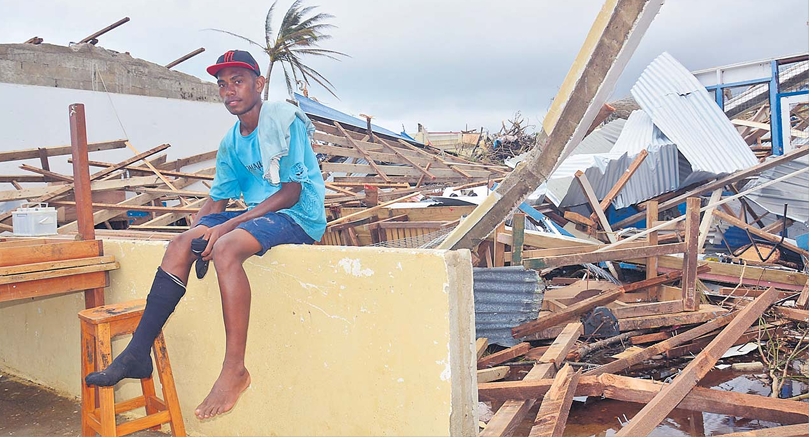
Winston nightmare lives on
On February 20, 2016, a tidal wave tore through Senivaca Village, Koro, sweeping Loraini Divadra Biaukula, her husband, and baby Apisai Vulaono out to sea. She handed her 10-month-old son to his father, never imagining it would be the last time she’d hold him. For eight harrowing hours, she and several villagers battled wind and waves, clinging on to moving trees, swimming desperately to find dry land. At one point they separated, and when she saw her husband again, Apisai was gone. But it was when she finally reached safety, that the cries of the village revealed the full horror. Her son and his grandmother, Makereta Seru, had become casualties of monster Tropical Cyclone Winston. Rajnesh Ishwar Lingam, Nadawa, Nasinu
Name and shame
A based trader was fined $1600 and ordered to pay $8337 restitution for failing to deliver building materials to his customers. He was found guilty on eight counts of accepting payments without supplying the goods. While sentencing him the court had noted his earlier convictions in 2024 and 2025 for similar offences. In my view such conduct is tantamount to fraud and as such should be treated accordingly. Therefore, I agree with Ajai Kumar that by suppressing the name, we are only protecting the interest of the trader and not the consumers. I will leave it to the good judgement of FCCC on whose interest is more important. Let’s hope he will be exposed in social media by the victims. I believe if there is a breach of the business licence then the issuing authority should take appropriate action against this trader. SELWA NANDAN Lautoka
Zero to hundred
Can someone tell me where to test the zero to hundred in 10 seconds? Vehicle dealerships are claiming 0-60 speed timings and 0-100 timings in newspaper adverts and elsewhere. The 0-60 is within legal limits but where can the 0-100 be proven? It’s like letting traders sell dark tint, illegal lights and accessories. All bookable offences. I thought a little distraction from the sports paisa scams, court cases and almost everything else, was needed. So where to test the 0-100? Donald Singh Nausori
Ocean of peace
Foremost, the “Ocean of Peace” must now fervently begin with looking after the betrayal of senior pensioners, pre-2011. Any failure to address this, exhibits the cold harsh reality of cruelty at its very best to seniors in their twilight years — and struggling to survive. This is a cruel world. Is this Christianity? There are about 1400 survivors today. Our numbers dwindle. Time is not on our side. Ronnie Chang Martintar, Nadi
Poor pay
Narayan Reddy’s letter on “so poor” indicates that everyone is poor in Fiji, struggling to survive. I believe it’s due to poor pay, and that matters the most. Tahir Ali Hamilton, New Zealand
Tap water
At times the smell of chlorine is strong when turning on the tap in Lautoka. I’m not sure if other parts of Fiji experience the same. Is our tap water medically safe to drink? Dan Urai Lautoka
FNPF consultation
Good luck to Sukha (FT 20/2) for enjoying the food parcel and drinks with the courtesy of FNPF. If FNPF had not hit the older members below the belt in 2012, the pensioners would also have been singing the swansong and be living a leisurely life. Ajai Kumar Nadi
Mobile phone
It is interesting to observe how a number of our communities are placing restrictions on the consumption of illegal drugs, alcohol and kava. This is commendable and a step in the right direction, but there is something even more important which adults need to better manage. The usage of their phones, in particular, internet, appears like a big addiction which is taking our households and communities by storm. All in all, this is an individual choice but over the weekend, do control that phone. After all, our children watch and learn from our habits at home. Floyd Robinson Micronesia
Relocation factor
So, are we still considering relocating civil services out of Suva to Nasinu or Nausori area? I thought this was an option we were considering at one point. Kartik Krishneel Makoi, Nasinu
Problem solving
So how do you expect them to solve the nation’s problems when they are seriously busy solving their own problems? Mohammed Imraz Janif Natabua, Lautoka
No bail
I BELIEVE there should be a specific provision in Fiji’s Dangerous Drugs Act that accused persons charged with a drug offence punishable with jail term more than a certain number of years should not be granted bail. I believe Government needs to admit that our current drug laws have failed. Sobo! WISE MUAVONO Balawa, Lautoka
It’s not gender or climate
Thank you The Fiji Times for the article by Erin Anderson in your opinion section. The article titled, ‘It’s not gender or climate — It’ both or neither’ is very informative and deals with a contemporary issue. It is for this reason, I urge teachers to read The Fiji Times daily, photocopy articles for resource files or save them and discuss issues that directly affect us. Even turn them into expository essays. Language teachers are most influential in shaping young minds because of varied subjects we deal with. Rakesh Chand Sharma Nadi
Admirable words
Wow! A truly powerful statement indeed. Sincere thanks and much admiration for the eloquence of “Admirable words” in The Fiji Times of Friday, February 20, 2026 — Page 9. In recent years in Fiji, there are inadvertently two rules:
- One for the powerful, rich and famous.
- One for the downtrodden and humiliated senior betrayed pre-2011 FNPF pensioners.
We suffer irreparable harm and injustice. Volumes have been written. Our brave and fearless stalwarts in the late David Burness and Jackson Mar fought the good fight. Some of us continue their “rich” legacy by God’s grace to persevere and fight on. Our heartfelt thanks also goes to Emosi Balei in yesterday’s FT for his generously kind and supportive statement in our fight for justice denied by the super insensitivity of our all powerful corporate financial institution, FNPF, who are mandated by law to adequately care for our justly earned fiduciary benefits. To date, FNPF remains grossly tone deaf. Beware the wrath of karma when it knocks at your doorsteps. That day will come, one way or another. Earthly or divine. Your victory today. My loss today. Beware, the scales of God’s justice … they will beckon … when you least expect. We hurt and suffer badly today. The sun will surely rise on us in God’s perfect time. Ronnie Chang Martintar, Nadi
Glue sniffing
I am writing to formally raise serious concerns regarding the increasing number of individuals involved in glue sniffing on the streets of Lautoka City. This situation is creating significant problems for business owners, taxi operators, and members of the public. Many of these individuals appear to be under the influence of toxic substances, which makes their behaviour unpredictable and potentially dangerous. There is growing fear that someone may be harmed if immediate action is not taken. The presence of such activities is also negatively affecting businesses and public confidence within the city area. Taxi operators and customers feel unsafe, and this is damaging the reputation and daily operations of our community. We respectfully request the relevant authorities to urgently look into this matter and take appropriate action to ensure the safety and well-being of the public. Thank you for your prompt attention to this serious issue. Saynil Kumar Lautoka
Rise to the challenge!
HIS excellency Ratu Naiqama Lalabalavu delivered a powerful and an inspirational address to Members of Parliament as he officially opened the 2026 Parliament session. He urged inclusive governance, a vital tool in the smooth running of a nation. He also urged MPs to debate responsibly, stressing on the need to be disciplined and respect each other. He urged MPs top approach their responsibilities with objectivity, discipline and respect. I salute Ratu Lalabalavu for these powerful lines (FT: 18/02), “Greater freedom and parliamentary debate is the lifeblood of democracy, but it must be grounded in evidence with good reasons and practical solutions, cautioning against personal attacks and political point-scoring that erode public trust.” Furthermore, I echo the sentiments of Honourable Inia Seruiratu where he called upon Members of Parliament to rise to challenge. It’s 2026, and we are counting days to the General Election. The nation is watching, MPs, so, please, debate responsibly! Rajnesh Ishwar Lingam Nadawa, Nasinu
Our water woes
I read Dewan’s letter (FT 28/01/26) with a sense of bitter irony, as it echoed what many of us have long observed about the operations of the Water Authority of Fiji. During the period surrounding the Rewa River Water Scheme Project, before and after COVID, I witnessed activities that appeared to disregard environmental safeguards, landowner interests, and the rights of indigenous communities. There seemed to be little respect for established biodiversity principles or for meaningful consultation with affected stakeholders. Such conduct, if accurate, reflects poorly on any institution tasked with serving the public. The impression WAF gives is that profit and project completion take precedence over accountability, environmental protection, and community wellbeing. We are now told that a “new automatic meter reading system” will solve billing concerns. While technological improvements are welcome, public trust cannot be restored by systems alone. Trust is built through transparency, accountability, and a genuine willingness to acknowledge and correct past shortcomings. Until these deeper issues are addressed, public scepticism will remain. After all, many residents in the Suva–Nausori corridor are still facing ongoing water problems, despite your 990cm pipeline that runs throughout Central Naitasiri. A concerned citizen. Peceli Alistir Waitolu, Naitasiri
Trade skills gap
Fiji continues to face significant trade skill shortages in construction, electrical, plumbing, automotive, and other technical sectors. To address these gaps effectively, we must embrace innovative education models such as Open TVET. Open TVET refers to flexible and inclusive technical and vocational education systems that remove barriers to entry. It allows learners of all ages to access trade training regardless of prior qualifications, location, or employment status. It promotes lifelong learning, recognition of prior learning (RPL), and industry-aligned skills development to meet labour market needs. In Open TVET concept, Open Distance Learning (ODL), Technology-Enabled Learning (TEL), and Open Educational Resources (OER) must apply. Institutions such as Fiji National University, the Ministry of Education and Pacific Polytech which currently engage students on practical assessment model, can expand flexible entry pathways into technical programs, allowing school leavers, dropouts, and working adults to re-engage in skills training. Recognition of Prior Learning (RPL) should also be strengthened to certify informal skills already present in our communities. Through ODL and TEL, trade theory components can be delivered online or through blended modes, making access possible for rural and maritime learners. Practical competencies can then be assessed through structured workplace attachments and industry partnerships. Furthermore, adopting OER will reduce training costs and enable local adaptation of high-quality trade materials. Fiji can collaborate with regional partners and industry stakeholders to develop shared digital trade resources. By investing in open and flexible TVET systems, Fiji will not only reduce unemployment but also strengthen national productivity and resilience. It is time to modernise our approach to technical education and empower our youth with industry-relevant skills. Indar Deo Bisun Sakoca, Nasinu
Heavy fines
TO those against the heavy fines under the government’s Employment Relations Act Amendment Bill. Just look to the new Lautoka bus stand. Bus owners pay the $40 fines for oil leakage from their buses but they don’t seem to repair the bus as oil continues to seep on to the road every single day. Heavy fines are a deterrent. Otherwise as in Lautoka, the city council is rendered useless. DAN URAI Lautoka
Patient comfort
ASPEN Hospital is 70 per cent owned by government through FNPF. So who is FNPF? Isn’t it 50/50 owned by employees and employers? Anyway, involvement of FNPF and Aspen should give an idea of rich partners delivering quality service but it’s not even a figment of this imagination. Take for example seating for customers and patients. Whilst all FNPF officers are cooled through air conditioners, the hospital has fans of sorts spinning continuously through hot air. While you find good chairs at FNPF, the hospital has long church like wooden benches to sit on. The benches are hard and spaced 2 inches apart so some part of your rear hang through the gaps. It very uncomfortable especially for the sick who have to wait for long hours before they reach the doctor. So can Aspen please start replacing the wooden benches with individual cushioned chairs. They would not cost an arm and a leg. Ajai Kumar Nadi
Absence of agencies
The recent incident involving the recovery of two children under a court-issued order (15/02) has understandably generated public concern. It is acknowledged that the police were acting under a lawful recovery order and were therefore responsible for carrying out the court’s directive. However, the situation raises an important question about how such sensitive matters involving children are managed in practice. While the police are mandated to execute court orders and ensure peace is maintained, cases involving custody disputes are often emotionally charged and deeply distressing for children. Although social welfare or child-protection agencies were not directed by the court to carry out this particular order, greater coordination with trained child-welfare professionals in similar situations could be beneficial. Their expertise in safeguarding the emotional and psychological wellbeing of children may help ease tensions, reassure families, and minimise trauma during transitions. This is not about questioning the authority of the police, who have a duty to enforce lawful orders. Rather, it is about exploring ways to strengthen procedures so that the best interests of children remain the central priority. Perhaps this incident offers an opportunity to review how recovery orders are implemented in particularly sensitive cases. As the proverb reminds us: “In the multitude of counsellors, there is safety.” Collaboration and wisdom often lead to more compassionate outcomes. Peceli Alistir Waitolu, Naitasiri
Accessibility and regulation
As the nation approaches another general election, much attention is being placed on democratic participation, accountability, and fair representation. However, there is a growing concern regarding the accessibility of voter registration services provided by the Fiji Elections Office (FEO), particularly for those living outside the mainland. New and proposed political parties are required to collect 5000 valid signatures from registered voters in order to be officially recognised. While this requirement may be designed to ensure seriousness and national support, the process becomes unnecessarily burdensome when voter registration services are not easily accessible to the very citizens whose signatures are required. In the Northern Division and other maritime areas, many individuals who wish to sign in support of new parties are unable to do so because they have not been able to register, renew expired voter cards, or replace lost cards. Without active voter registration, their support cannot be counted. This creates an uneven playing field and places emerging parties at a distinct disadvantage. It is concerning that while strict compliance standards are imposed on political parties, the availability and accessibility of FEO services do not appear to match those expectations. If the requirement is firm, then the infrastructure to enable citizens to meet that requirement must also be equally robust and accessible. Democracy functions best when participation is encouraged and facilitated — not when logistical barriers limit involvement, especially in regions already facing geographic challenges. The people of the North and other non-mainland communities deserve equal opportunity to engage in the political process. I respectfully urge the Fiji Elections Office to expand and publicise accessible voter registration outlets, particularly in rural and maritime areas, so that all citizens have a fair chance to participate in the formation and registration of political parties. If we are to uphold the integrity of our democratic system, accessibility must go hand in hand with regulation. Noleen Billings Savusavu
More than a legal document
I’ve often wondered if Fiji’s constitution had begun with, “We the people…” Imagine how much different things would’ve been today! A nation’s constitution is more than a legal document. It’s the moral and structural backbone of a country. It defines how power is gained, how it’s limited and how citizens are protected. When designed well, it becomes a shield for the people. When designed poorly, it can become a tool of exclusion with instruments of control and manipulation. A sound constitution begins with an inclusive process. It shouldn’t be written solely by those in power, but shaped by broad representation of legal experts, elected delegates, civil society, minority groups and community voices. Public consultation isn’t a luxury; it’s essential. When people are invited to contribute, the constitution gains wide ranging acceptance, legitimacy and trust. Fair constitutions clearly separate powers between the executive, legislature and judiciary, ensuring no single arm of government can dominate the others. Strong checks and balances reduce the risk of abuse and corruption. An independent court system must be empowered to interpret the constitution and defend citizens’ rights without political pressure swaying decisions in favour of the state. A just framework also contains a meaningful bill of rights protecting freedom of belief, speech, equality before the law, due process and protection from discrimination. Many modern charters draw guidance from principles advanced by the United Nations human rights standards. These rights must be enforceable, not merely symbolic. History shows that inclusive drafting leads to stronger outcomes for stable governance. The Constitution of South Africa is often praised because it emerged from wide public participation after deep national division. By contrast, constitutions imposed without consent often struggle for credibility and durability. Even enduring frameworks like the United States Constitution has required amendments over time to correct injustices and expand protections. A fair constitution ultimately rests on one principle: power belongs to the people, and government is accountable to them. When every citizen can see themselves protected within its pages, the constitution becomes not just law but a shared national covenant.The tragedy of Fiji’s current constitution is that it didn’t follow these principles and precepts and is therefore not a representative covenant of the people. “We the people” is missing from Fiji’s Constitution. Colin Deoki Australia
The beginning of lent!
February 18 marked the beginning of Lent, a 40-day period of fasting, repentance, and spiritual preparation leading up to Easter. Traditionally observed by Catholics and now embraced by several Protestant denominations, Ash Wednesday serves as a solemn reminder of human mortality and the need for repentance. The ashes symbolise grief over sin, humility before God, and the hope found in Jesus Christ’s sacrifice on the cross. The victory of Jesus Christ over temptation is a powerful reminder that we can rely on God’s word and strength in our own struggles, too. A prayer is a powerful tool that connects us to God and makes us a better person. As we anticipate Easter, let’s connect ourselves spiritually and make Easter meaningful for us and our loved ones. Let’s pray for our beloved Fiji, with the hope of building a bigger and better country, where every Fijian is loved, cared and protected! Rajnesh Ishwar Lingam Nadawa, Nasinu
Mahika’s dream comes true!
It was an honour to attend the prefect investiture ceremony at Rishikul Primary School on Wednesday. At the outset, I thank the school management, administration team, ancillary staff and staff for organising the program to the best of their ability. As usual, handling primary school students during a program of such magnitude is a momentous task, but I salute the staff for giving their best. It was a pleasure also to meet Donald Singh, our brave and bold writer, who scooped back-to-back letter of the year awards. My daughter Mahika Lingam attends 601 at the institution. She had a dream of becoming the class captain. But somehow missed out. This year, when she told me about her selection as the class captain, I somehow brushed it aside. It was hard to believe the news. However, when her class teacher confirmed the news, it was hard to contain my emotions. Mahika lost her mother in 2024 (September 24). Her mother had a wish — it was to see our little princess become a leader, and now that Mahika became one, she was not there to witness that proud moment. I sat still, silently holding onto my tears, seeing my little girl walk up the stage and get badged. Leaders in schools need capacity building sessions to develop and nurture them to become better and versatile leaders. After all, these leaders will one day lead our country. Height, ethnicity and gender should not matter if a child is able to execute responsibilities showered on him/her. Mahika’s determination was rewarded as she was selected to be the class captain. I’m proud of her. I continue to talk to her and motivate her. I wish all our school leaders and class captains all the best. May you all continue to shine in your new roles! Rajnesh Ishwar Lingam Nadawa, Nasinu
Safe spaces
As consultations on the Counter Narcotics Bureau Bill continue and the public is encouraged to provide submissions, it appears as if we have overlooked an important question. Is there a safe space for parents and guardians to share their experiences with children who are addicted to dangerous drugs? Where can they go for counselling, and is professional support readily available? The journey for parents and guardians caring for loved ones, especially children, who have fallen into addiction, is emotionally and physically draining. Families often watch their children become unrecognisable once hooked on substances like methamphetamine and cocaine. And it is not only parents who suffer but the entire family is affected in one way or another. If recent media reports are accurate in highlighting a street value of roughly $700 million worth of drugs recently intercepted in Vatia, then, with all due respect, this has major implications for our communities. Our innocent nation may be used a transit point for drug trafficking. Having recently travelled to Fiji, I saw first-hand the devastating impact these hard drugs are having on the health and wellbeing of our youth. It broke my heart, and I can only imagine the daily struggle faced by innocent parents watching their children battle addiction. Personally, I feel we have lost the innocent Fiji many of us grew up in during the 1990s. While people are entitled to their views, I believe we must maintain open hearts by advocating strongly for safe spaces and support systems for parents and guardians who are suffering in silence. Their wellbeing is also part of a broader national development issue that deserves urgent attention. Wishing everyone a safe weekend. Let us remember to have compassion for the parents and guardians among us who are fighting battles that others may not comprehend. Floyd Robinson Micronesia
Compliance or threat?
I write with deep concern regarding the recent actions taken by the Ministry of Environment against a refrigeration technician and businessman in his late 60s in the North, whose working equipment — including his refrigerant gas and gauges — were confiscated due to alleged non-compliance with current regulations. This gentleman has been qualified and working in his trade long before the introduction of the newer environmental and licensing laws. Despite being illiterate, he has built a reputation over decades as one of the North’s most experienced and trusted private-sector repairers. His lack of formal education has never prevented him from contributing meaningfully to society through honest, skilled work. It is understood that the ministry’s action was based on his not having a formally approved storage facility for his refrigerant gas and not holding the required licence to transport it. However, this is a small-scale tradesman who carries only one gas cylinder at a time, which he keeps in his truck as he travels from job to job. His livelihood depends on being mobile, as most of his work requires him to be on the road assisting homes and small businesses. While compliance with environmental laws is important, there must also be room for proportionality, understanding, and assistance — particularly where small operators are concerned. Removing a person’s tools of trade effectively removes their ability to earn a living. At 69 years of age, this is not merely an inconvenience; it is a serious blow to his dignity and survival. Surely the role of government ministries is not only to enforce regulations but also to guide and support citizens toward compliance. Workers like him should be assisted to regularise their operations through clear guidance, reasonable timelines, and practical solutions — not immediately penalised in ways that threaten their livelihood. One must ask: are we creating a system that protects the environment while also protecting people, or are we unintentionally pushing small, honest tradespeople out of work? I respectfully urge the ministry to review this matter with compassion and fairness, and to consider mechanisms that help small operators comply rather than rendering them unable to work. Noleen Billings Savusavu
Defend the fortress
THE fortress in Lautoka, now breached.
Team Moana Pasifika,
was not so placid.
Secure the barricades,
defend our fortress.
Don’t let the raging winds of the Hurricane,
bring us more distress.
Meanwhile, Tahs up next,
in the dreaded away game.
But, let’s put this Ozzie flower to rest
this weekend and bring us fame! Edward Blakelock Admirals Circle, Pacific Harbour
Tracking time spent on screens
It is evident that children today are interacting with technology from a very young age. Consequently, they often spend significant amounts of time in front of screens, whether watching television, playing video games, or using smartphones and tablets. This frequent interaction with technology can have adverse effects on their social, emotional, and mental development. Additionally, excessive screen time has been linked to issues with language development and social skills. Moreover, prolonged screen usage can lead to problems such as poor sleep, obesity, and difficulties with concentration. Given these potential risks, it is important to consider reducing children’s screen time proactively. Encouraging outdoor play, fostering family connections, and setting clear boundaries on screen usage can help children become less reliant on technology. Parents and Guardians play a crucial role in guiding children toward a healthier balance in their technology use while promoting their overall development and well-being. Early intervention plays a crucial role. Suresh Chand Nadi
Trump’s threats
I believe that Iran is calculating on the fact that Donald Trump will not order air strikes on Iran due to mid-term elections in November. Americans will not accept lightly “bodybags” arriving in the USA. I believe that if a US strike happens, it may be a ‘Noora Kushti’ – fixed wrestling match like before. Trump also knows that amongst a barrage of missiles, even if one or two hits one of the aircraft carriers, it may turn into a ‘Pearl Harbour’ moment for the USA. Netanyahu too understands that Israel is now war wary and incapable of absorbing all those Iranian missiles. Israel is a very small country compared to Iran. It cannot fight a wider Middle Eastern war. Rakesh Chand Sharma Nadi
Work ahead of Vancouver 7s!
I was on cloud nine after reading that Yaro Chiefs standout players, Tomasi Stark and Wame Ratuva, who played crucial roles in their side winning the 2026 McDonalds Coral Coast 7s tournament, were selected to be part of the extended 7s squad. Their inclusion will add depth to the Fiji Airways Fiji men’s 7s team, who is leading the charge on the 2025/26 HSBC SVNS WRSS circuit. Fiji is preparing hard for the Vancouver and New York 7s tournaments at the BC Place and Sports Illustrated Stadium, respectively. Last year in Vancouver, Fiji topped pool C after beating Uruguay 38-12, the USA 33-12 and Spain 26-21. Fiji thrashed Great Britain 24-0 in the Cup quarter-final but lost to South Africa 12-10 in the semi-final. Fiji finished third in Vancouver after beating Spain 22-7. The series is getting tough and Fiji is in a tough pool with Australia, Argentina and France in the pool of death. Fiji has an explosive outfit and the inclusion of Stark and Ratuva adds excitement and thrust. I agree with head coach Osea Kolinisau that having the new faces would add to their ranks and urge the players to fight for a spot to don the white jumper in Vancouver. I quote Kolinisau (FT: 19/02), “In the squad, I told the boys ‘Here it’s best on best so make sure you bring your point of difference when you come here’. You want to see if they have got what it takes. They understand the way you want to play, the pattern and how they’re dealing with the players. We want boys that are going to compete in here. I told the boys ‘If you’re not going to compete in here, you’re wasting our time.’ We want boys that come here to compete and push for our sport.” I love the high standards that Kolinisau has set. All the best, Oscar! Rajnesh Ishwar Lingam Nadawa, Nasinu
Restorative justice
What does restorative justice mean in the simplest of terms? It means repairing the harm caused by wrongdoing rather than merely punishing the offender. It’s a process that brings together, when appropriate, the person who caused the harm, the person who was harmed and sometimes the wider community to acknowledge what happened, understand the impact, take responsibility, make amends where possible and work towards genuine healing and restoration. Instead of asking only, “What law was broken and how should we punish?”, restorative justice asks a deeper and more human question: “Who was hurt, what do they need, and how can the harm be repaired?” Perhaps this principle deserves more than passing mention in public policy discussions. It deserves practical application. The ongoing issue involving affected pensioners and the outstanding matters connected to the Fiji National Provident Fund calls for more than administrative closure. It calls for restorative thinking and restorative action. True peace isn’t built through speeches or slogans, but through fairness and restoration where harm has been felt and acknowledged. We can’t speak of an ocean of peace while a group of elderly citizens continues to feel unheard and unresolved after more than a decade. Peace must first begin at home before it can be convincingly offered to the wider world. Or, we make a mockery of that historical scripture from Matthew 5:19: “Blessed are the peacemakers for they shall be called children of God!” Colin Deoki Australia
Prefects’ induction
Leaders are not born, they are made. Heartfelt congratulations to all the newly elected leaders across the nation. May you lead with courage, speak with kindness, and act with integrity. Believe in yourself and in your ability to make a difference. The leadership journey will have its ups and downs but remain focused on your vision and steadfast in your commitment to serving others. You are our future leaders, leaders who will stand against the common threat of drugs and other social challenges. Walk alongside your peers and guide them on the right path. God bless you all. RODNEY CLARENCE RAJ, NALEBA, LABASA

